Fellows Fine Jewels sale spotlights rare diamonds and signed pieces
A 350-lot Fellows sale puts Cartier, Bulgari and a fancy pink diamond ring at the center of a market where provenance now carries real weight.
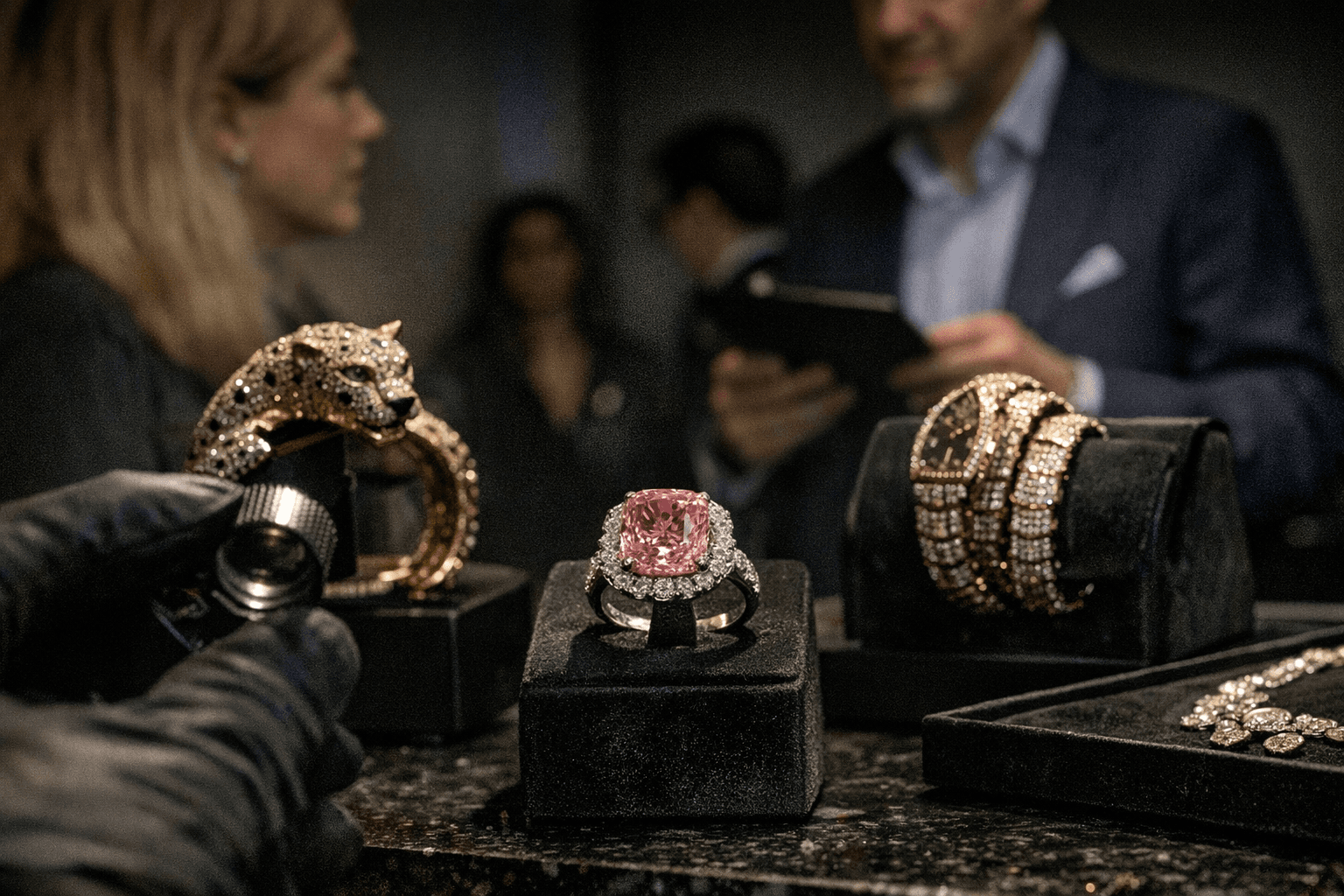
A natural diamond now has to earn its premium twice: once through the stone itself and again through the name, setting and paperwork that travel with it. Fellows Auctioneers’ Fine Jewels sale, scheduled for Wednesday, 22 April 2026 at 10am, is built around that calculation, with 350 lots that lean on high-value natural diamonds and signed pieces rather than anonymous sparkle.
The sharpest estimates tell the story. A Cartier 18ct gold diamond Agrafe necklace is placed at £10,000 to £15,000, while a Bulgari 18ct gold diamond Serpenti Viper bracelet carries the same range. A mid-20th-century platinum and gold diamond and sapphire clip is estimated at £6,000 to £8,000, and the most eye-catching stone in the room may be a platinum fancy pink diamond and diamond cluster ring, guided at £17,000 to £22,000. In a market that prizes rarity, the fancy pink diamond is the clearest signal that value is being anchored by material scarcity rather than branding alone.
The signed jewels matter just as much. Cartier, Tiffany & Co., Chopard and Bulgari all appear in the sale, and that pedigree changes how buyers read the lots. A signed jewel brings a second layer of desirability: design authorship. Louis-Francois Cartier and Alfred Cartier built a house language that collectors still recognize, and the continued pull of those names shows that craftsmanship and heritage can still support price discipline when a piece is well preserved and properly attributed. In practical terms, a signed jewel gives a buyer more than decoration. It gives a point of comparison.
That is where Fellows’ own infrastructure becomes part of the buying decision. The company says its jewellery team includes qualified gemmologists and diamond graders with qualifications from Gem-A, GIA and Birmingham City University’s School of Jewellery, and that pieces are authenticated, appraised and graded with detailed cataloguing and condition reports. For a buyer weighing whether an estimate is ambitious or realistic, that matters as much as the carat weight. Fellows also says its archive holds more than 1 million sold items, with realized prices, descriptions, photographs and condition reports, which allows bidders to compare a Cartier necklace or a Bulgari bracelet against prior market results rather than guess in the dark.
Paul Greer, Fellows’ International Head of Jewellery, brings more than 30 years in the trade, including senior roles at Bentley & Skinner and work connected to royal warrants and Damien Hirst’s diamond-set For the Love of God. That background suits a sale like this one, where the real question is not simply what shines brightest, but which jewels have the combination of rarity, condition and house name that still commands confidence. From Birmingham’s Jewellery Quarter, Fellows is presenting a sale that treats high-value natural diamonds less as commodities than as artifacts of taste, authorship and proof.
This article was produced by Prism’s automated news system from verified source data, official records, and press releases, then run through automated quality and moderation checks before publishing. The system is built and supervised by the people who set the standards it runs under. Read our full AI policy.
Did this article answer your question?