How to Clean Diamond Jewelry Safely, Protect Settings and Sparkle
Sparkle survives gentle soap and a soft brush, but prongs, platinum and delicate stones do not forgive rough cleaning. The safest routine is simpler than most people think.
Why diamond jewelry needs gentler care than its sparkle suggests
A diamond may be the hardest stone in the case, but that does not make it indestructible. GIA breaks durability into three separate qualities, hardness, toughness and stability, which is why a diamond can still chip, react to heat or suffer damage if it is struck or mishandled. That distinction matters most at home, where the fastest way to dull a ring is often not dirt alone, but the wrong cleaning habit repeated over and over.
The real goal is not aggressive scrubbing. It is protecting the setting, preserving the metal finish and keeping grime from building up around the stone’s edges, where brilliance is most easily blocked. For engagement rings and other pieces worn daily, the smartest care routine is preventive, not heroic.
A safe home-cleaning routine
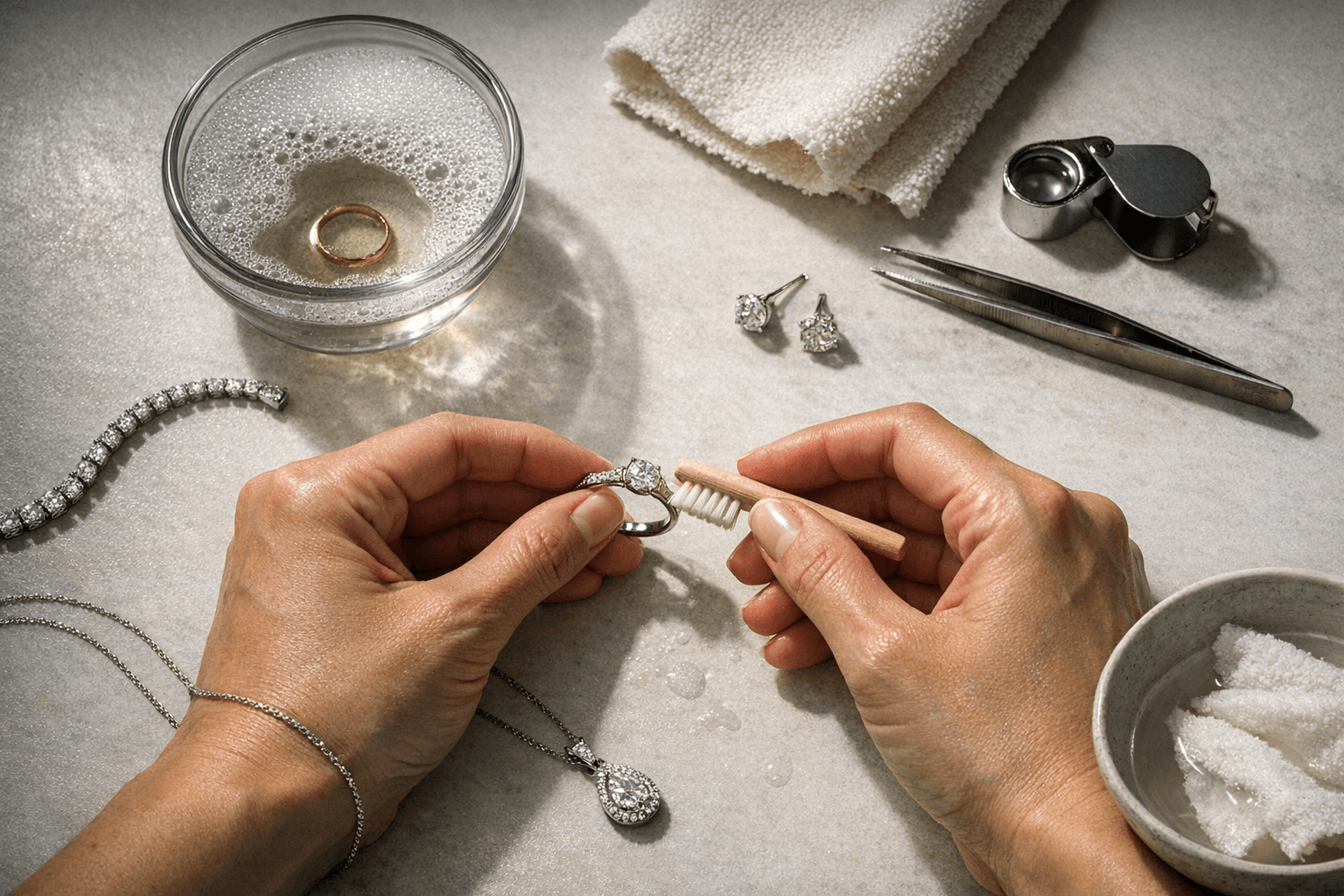
The simplest method is also the one GIA recommends: soak diamond jewelry in a gentle degreasing solution, such as water with a few drops of mild dish soap, once or twice a week. That short soak loosens everyday oils, lotion residue and the film that collects on a ring from constant wear. After the soak, use a new soft toothbrush reserved exclusively for jewelry, so you can lift away buildup without grinding grit into the metal or prongs.
A careful routine should stay calm and repetitive rather than inventive. The point is to refresh the stone, not to attack it. If the jewelry has been worn in the gym, in the kitchen or through a long day in city air, the same gentle soak still applies, because dust, skin oil and pollution are exactly what cloud sparkle in the first place.
The safest sequence at home
1. Soak the piece in water with a few drops of mild dish soap.
2. Use a new soft toothbrush reserved only for jewelry.
3. Clean gently around the stone and setting, not with force.
4. Stop if the piece has a loose-looking setting, a damaged prong or a stone that needs special care.
That last step matters because cleaning should never become a substitute for inspection. If a setting is already compromised, even a soft brush can turn a small problem into a bigger one.
What to avoid when cleaning diamond jewelry
The biggest risk is not a dirty ring. It is the habit of treating every piece like a hard, simple object that can survive anything. Diamonds can chip if they are hit with enough force or at just the right angle, and aggressive cleaning can stress the very prongs that hold them in place.
Never use the following on a ring that you want to keep secure:
- Harsh scrubbing that can bend prongs or wear down metal
- Strong heat that can put stress on the stone or setting
- Chemical cleaners that are too aggressive for fine jewelry
- Old or abrasive brushes that can grind dirt against the metal finish
- Ultrasonic or steam cleaning on pieces you have not checked carefully first
GIA notes that ultrasonic cleaners and steam cleaners can reach dirt hidden in hard-to-access places, which makes them useful in the right circumstances. But “can” is not the same as “always should.” They work best when the setting is sound and the jewelry is suitable for that kind of cleaning, which is why caution matters more than convenience.
Why some stones need special handling
Diamond jewelry is often mixed with other gemstones, and that is where at-home cleaning becomes trickier. Tiffany & Co. identifies amethyst, emerald, kunzite, opal, pearl, peridot, tanzanite and tourmaline as delicate stones that need special care. Those gems do not belong in the same casual cleaning routine as a plain diamond ring.
That warning is especially important for stacked rings, cocktail pieces and designer settings where several materials meet in one mount. A diamond may tolerate more than an opal or pearl, but the setting is only as safe as its most fragile component. If a piece combines a diamond with a softer gem, the gentlest approach should win every time.
When professional maintenance is the right move
There comes a point when another home cleaning is not the answer. Tiffany says dust, pollution and daily wear cloud the brilliance of gemstones and dull platinum and gold, which is why periodic professional maintenance is part of proper care, not a luxury extra. Trained staff can clean the piece and check the setting at the same time, which is exactly what most at-home routines cannot do.
That inspection is more than cosmetic. Prong checks and repairs catch the early signs of loosening before a stone is lost. Tiffany also offers complimentary on-site cleaning for gold and diamond jewelry in some markets, a reminder that even the most durable fine jewelry benefits from routine checkups rather than endless DIY handling.
The clearest sign that it is time to stop cleaning and start inspecting is impact. If a ring has been knocked, hit or dropped hard enough to leave you uncertain, professional care should come first. The second sign is wear itself: a ring worn daily deserves periodic checking because the setting, not just the center stone, absorbs the life of the piece.
Clean diamond jewelry with restraint and you protect the whole object, not just the sparkle. Gentle soap, a soft brush and regular inspection keep brilliance alive without asking the settings to survive more than they should.
This article was produced by Prism’s automated news system from verified source data, official records, and press releases, then run through automated quality and moderation checks before publishing. The system is built and supervised by the people who set the standards it runs under. Read our full AI policy.
Did this article answer your question?