Sotheby’s sees collector-driven diamond market as rare stones surge at auction
Rare blues and pinks are steering Sotheby’s diamond business, where collector appetite is now shaped by color, provenance and scarcity more than by simple price math.
The collector turn
At Sotheby’s, the most compelling diamonds are no longer behaving like commodities. Frank Everett, the house’s vice chairman of jewelry for the Americas, is describing a market in which rarity, unusual color and personal history matter as much as carat weight, and Sotheby’s has already adjusted its language to match. Its longtime Magnificent Jewels sales have been renamed High Jewelry, a cleaner fit for a marketplace that is increasingly digital and increasingly collector-led.
That shift is more than a marketing refresh. It reflects a change in how the finest stones are being viewed: not as standardized units with a fixed price logic, but as singular objects with narrative gravity. At the top end of the diamond market, the buyer is often choosing the emotional and historical charge of a jewel as much as its gemological statistics.
Why color has the market’s attention
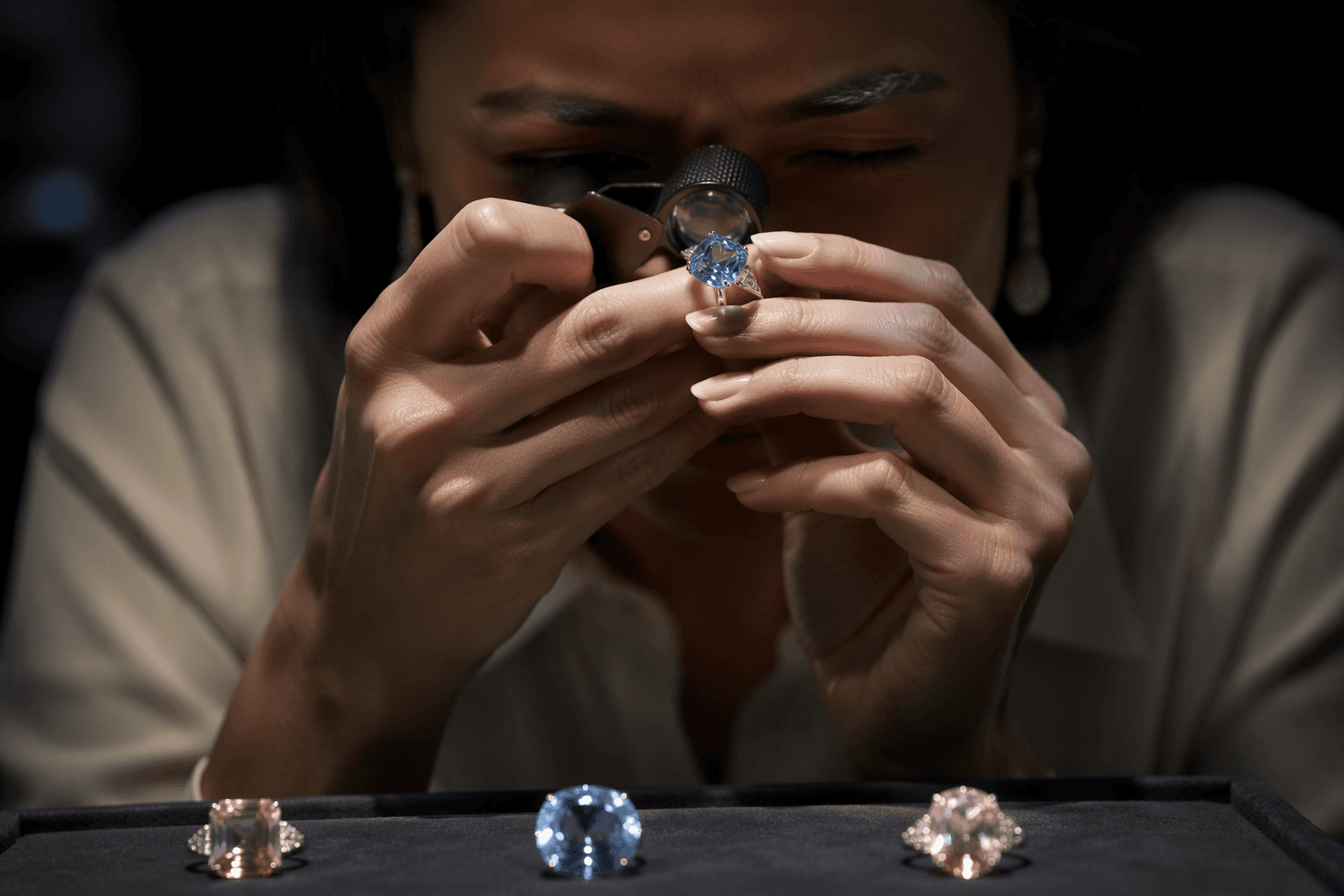
The clearest evidence sits in the stones themselves. In May 2025, Sotheby’s Geneva sold The Mediterranean Blue, a 10.03-carat fancy vivid blue diamond, for $21.5 million to a U.S. collector. Sotheby’s identified the stone as Type IIb, a category that represents less than 0.5% of all diamonds. That kind of rarity does not merely support value; it creates it.
Blue and pink diamonds occupy a very different category from the white stones that dominate everyday diamond buying. Their color is immediate, unmistakable and difficult to replicate, which is why they draw collectors rather than comparison shoppers. In this tier of the market, the stone does not need to fit into a neat spreadsheet of conventional pricing. It only needs to be extraordinary enough to stop the room.
Sotheby’s 2025 New York High Jewelry sale underscored the same point. The sale was led by The Glowing Rose, a 10.08-carat Fancy Vivid Pink diamond, another stone whose value rests on a rare color signature that cannot be standardized. When the best results are being driven by vivid blues and vivid pinks, the market is telling you exactly where scarcity still commands premium attention.
What the auction results are really saying
Auction results are not just headlines; they are a practical read on where confidence remains strongest. Sotheby’s said another New York High Jewelry sale in 2025 totaled $31.4 million and achieved a 95% sell-through rate. That is the kind of result that suggests buyers are still highly selective, but very willing to compete for jewels that combine excellence with distinction.
For collectors, that distinction often lives in three places:
- Color that is rare enough to feel unmistakable, especially fancy vivid blue and fancy vivid pink
- Provenance, which turns a stone from a beautiful object into a piece with social and historical memory
- Condition and quality so strong that the jewel can stand apart from broader price comparisons
This is where the market has moved beyond generic luxury. The best stones are not simply expensive because they are large. They are expensive because they are rare in a way the market can immediately understand, and because they arrive with a story that deepens their desirability.
Provenance is part of the price
Everett has repeatedly emphasized that provenance matters because the story of who wore a jewel, and how it was worn, adds to its appeal. That idea is central to the collector mindset. A diamond with a known past is not just a gemstone; it is a witness to a life, a place, or a moment in fashion history.
In practice, provenance can elevate a jewel in the same way a signature can elevate a painting. It gives the buyer a reason to care beyond the certificate. Two diamonds may share color and size, but the one with a compelling lineage can feel far more alive, especially for collectors who want objects that carry cultural weight as well as material value.
Everett’s own background helps explain that sensitivity. Before his role at Sotheby’s, he began his jewelry career at Bulgari in San Francisco, a house known for treating jewels as design statements, not just mineral specimens. That perspective suits a market where the best diamonds are increasingly judged as wearable art.
Where natural diamonds still hold pricing power
The broader market context supports the same conclusion. In February 2026, the Natural Diamond Council said U.S. specialty-jeweler sales of natural diamonds grew 2.1% in 2025, while the average price of natural diamond jewelry rose 10%. Those figures matter because they point to demand that held up even amid inflation and higher gold prices.
That resilience suggests natural diamonds still have meaningful pricing power when the product is exceptional. The strongest demand is not spreading evenly across all categories. It is concentrating around stones that offer a clear story of rarity, especially those with distinctive color, strong quality and a level of exclusivity that justifies the premium.
For buyers, the practical lesson is straightforward. Standardized price logic still matters in the broader market, but at the summit, it is being replaced by a different set of values. The diamonds holding attention are the ones that can be described in a single memorable sentence: a 10.03-carat fancy vivid blue; a 10.08-carat fancy vivid pink; a Type IIb stone from a category that makes up less than 0.5% of all diamonds.
That is where the natural diamond market still has its sharpest edge. In a world awash in digital comparison, the stones that rise are the ones that cannot be reduced to a formula. Their value comes from rarity, from color, and from the human story attached to them, and that is why the collector market is setting the tone for the finest diamonds now.
This article was produced by Prism’s automated news system from verified source data, official records, and press releases, then run through automated quality and moderation checks before publishing. The system is built and supervised by the people who set the standards it runs under. Read our full AI policy.
Know something we missed? Have a correction or additional information?
Submit a Tip