Trapeze-cut diamonds find fresh appeal in geometric jewelry designs
Trapeze-cut diamonds are reappearing as a rare geometric option, prized in bespoke rings and auction jewels for their sharp symmetry and distinctive, less-common profile.
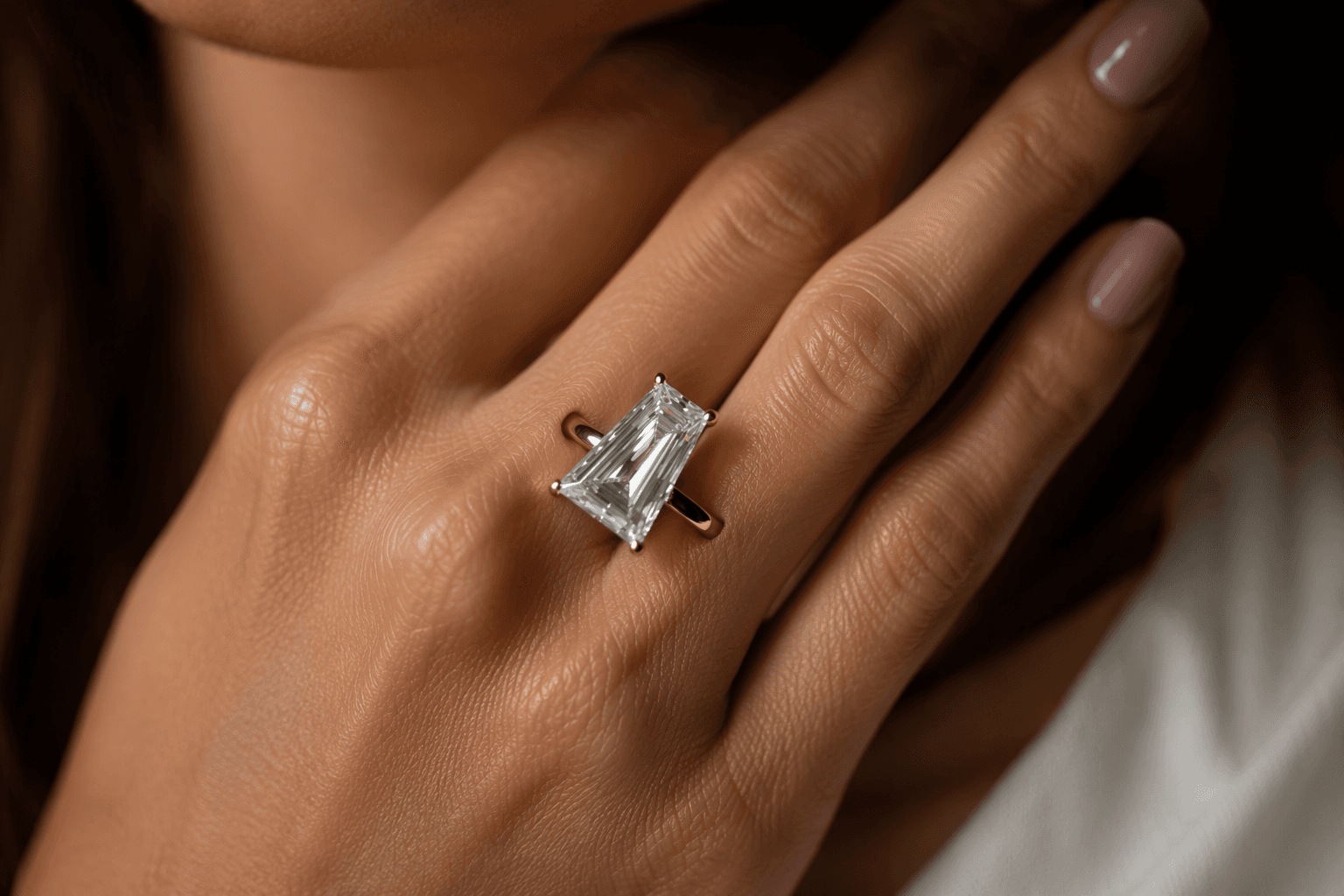
Round brilliants may still rule the center stone conversation, but trapeze-cut diamonds are reclaiming attention from the edges inward. Their appeal is partly visual, partly strategic: the shape brings a crisp architectural line to rings, earrings, and necklaces, while remaining uncommon enough to feel intentional rather than familiar. In a market drawn to custom bridal and distinctive antique references, that rarity is exactly the point.
A shape built on tension
The trapeze cut is one of those diamond shapes that changes a jewel’s entire tempo. JCK has described it as rare and geometry-driven, and that is the right lens through which to read its return. The cut can make a design feel sharper and more modern without losing softness altogether, which is why the collection spotlighted by JCK reads “at once curvy and linear.” That duality gives the shape unusual range: it can cool down a highly polished ring, or add structure to a piece that might otherwise lean ornate.
Unlike the round or oval, the trapeze cut is not a democratic shape. It asks for a designer who knows what to do with asymmetry, proportion, and negative space. That is part of the attraction. A trapeze stone does not disappear into a setting; it changes the setting around it.
Where it is showing up now
The clearest evidence of renewed interest comes from Mingle, whose trapeze-led pieces use the shape in rings, earrings, and necklaces rather than treating it as a one-off novelty. The collection includes Mingle Trapeze stud earrings in 18k yellow gold with 0.62 carat total weight of diamonds, priced at $5,800, a figure that places the design squarely in the realm of considered fine jewelry rather than entry-level sparkle. Other pieces use trapeze stones in gold frames and diamond-set links, including a necklace built with seven pairs of trapeze-cut stones.
That kind of placement matters. Trapeze diamonds work best when the whole jewel is designed around their geometry, not when they are forced to impersonate a more conventional silhouette. In rings, they can create an assertive side profile or flank a center stone with a tailored edge. In earrings, the shape reads as modern and graphic. In necklaces, especially those with linked elements, trapeze stones can turn repetition into rhythm.
A shape with auction pedigree
The trapeze cut is not a recent invention dressed up as a trend. It has a long record as a side stone in high jewelry, where it has been used to sharpen the profile of larger center stones rather than compete with them. That lineage gives the shape a kind of authority that many newly fashionable cuts lack. It has already proven that it can hold its own in serious stones and serious settings.
National Jeweler has tracked that history through a series of headline auctions. In 2019, Sotheby’s Hong Kong sold a 10.64-carat fancy vivid purplish-pink diamond ring set with trapeze diamonds. In 2017, Sotheby’s New York sold a 10.02-carat square emerald-cut diamond with trapeze-cut diamonds for $394,000. Go back further, and a 26.44-carat emerald-cut diamond flanked by two trapeze-cut diamonds brought in a little more than $2 million at Sotheby’s in 2014. The shape also appears in one of the most famous colored-diamond sales of recent years: the 11.15-carat Williamson Pink Star, which sold for $57.7 million at Sotheby’s Hong Kong in October 2022, was set in a ring with trapeze-cut diamonds and brilliant-cut pink melee.
That auction record is important for buyers because it shows the cut is not merely decorative. In top-tier jewels, trapeze stones are trusted to do structural work, to frame, stabilize, and visually extend the center stone. They are supporting actors, but in jewelry, supporting actors often decide the final silhouette.
Why designers are leaning into it now
The broader market context explains the timing. JCK has reported a move toward custom bridal and away from preset A-to-D ring formulas, with buyers increasingly chasing uniqueness through color, cut, quality, or some combination of the three. National Jeweler has also noted strong interest in vintage-inspired engagement rings and antique cuts. Put those two currents together and the trapeze cut makes perfect sense: it satisfies the desire for a recognizable diamond, but not a predictable one.
That is especially true in engagement jewelry, where the pressure to be personal has only intensified. A trapeze stone can signal taste without shouting, and it lets a designer build a ring that feels tailored from every angle. In toi et moi settings, which rely on contrast and dialogue between stones, the cut has even more potential. Its flat sides and angled edges create a clean counterpoint to a pear, oval, emerald, or antique cushion, giving the composition a sense of motion rather than symmetry for symmetry’s sake.
What the cut means for value
For buyers, the trapeze cut sits in an interesting place between connoisseurship and value. Its rarity and layout constraints make it a distinctive-value choice now, particularly if you want a piece that feels bespoke without requiring a wildly extravagant center stone. Because the cut is less common, the design can feel more special at the same size and carat weight than a standard shape with similar materials.
Whether that translates into a future price premium is another question. Trapeze stones are still more often used as architectural accents than as the main event, so liquidity may remain tied to design quality and the strength of the center stone around them. But that is exactly why the category has upside. If custom bridal keeps favoring unusual geometry and if collectors continue to respond to antique-minded silhouettes, trapeze-cut diamonds could move from design insider’s choice to a more recognized premium detail.
For now, the cut’s real luxury lies in discretion. It does not ask to replace the round brilliant; it offers another vocabulary altogether, one built on angles, proportion, and the quiet confidence of knowing the room will notice the shape before it names it.
This article was produced by Prism’s automated news system from verified source data, official records, and press releases, then run through automated quality and moderation checks before publishing. The system is built and supervised by the people who set the standards it runs under. Read our full AI policy.
Know something we missed? Have a correction or additional information?
Submit a Tip