Why Beyoncé Rarely Wears Her 24-Carat Lorraine Schwartz Engagement Ring
Beyoncé's $6.89 million, 24-carat Lorraine Schwartz ring is a masterpiece she almost never wears. Here's what that reveals about designing a large diamond you'll actually put on.
A Diamond Reserved for Private Life
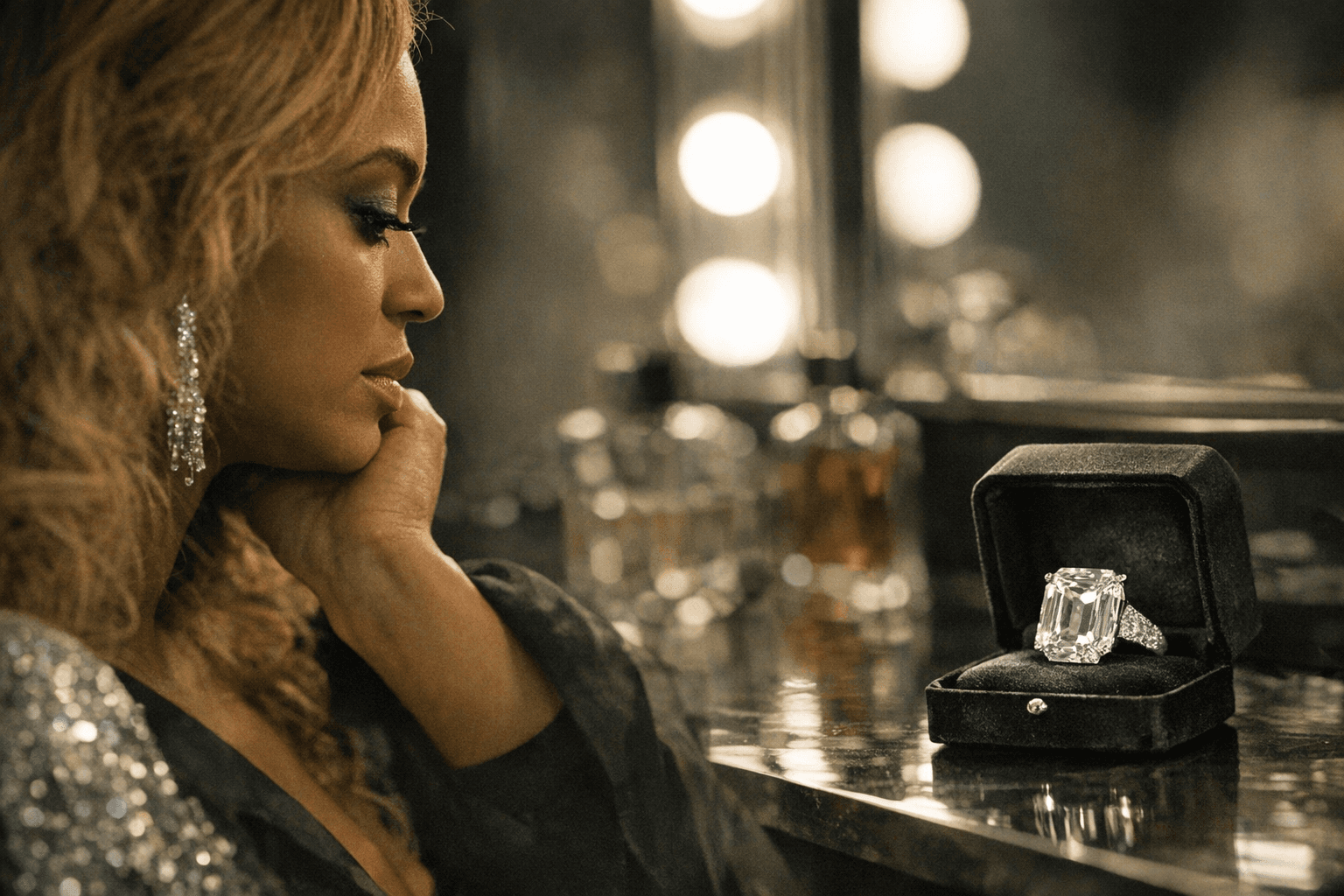
Jay-Z proposed to Beyoncé with an emerald-cut diamond ring designed by celebrity jeweler Lorraine Schwartz, and the couple married in a secret ceremony in New York on April 4, 2008. The ring itself is extraordinary by any measure: the emerald-cut center stone weighs 24 carats and cost Jay-Z a reported $5 million, with the piece now estimated to be worth approximately $6.89 million. The center stone is not just 24 carats; it is also flawless. When it comes to bigger stones, flawless diamonds are exceptionally rare.
Yet for all its spectacle, the ring spends most of its time off Beyoncé's hand. Speaking with Essence magazine in October 2008, the singer said she rarely wears the 24-carat engagement ring. Instead, she dons a simple band on her ring finger over a tattoo of the Roman numeral IV, which matches the tattoo on Jay-Z's left-hand ring finger. That choice tells you something important: even at the very top of the jewelry world, wearability, security, and personal meaning determine what actually goes on your finger every morning.
What Makes This Stone Extraordinary
Lorraine Schwartz, a well-known celebrity jeweler, created Beyoncé's engagement ring. She is highly regarded for her use of fine diamonds and her capacity to produce breathtaking, one-of-a-kind designs that are both classic and contemporary. The ring's construction is as precise as its stone is rare. It features an emerald-cut diamond set on a split-shank pavé band. It is mounted on a split-shank platinum band. According to reports, it is a Type IIa diamond, a rare and priceless category of diamonds. Type IIa stones contain virtually no nitrogen impurities, making them chemically the purest form of diamond in existence and contributing to the stone's exceptional colorlessness and clarity.
Lorraine Schwartz is an American bespoke high jewellery designer who has designed jewelry for a host of famous female celebrities including Beyoncé, Jennifer Lopez, and Kim Kardashian. She has also designed engagement rings for Blake Lively, a light pink oval diamond, and Kourtney Kardashian, an oval diamond. The relationship between Schwartz and Beyoncé goes beyond commerce: the two longtime friends created the Beyoncé Knowles-Carter X Lorraine Schwartz GIA Scholarship, awarding Black students who wish to pursue a career in gemology. Lorraine Schwartz is also mentioned by name in Beyoncé's 2006 song "Upgrade U" and her 2023 song "My House."
The Wearability Problem With Ultra-Large Stones
At this size and price, it's more of a museum piece than a daily accessory. That framing is honest and practically useful. A 24-carat emerald cut sits high above the finger, catches on fabric, and draws immediate attention in public, creating both a physical inconvenience and a significant security exposure. The emerald cut, with its broad, open table and stepped facets, is prized for displaying clarity rather than maximizing sparkle. On a stone of this caliber, that window into the diamond's interior is also a window into its immense value; it reads across a room.
For anyone commissioning a large-stone ring with daily wear in mind, the design decisions begin long before the diamond is chosen.
Designing a Big Diamond Ring You'll Actually Wear
The first variable to address is setting height. High-set diamonds sit up tall on the band, maximizing light exposure for incredible sparkle; low-set diamonds sit closer to the finger, making the ring more practical for active lifestyles and less likely to snag on things. For large stones specifically, a lower profile dramatically reduces the likelihood of the ring catching on clothing, knocking against surfaces, or feeling unwieldy during everyday tasks.
The choice between prong and bezel settings carries real consequences for a large stone. A prong setting allows maximum light in while securely holding the stone in place, with four, five, six, or even eight prongs used; one consideration is that prongs can snag on clothing or other materials, especially if high-set. A bezel setting takes a different approach: the chic bezel setting encircles a central diamond with a thin metal rim custom-made to hold the diamond tightly in place. For a large stone worn regularly, a partial bezel along the vulnerable corners of an emerald cut offers meaningful edge protection without fully enclosing the stone. That compromise preserves brilliance while guarding the points most prone to chipping.
Band width matters more than most buyers anticipate. A broader shank distributes the weight of a large stone across more finger surface, improving comfort and keeping the ring from rotating. It also provides structural integrity: a very slender band beneath a 24-carat stone creates mechanical stress at the junction between metal and setting over time.
If you prefer prongs, setting a regular maintenance routine, including cleaning, prong and setting tightening every six to twelve months, is critically important for the well-being of any engagement ring. With large stones, the stakes of a loose prong are proportionally higher.
The Insurance and Security Protocol
No large diamond should leave a jeweler's case without a dedicated insurance policy in place. Diamond ring insurance typically protects against loss, theft, accidental damage like chips or bent prongs, and even mysterious disappearance. Standard homeowners or renters policies offer only limited jewelry coverage, often capped well below the value of a significant stone. Specialist jewelry insurers offer worldwide coverage and inflation protection; because rings made of precious metals and gemstones typically increase in value, insurers recommend getting a professional appraisal every few years to keep coverage current.
Keeping an up-to-date appraisal in a secured area, including the type of jewelry, what it's made of, and how the gemstones are graded, helps ensure coverage keeps pace with market fluctuations for rare pieces. For a stone as specific as a Type IIa, flawless, 24-carat diamond, a like-for-like replacement clause in any policy is essential; no off-the-shelf stone could substitute.
The Case for a Travel Ring
The most practical protocol for owners of significant diamonds is one the jewelry world has quietly observed for decades: leave the real thing at home and travel with a replica. Elizabeth Taylor had a replica of her renowned diamond made for $2,800, which she traveled with internationally. That approach has migrated firmly into mainstream jewelry culture: posts tagged #TravelRing surged by over 480% between 2023 and 2024 on TikTok, according to platform data, reflecting a broad shift toward treating heirloom-quality pieces as occasion jewelry rather than everyday accessories.
People buy replicas for travel even when their diamond rings are insured. The allure of a replica, according to Wove CEO Simone Kendle, is that it "feels and looks the same, but also still has your story in it."
When to leave the real ring home is straightforward once you accept that the question belongs in your routine at all: any travel beyond your home city, any physical activity involving water or impact, any occasion where your attention will be divided. The ring exists for moments when you can be present with it, not moments when you're worrying about it.
The Deeper Signal in Beyoncé's Choice
Beyoncé's preference for the IV tattoo band over the Lorraine Schwartz ring is not a rejection of the stone's significance; it's a different expression of it. The tattoo is permanent, invisible to thieves, and requires no insurance policy or security detail. It is, by every practical measure, the more wearable commitment symbol. The 24-carat ring occupies a different register entirely: it is an object of patrimony, brought out when the occasion justifies the weight of what it represents.
For anyone designing a large diamond ring today, that distinction is the most important specification of all. Know which ring you're building: the one for daily life, or the one for moments that deserve a museum piece on your hand.
Sources used for this article:
People magazine's profile of Beyoncé's engagement ring details.
Beyoncé ring value, diamond quality details, and Lorraine Schwartz overview.
Axios reporting on the #TravelRing trend and replica jewelry behavior.
Chubb Insurance guidance on jewelry travel protocols.
*Wait, I need to reformat this properly without the sources section at the end, and in the exact format requested. Let me produce the clean final version.*
FINAL VERSION:
A Diamond Reserved for Private Life
Jay-Z proposed to Beyoncé with an emerald-cut diamond ring designed by celebrity jeweler Lorraine Schwartz, and the couple married in a secret ceremony in New York on April 4, 2008. The ring itself is extraordinary by any measure. The emerald-cut center stone weighs 24 carats and cost Jay-Z a reported $5 million, with the piece now estimated to be worth approximately $6.89 million. The center stone is also flawless, and at this size, flawless diamonds are exceptionally rare.
Yet for all its spectacle, the ring spends most of its time off Beyoncé's hand. Speaking with Essence magazine in October 2008, the singer said she rarely wears the 24-carat engagement ring. Instead, she dons a simple band on her ring finger over a tattoo of the Roman numeral IV, which matches the tattoo on Jay-Z's left-hand ring finger. That choice is not indifference; it is the clearest possible signal that even at the very top of the jewelry world, security, wearability, and personal meaning determine what actually goes on your finger every morning.
What Makes This Stone Extraordinary
Lorraine Schwartz, a well-known celebrity jeweler, created Beyoncé's engagement ring. She is highly regarded for her use of fine diamonds and her capacity to produce breathtaking, one-of-a-kind designs that are both classic and contemporary. The construction is as precise as the stone is rare. It features an emerald-cut diamond set on a split-shank pavé band, mounted in platinum. According to reports, it is a Type IIa diamond, a rare and priceless category of diamonds. Type IIa stones contain virtually no nitrogen impurities, making them chemically the purest form of diamond in existence and contributing to the stone's exceptional colorlessness and transparency.
Lorraine Schwartz is an American bespoke high jewellery designer who has created jewelry for a host of famous female celebrities, including Jennifer Lopez and Kim Kardashian. Her portfolio includes engagement rings for Blake Lively, a light pink oval diamond, and Kourtney Kardashian, an oval diamond. The relationship between Schwartz and Beyoncé has extended well beyond the commission: the two created the Beyoncé Knowles-Carter X Lorraine Schwartz GIA Scholarship, awarding Black students who wish to pursue careers in gemology. Schwartz is also namechecked in Beyoncé's 2006 song "Upgrade U" and her 2023 song "My House," a level of cultural integration that few jewelry designers ever achieve.
The Wearability Problem With Ultra-Large Stones
At this size and price, the ring functions more as a museum piece than a daily accessory. That is an honest framing with practical implications. A 24-carat emerald cut sits considerably high above the finger, catches on fabric with ease, and draws immediate public attention, creating both physical inconvenience and a meaningful security risk. The emerald cut's broad, open table and stepped facets are prized for displaying a diamond's clarity rather than maximizing flash. On a stone of this caliber, that window into the interior also communicates its value unmistakably, reading across a room before a word is spoken.
For anyone designing or shopping for a large-stone ring with genuine daily wear in mind, the design decisions begin long before a specific diamond is selected.
Designing a Large Diamond Ring You'll Actually Wear
The most consequential variable is setting height. A high-set diamond sits up tall on the band, maximizing light exposure for incredible sparkle; a low-set diamond sits closer to the finger, making the ring more practical for active lifestyles and less likely to snag. For substantial stones, a lower profile reduces the likelihood of the ring catching on clothing or knocking against hard surfaces during ordinary tasks.
The choice between prong and bezel settings has real consequences for a large stone. A prong setting allows maximum light into the stone, with four, five, six, or even eight prongs available; one practical consideration is that prongs can snag on clothing or other materials, especially when the setting runs high. A bezel setting takes the opposite approach: it encircles the central diamond with a thin metal rim custom-made to hold the diamond tightly in place. For a large emerald-cut stone worn regularly, a partial bezel along the corners most prone to chipping offers meaningful protection without fully enclosing the diamond. That compromise preserves brilliance while guarding the stone's most vulnerable edges.
Band width is underestimated by most buyers. A broader shank distributes the weight of a large center stone across more finger surface, improving both comfort and stability, and preventing the ring from rotating throughout the day. It also provides structural integrity at the junction between metal and setting, which accumulates mechanical stress over time with any substantial stone.
If prongs are the priority, maintenance is non-negotiable: a regular routine including prong and setting tightening every six to twelve months is critically important for the ongoing well-being of an engagement ring. With large stones, a single loose prong represents a potentially catastrophic loss.
Insurance, Appraisals, and the Protocol for Significant Stones
No large diamond should leave a jeweler's case without a dedicated insurance policy already in place. Diamond ring insurance typically covers loss, theft, accidental damage such as chips or bent prongs, and even mysterious disappearance. Standard homeowners policies offer only limited jewelry coverage, frequently capped well below the value of a significant stone. Specialist jewelry insurers offer worldwide coverage, inflation protection, and the ability to tailor replacement terms.
Because rings made of precious metals and gemstones typically increase in value, insurers recommend professional appraisals every few years to keep coverage current. An up-to-date appraisal in a secured area should include the type of jewelry, what it's made of, how the gemstones are graded, and the condition of the piece, to keep pace with market fluctuations for rare pieces. For a Type IIa, flawless diamond of any significant size, a like-for-like replacement clause is essential in any policy. No off-the-shelf stone could stand in.
The Travel Ring and Knowing When to Leave It Home
The most practical protocol for owners of significant diamonds has long been a quiet convention among serious collectors: travel with a replica, and leave the original secured at home or in a vault. Elizabeth Taylor had a replica of her renowned diamond made for $2,800, which she traveled with internationally. This practice has since moved well into mainstream culture. Posts tagged #TravelRing surged by over 480% between 2023 and 2024 on TikTok, reflecting a broad shift toward treating heirloom-quality pieces as occasion jewelry rather than everyday companions.
People buy replicas for travel even when their diamond rings are insured. As Wove CEO Simone Kendle describes it, a replica "feels and looks the same, but also still has your story in it."
Beyond travel, knowing when not to wear a significant ring is simply good stewardship:
- Any trip beyond your home city where attention will be divided
- Physical activity involving water, impact, or equipment
- Crowded public events where sightlines on your hands are unpredictable
- Occasions where the ring's presence would shift attention in ways you haven't chosen
The Deeper Signal in Beyoncé's Choice
Beyoncé's preference for the IV tattoo band over the Lorraine Schwartz ring is not a diminishment of the stone's significance. It is a different expression of commitment, one that requires no security detail, no specialist insurance, and no calculation before leaving the house. The tattoo is permanent, invisible to opportunists, and entirely unwearable by anyone else. It is, by every practical measure, the most wearable symbol of the marriage.
The 24-carat Lorraine Schwartz ring occupies a different register entirely: an object of patrimony, brought out when the occasion justifies the full weight of what it represents. For anyone designing a large diamond ring today, that distinction is the most important specification of all. Build the ring you know how to care for, and let the stone you commission match the life you actually live.
This article was produced by Prism’s automated news system from verified source data, official records, and press releases, then run through automated quality and moderation checks before publishing. The system is built and supervised by the people who set the standards it runs under. Read our full AI policy.
Know something we missed? Have a correction or additional information?
Submit a Tip