Blue Nile's Engagement Ring Guide Covers Styles, Diamonds, and Budgeting Basics
The setting you choose shapes how big a diamond reads on hand, often more than carat weight does. Five archetypes, decoded for sparkle, security, and style.

When Ariana Grande's multi-stone engagement ring became one of the most-searched bridal references of the past several years, and TikTok simultaneously revived the Carmela Soprano school of maximum-carat maximalism, the conversation that followed wasn't really about diamonds. It was about the architecture holding them. A setting does more than secure a stone; it defines the ring's silhouette, controls how much light the diamond returns, and determines whether that ring still looks pristine after a decade of daily wear. Here is what the five core setting archetypes actually deliver, where buyers consistently go wrong, and what each realistically costs.
The Solitaire: Total Exposure, Total Accountability
*Visual promise: Every photon of light the diamond captures is yours alone, unshared and undiluted.*
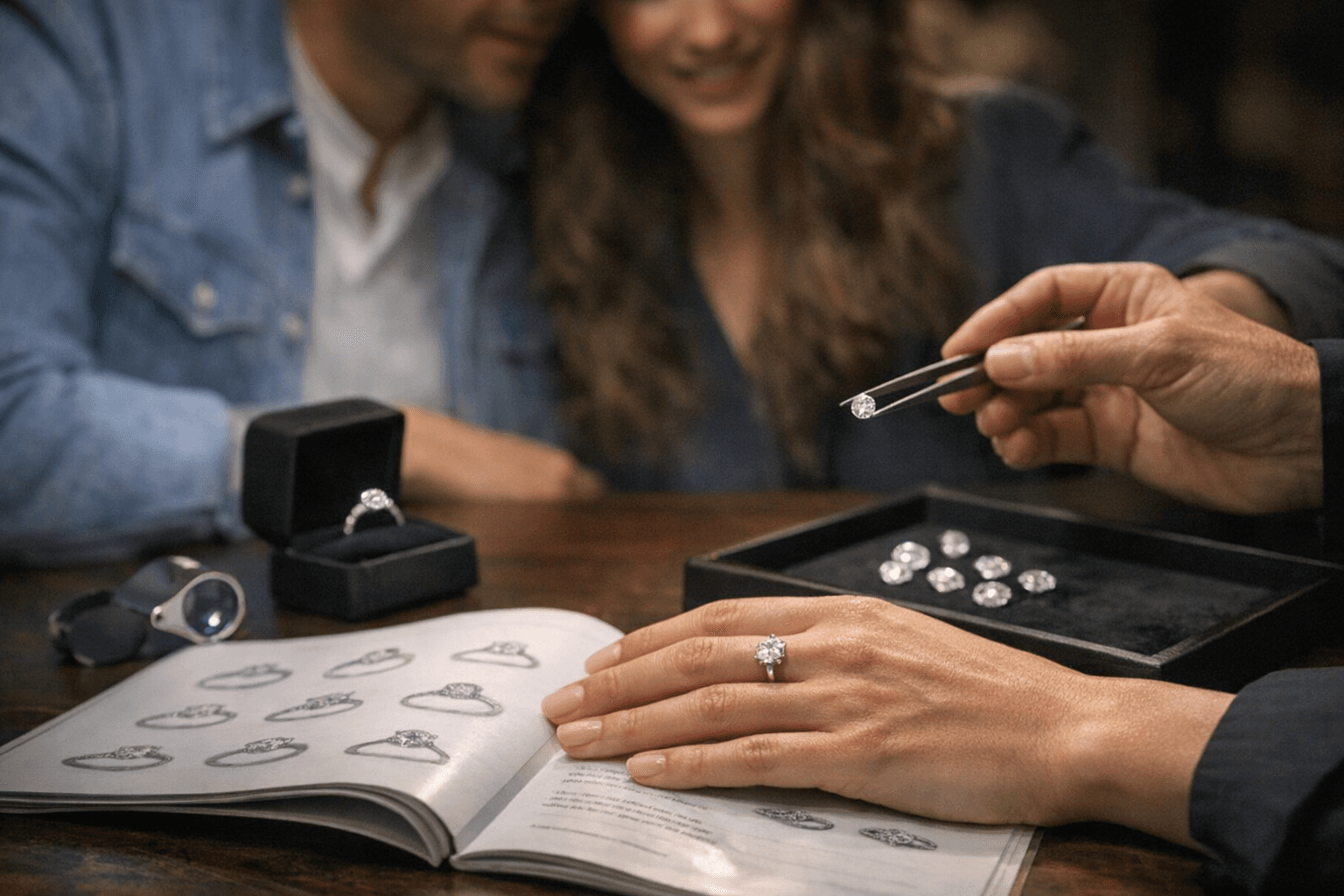
The solitaire is the most demanding setting precisely because it offers nowhere to hide. A single stone sits on a clean metal band, held by four or six prongs or a bezel rim, with no accent diamonds to distract from the center stone's performance. Blue Nile identifies 1- and 2-carat rounds as the most popular configuration in this style. The Classic Six-Prong Solitaire setting in 14k white gold starts at $220; the same geometry executed in platinum runs $690. Add a GIA-certified 1-carat, G-color, VS2 round brilliant and the completed ring typically lands between $6,000 and $9,000 depending on cut grade.
Common mistake: Trading cut quality for carat weight. Because nothing competes for the eye in a solitaire, an Excellent-cut 0.90-carat stone will visually outperform a 1.10-carat stone graded Good in cut. The face-up size difference is negligible; the sparkle difference is not.
The Halo: Borrowed Light, Maximum Face-Up Impact
*Visual promise: The center stone reads measurably larger on hand than its carat weight would suggest.*
A halo encircles the center diamond with a ring of smaller pavé or micropavé-set accent stones, adding perceived diameter without adding carat weight to the center stone. The double halo builds a second concentric ring for added dimension and sparkle; the hidden halo tucks the diamond circuit below the center stone so the effect disappears when the ring is viewed straight on, revealing itself only from the side. The Cushion Halo Diamond Engagement Ring in 14k white gold, carrying 1/3 ct. tw. in accent stones, starts at $1,490 for the setting alone, a meaningful price jump from a comparable solitaire that reflects the additional stone count and craftsmanship.
Common mistake: Selecting a halo shape that misreads the center stone's cut style. A round halo around a marquise center dilutes the marquise's characteristic elongated drama; a cushion halo around an emerald cut disrupts the clean, stepped geometry that makes emerald cuts compelling. Match the halo's outline to the stone's shape deliberately, or choose a plain, tight halo that reads as a frame rather than a competing element.
The Cathedral: Elevated, Architectural, High-Maintenance
*Visual promise: The center stone rises dramatically above the hand, framed by sweeping metal arches that reference Gothic architecture in miniature.*
Cathedral settings lift the center diamond via two curving metal supports that arch up from the shank on either side of the stone. The effect is formal and proportionally grand, lending any ring a sense of ceremony even before the stone is factored in. The Cathedral Pavé Diamond Engagement Ring in 18k white gold, set with 1/4 ct. tw. in accent stones, starts at $1,440; the Petite Cathedral Solitaire in 14k white gold begins at $390 for buyers who want the silhouette without the additional diamond cost. Cathedral architecture creates room for further detail work, including hidden halos tucked into the gallery space and accent stones set along the arch, which is why this style frequently appears as the structural backbone of more elaborate custom designs.
Common mistake: Underestimating the cleaning commitment. The raised profile and metal arches trap soap residue, lotion, and debris far more readily than a low-profile setting. Cathedral rings benefit from at minimum a weekly rinse with warm water and a soft-bristled brush, plus professional cleaning twice annually. The elevated silhouette also catches on fabric and knitwear, a practical consideration for anyone with an active lifestyle or hands-on profession.
The Bezel: Maximum Security, Sculptural Modernity
*Visual promise: A continuous metal rim hugs the diamond completely, producing a sleek, architectural silhouette that reads as unambiguously contemporary.*
In a bezel setting, a metal collar replaces prongs entirely, wrapping around the diamond's girdle to hold it in place. The trade-off is intentional: the bezel slightly reduces light entry from the sides, which means marginally less scintillation compared to a six-prong solitaire of equivalent stone quality. What it offers in return is superior protection, a significant benefit for active wearers or for shapes with vulnerable pointed tips. Blue Nile configures bezel settings across Lab Grown Emerald Cut diamonds in 14k yellow gold (3 ct. tw.) and 18k yellow gold (2 ct. tw.), and Lab Grown Marquise diamonds in 18k yellow gold (2 ct. tw.), reflecting the setting's particular affinity for marquise and pear cuts, where exposed points are prone to chipping under unprotected prongs.
Common mistake: Defaulting to a full bezel when a partial, or east-west, bezel would deliver more light return and the same protection along the most vulnerable edges. The full bezel's streamlined look is an aesthetic commitment, not a structural requirement; a partial bezel is a legitimate middle ground.
The Three-Stone: Width, Narrative, and Visual Balance
*Visual promise: Three stones across the finger create both physical presence and a layered story, worn as a single, unified band.*
The three-stone setting has become one of the fastest-growing engagement ring configurations, driven partly by celebrity choices and partly by a cultural shift toward rings that carry symbolic intent alongside visual impact. The center stone is flanked by two side stones that either mirror the center's cut or complement it with a contrasting shape. Pairing a round brilliant center with tapered baguette sides leans vintage; an oval center with two round flanking stones reads as contemporary and architectural. The Graduated Side Stone Diamond Engagement Ring in 14k white gold, set with 3/8 ct. tw. across the two flanking stones, starts at $1,620 for the setting.
Common mistake: Misjudging the side stone proportions. Side stones that are too large compete with the center stone for dominance; side stones too small read as decorative afterthoughts rather than intentional design elements. As a practical rule, the combined carat weight of both side stones should equal approximately 50 to 75 percent of the center stone's carat weight for the arrangement to read as balanced.
The 4Cs, Decoded
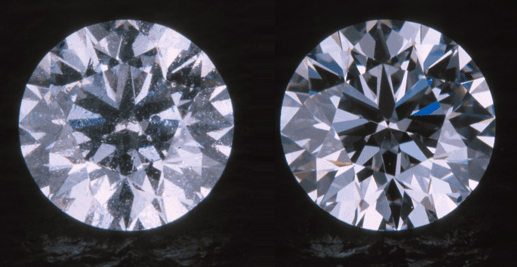
Cut, color, clarity, and carat weight are the four criteria used to grade diamonds, and of the four, cut is the only variable that directly determines how much light a stone returns to the eye. A poorly cut diamond of 1.5 carats can appear flatter and smaller on hand than a well-cut stone of 0.90 carats, a counterintuitive fact that still surprises first-time buyers. For color, grades G and H sit in the near-colorless range and represent strong value against the D-through-F premium tier, especially in yellow or rose gold settings where slight warmth in the stone blends with the metal. For clarity, SI1 and SI2 stones are typically eye-clean and offer meaningful savings over VS2 and above grades.
Beyond the round brilliant, diamond shapes include oval, cushion, marquise, pear, emerald, and Asscher cuts. Elongated shapes, particularly oval and marquise, read larger face-up than rounds of equivalent carat weight and create the visual illusion of an elongated finger. Cushion cuts, with their rounded corners and pillow-like silhouette, have become one of the most-requested shapes alongside rounds, owing to a warmth that lends itself naturally to three-stone and vintage-inspired settings.
Metal, Durability, and the Long View
Platinum, 14k and 18k white gold, 14k and 18k yellow gold, and rose gold each behave differently over time. Platinum is the densest and most wear-resistant option, making it particularly well-suited to prong settings where metal integrity directly protects the stone; it develops a soft patina with wear that many buyers find adds character. White gold requires periodic rhodium plating to maintain its bright white finish, a recurring cost that is worth budgeting for from the start. Yellow gold has staged a significant return in engagement jewelry, partly driven by vintage aesthetics and partly by the trend toward warmer, non-traditional bridal palettes; 14k is harder and better suited to daily wear than 18k, which carries more pure gold but sacrifices some scratch resistance as a result.
Certification, Budgeting, and the Practical Details
GIA and AGS certifications represent the benchmark for natural diamonds; IGI is widely accepted for lab-grown stones and provides the same assurance of independent grading. For any diamond above half a carat, a grading certificate is non-negotiable, as it documents the 4Cs independently and underpins the ring's insurance and resale value.
The three-months-salary rule is a mid-20th-century marketing construct with no bearing on what a ring should cost. Lab-created diamonds, which share identical optical, chemical, and physical properties with natural mined stones, typically cost 20 to 40 percent less, making a larger or better-cut stone genuinely accessible at every price point. Setting-only prices range from $220 for a simple solitaire to $3,650 for a designer pavé mount in platinum, with the completed ring cost driven almost entirely by stone selection.
Before finalizing any purchase, confirm the resizing policy, understand the return window, verify that the manufacturer's warranty covers structural defects for the life of the ring, and insure the piece separately through a dedicated jewelry rider or a standalone policy. A ring assembled to a custom specification cannot be replaced without a current appraisal on file, and most standard homeowner or renter policies carry jewelry sublimits that fall well short of even a modest engagement ring's replacement cost. The setting frames the stone; the paperwork protects both.
This article was produced by Prism’s automated news system from verified source data, official records, and press releases, then run through automated quality and moderation checks before publishing. The system is built and supervised by the people who set the standards it runs under. Read our full AI policy.
Know something we missed? Have a correction or additional information?
Submit a Tip