Briony Raymond’s Carousel collection turns hard stones into sculptural rings
Carousel turns hard stones into bridal references, but its real lesson is how to borrow the color and sculptural gold without forcing soft gems into daily wear.
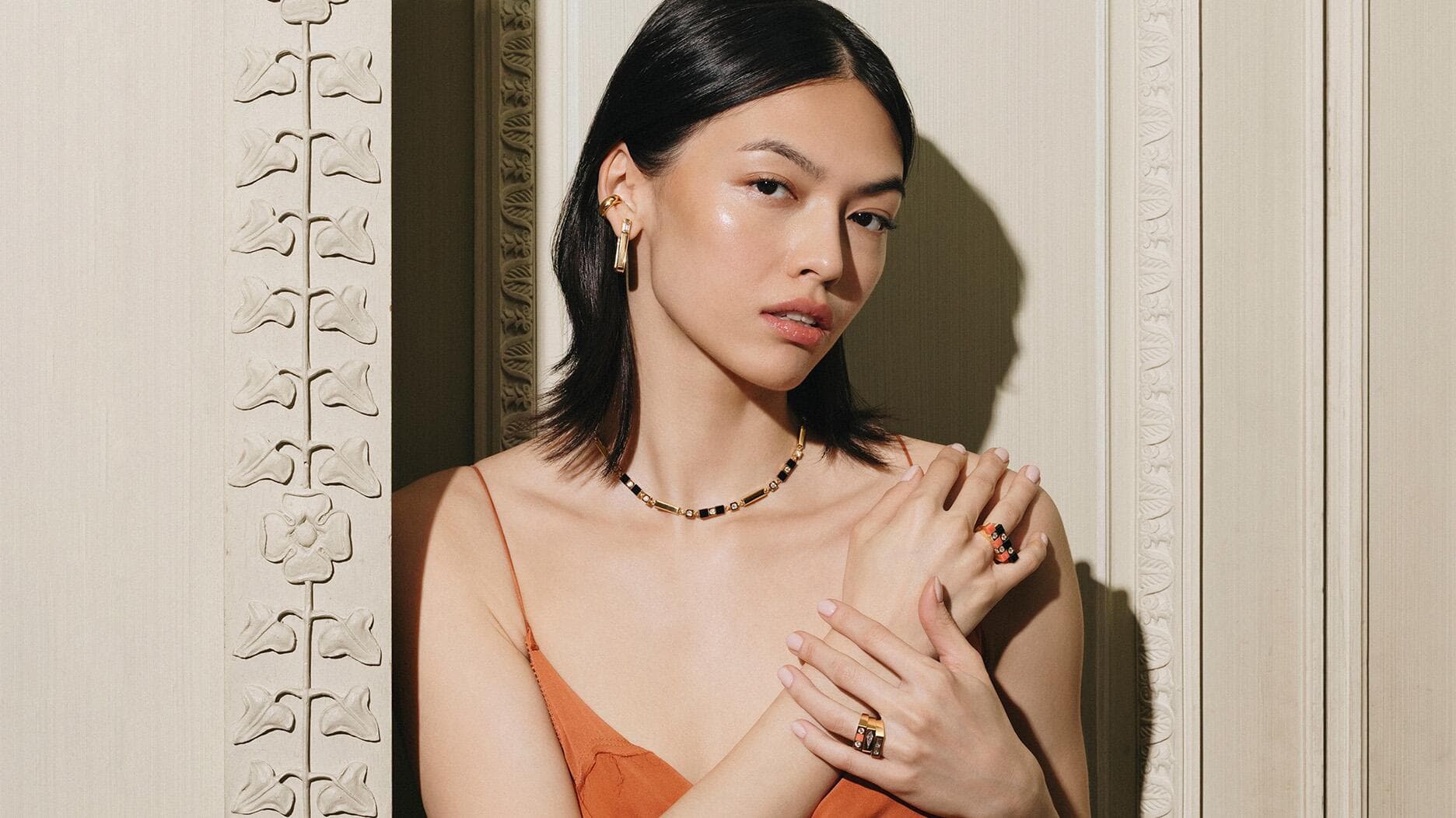
Briony Raymond’s Carousel collection pairs 18-karat yellow gold and diamonds with onyx, malachite, tiger’s eye, mother-of-pearl, lapis, turquoise, and coral in puzzle-like compositions that feel designed as much as they are made. Instead of treating hard stones as side notes, the line sharpens the language of fine jewelry into something more architectural. For engagement rings, the collection matters less as a literal template than as a cue to the direction bridal taste is heading: more color, more shape, and more personality.
A sculptural vocabulary built from hard stones
Carousel is spread across rings, necklaces, bracelets, and earrings, but the rings do the clearest work. Checkerboard styles sit around $6,400 to $7,200, while cocktail rings climb to about $17,750 to $18,500, giving the collection a wide price span inside contemporary fine jewelry. Earrings run in the range of about $10,800 to $17,800 and necklaces from roughly $28,000 to $100,750, showing the line moving from comparatively accessible statement pieces to serious high jewelry.
The design idea is tactile rather than fussy. Briony Raymond describes Carousel as an exploration of hard stones inspired by the beauty of analog objects and modular, shifting forms, and that shows up in the collection’s grid-like and interlocking surfaces. The effect is polished but not precious in the fragile sense; it suggests a hand-held object, a compact, a keepsake, or a vintage puzzle box translated into gold and stone.
What the collection says about bridal taste
Engagement-ring style is moving toward individuality, and color is no longer being treated as a detour from seriousness. By 2026, engagement-ring trends pointed to a growing appetite for rings with character, color, and individuality, and the Natural Diamond Council reported that consumer demand for natural diamonds and jewelry stayed resilient in 2025 despite tariffs, inflation, and rising gold prices.

That combination explains why a collection like Carousel lands so clearly now. It does not ask shoppers to abandon diamonds; it asks them to reconsider the frame around them. Briony Raymond’s own engagement-ring offerings already include both colored-stone and diamond options.
Craft matters as much as color
Raymond founded her namesake atelier in 2015 after nearly a decade at Van Cleef & Arpels. Each piece is handmade by master jewelers in its dedicated New York City workshop, with Raymond and her team guiding the process from sketch to wax model, gemstone selection, and final approval. Each finished piece receives a unique serial number and signature.
That emphasis on making also supports the brand’s bespoke work, including custom engagement rings. For clients shopping by appointment, in person or virtually, the process is built around specificity rather than shelf inventory. The brand has also moved into a by-appointment-only 4,000-square-foot showroom in Midtown Manhattan’s Fuller Building, designed as a salon-like space centered on art and antiques.
What translates to an engagement ring, and what does not
The most useful lesson from Carousel is not that every hard stone belongs on a ring finger. It is that bridal jewelry can borrow its mood while respecting what daily wear demands. Diamonds remain the most practical center stone for an everyday engagement ring because they handle repeated contact far better than softer or more delicate materials.
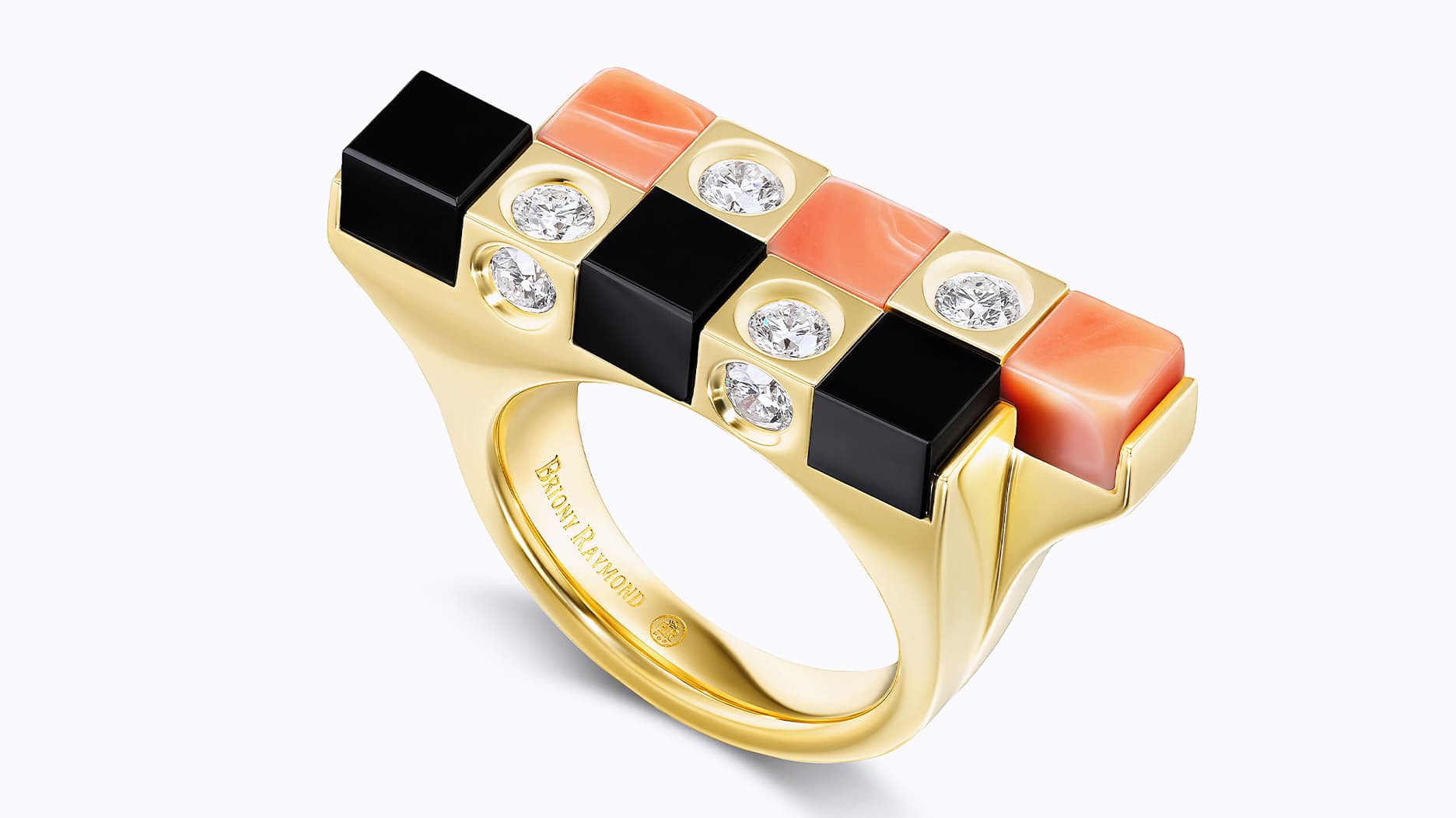
Many of Carousel’s stones are better used as inspiration than as direct substitutes for a lifelong ring. Onyx, malachite, turquoise, coral, and mother-of-pearl are more vulnerable to scratches, chips, and surface wear than diamond, and several of them also require more care around moisture, chemicals, and impact. Tiger’s eye is sturdier than some of the other stones in the mix, but the collection as a whole reads best as a study in color and composition rather than a blueprint for a no-exceptions, never-remove-it bridal ring.
What to borrow instead is the setting language:
- Use color blocking to turn the ring face into a small composition, not just a mounting for a center stone.
- Favor sculptural yellow gold if you want warmth and depth, especially with diamonds or colored gems.
- Look at checkerboard and modular patterns when you want texture without extra surface ornament.
- Let a ring feel heirloom-like through scale and shape, not only through size of stone.
Why the brand’s reach matters
Raymond’s profile has expanded well beyond New York. By 2025, Raymond was a favorite of Rihanna, A$AP Rocky, Lewis Hamilton, and Sarah Jessica Parker, and she also made a custom diamond umbrella for A$AP Rocky for the 2025 Met Gala. Her work has also appeared in Vogue, The Wall Street Journal, Town & Country, People, and E! News.
This article was produced by Prism’s automated news system from verified source data, official records, and press releases, then run through automated quality and moderation checks before publishing. The system is built and supervised by the people who set the standards it runs under. Read our full AI policy.
Did this article answer your question?