Celebrity colored diamond engagement rings spotlight rare natural gems
Celebrity rings may drive the fantasy, but the real story is scarcity: natural colored diamonds are just 0.01% of the market, and blue and red sit in another rarity league.

Jennifer Lopez’s 8.5-carat natural green diamond does more than catch the eye. Colored diamonds make up only 0.01% of all natural diamonds, according to Natural Diamonds, which is why celebrity examples keep pulling the conversation back to rarity rather than simple style.
Why colored diamonds sit in a category of their own
Fancy colored natural diamonds are not judged like standard white stones. Their value turns on hue, tone, and saturation, the qualities that give a pink, blue, green, or yellow diamond its exact personality and depth of color. These gems are rare by nature, with body color that develops from trace elements or unique crystal structures, which is why the market treats them as a distinct class rather than a tinted version of the usual engagement ring diamond.
A colored diamond is not automatically valuable because it is unusual. The stones that carry the strongest scarcity story are the ones whose color is both natural and exceptionally uncommon, which is where blue and red diamonds separate themselves from the broader colored-stone conversation.
The celebrity names that keep the category visible
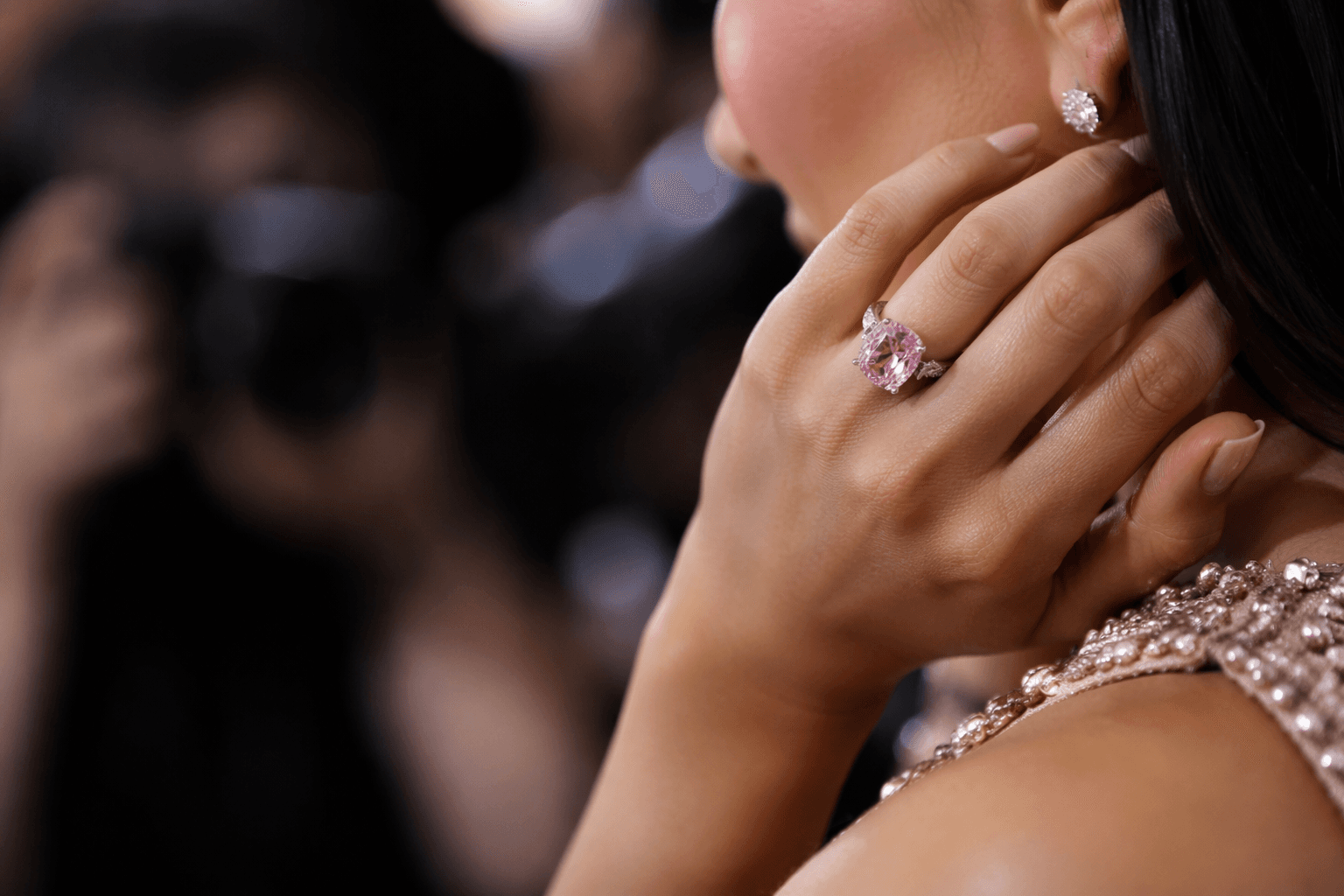
Celebrity engagement rings have long shaped taste, and British royalty, award-winning actresses, models, and other fashion tastemakers have helped popularize colored stones for decades. That pattern continues through the current wave of ring coverage, where Jennifer Lopez’s green diamond, along with pink-diamond rings worn by Victoria Beckham and Blake Lively, serves as shorthand for a category that feels luxurious precisely because it is not easy to copy.
A green diamond on Lopez reads differently from a pink stone on Beckham or Lively, and that difference is exactly what keeps the market interested: each color carries its own level of natural scarcity, visual contrast, and collector appeal.
Which colors are truly scarce
Not all colored diamonds are equally rare. Blue diamonds and red diamonds are far rarer in nature than sapphires and rubies, by factors of 10,000 and 100,000, respectively, according to Natural Diamonds.
Pink diamonds occupy a different kind of spotlight. They may not carry the same extreme rarity marker as red or blue, but they have become the celebrity-facing color most visible in ring coverage, helped by the continued attention on Victoria Beckham, Blake Lively, and similar high-profile examples. Green diamonds, like Jennifer Lopez’s, add another layer of intrigue because they are less familiar to many buyers, which can make them feel even more singular in a ring case.
How the grading works, and why that changes what you pay for
Fancy colored natural diamonds have their own grading logic, and it is built around color rather than the absence of it. Hue, tone, and saturation determine value, so two stones of the same rough size can land in very different places depending on how vivid, balanced, or intense the color appears. That is one reason the category can be hard to shop casually. The eye may notice the color first, but the grading system is what decides whether the stone is merely pretty or genuinely exceptional.
For anyone considering one of these stones in an engagement ring, documentation matters as much as the look. A natural colored diamond should be described clearly as natural, with the color explained in grading terms rather than loose marketing language.
The settings that make color wearable
Ring architecture matters because color needs a stage. The round-brilliant cut diamond solitaire has long been the classic engagement-ring setting, and that clean simplicity still works especially well when the center stone is colored. A solitaire gives the eye nowhere else to go, which can make even a modestly sized fancy-colored stone feel confident and deliberate.
In 2026 celebrity coverage, bold settings and antique cuts are shaping the year’s engagement-ring conversation. Antique cuts bring soft edges and old-world character, while bolder settings give a colored center stone enough structure to look modern rather than costume-like.
Why the market still leans in
The broader market is not cooling on colored diamonds. The Natural Diamond Council released a fancy-color-diamond report amid renewed media attention on high-profile pink diamonds, and Christie’s saw a 45% increase in colored-diamond auction participation. Those signals do not mean every colored diamond is suddenly a blue-chip asset, but they do show that buyers and collectors are paying closer attention to the category’s rarest stones.
This article was produced by Prism’s automated news system from verified source data, official records, and press releases, then run through automated quality and moderation checks before publishing. The system is built and supervised by the people who set the standards it runs under. Read our full AI policy.
Did this article answer your question?