Curved engagement rings gain favor as sculptural, stackable alternatives
Curved engagement rings turn the bridal solitaire into something more sculptural, with arcs, twists and bypass lines built for stacking and daily wear.
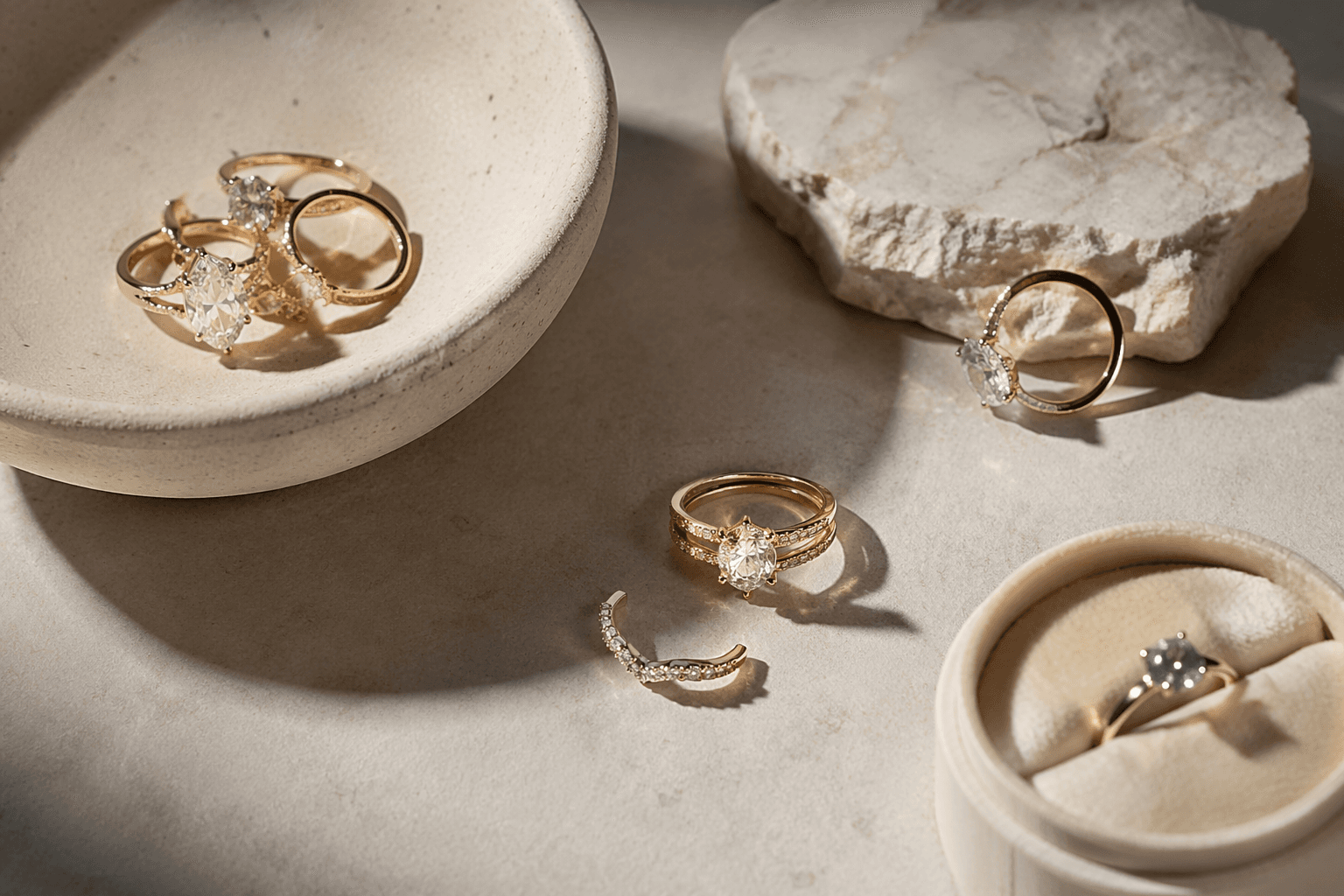
Curves, twists, sculptural shoulders and asymmetrical lines are giving engagement rings a softer, more architectural presence. The wavy ring offers a fresh alternative to conventional bridal styles when the profile does more than hold a center stone. These rings can feel like miniature objets d’art, yet they still need to sit comfortably on the hand and play well with a wedding band.
A new bridal silhouette
The strongest curved designs do not rely on novelty alone. They use organic lines and architectural bends to change the entire posture of the ring, pulling it away from the upright formality of a classic solitaire and toward something more fluid, more wearable, and often more personal. A straight cathedral setting or a round, centered head creates a familiar focal point; a curve, by contrast, redirects the eye across the finger, elongating the hand or softening a sharp stone shape.
That visual movement changes how the ring lives on the finger. A bypass ring that wraps from both sides around the center stone feels more kinetic than static. A twist adds a sense of motion, almost as if the band were caught mid-turn. A wave-like shank can be minimal or dramatic, but in either case it introduces negative space and asymmetry, two of the reasons these rings feel more sculptural than traditional.
How to read the design vocabulary
The best way to spot a strong curved ring is to look beyond the center stone and study the line of the metal itself.
- Curves create a softened outline and often make room for a wedding band to nest neatly beside the engagement ring.
- Twists introduce rotation, which can make a ring feel lively without relying on a large stone.
- Bypass lines sweep around the finger from opposite directions, creating an open-ended silhouette that feels modern and fluid.
- Asymmetry shifts the ring away from center-heavy convention, giving it a more editorial, less expected finish.
- Architectural bends add structure, especially when the ring is built with clean edges or geometric stone placement rather than purely romantic scrollwork.
Natural Diamonds’ July 8 feature centered these elements in the style. In these rings, the line of the ring matters as much as the stone.
Why stackability is part of the appeal
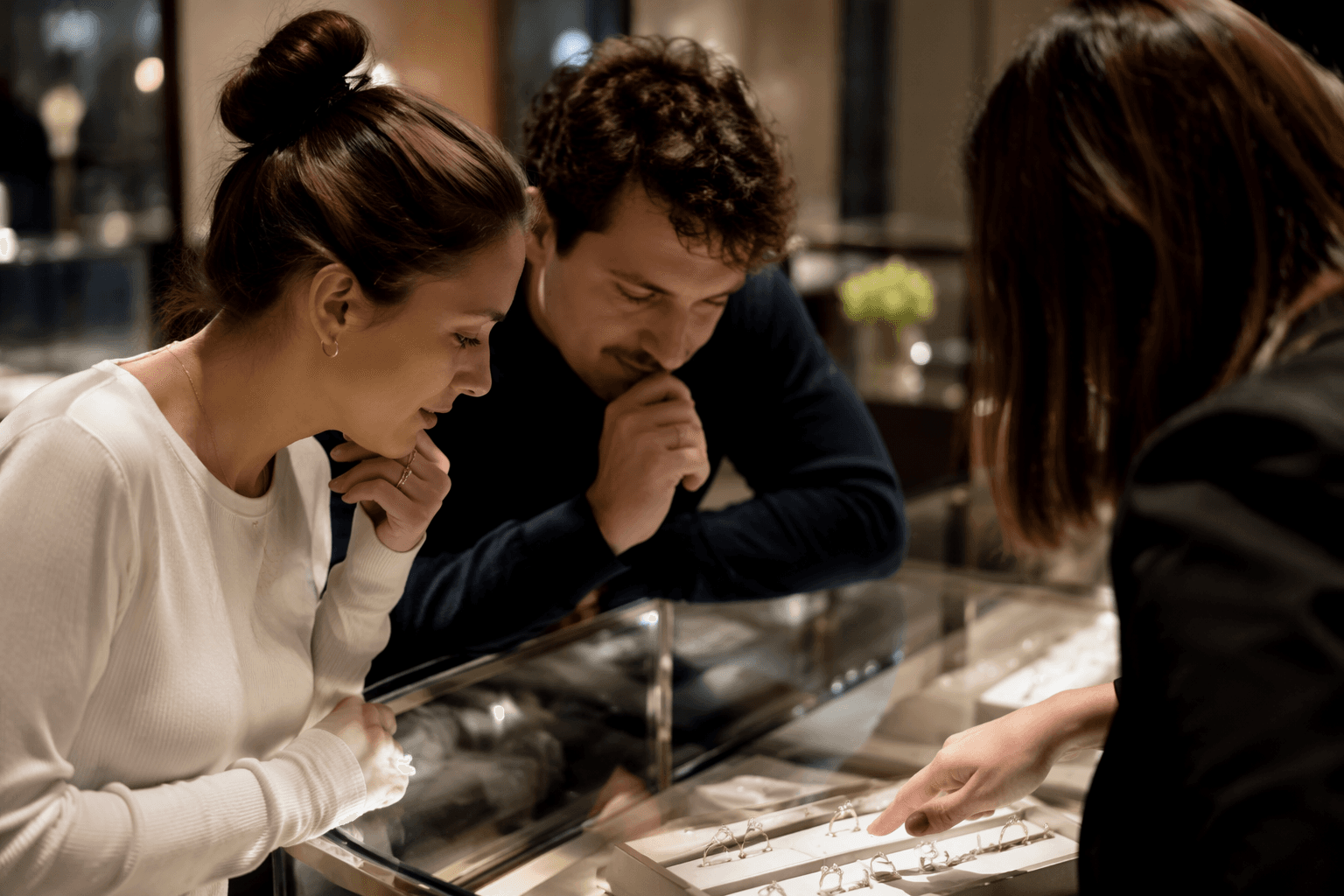
Curved rings are being sold not only as standalone engagement rings but also as stackable bands, and that dual role is one of their sharpest advantages. Blue Nile’s current curved-ring category presents arched and wave-like bands as popular for stacking or pairing with engagement rings. Instead of fighting a straight wedding band, many of these designs invite layering, creating a contour that can cradle another ring or frame a solitaire.
That compatibility is especially useful for buyers who want the engagement ring to do more than mark a proposal. A curved band can sit as a sculptural statement on its own, then evolve into a stack alongside an eternity band, a plain metal band or a second curve echoing the first.
How the style differs from a classic solitaire
A classic solitaire places almost all the visual weight on the center stone, usually with a straightforward shank and a clean, direct read. Curved rings redistribute that weight. The center stone may still be the star, but the band, setting and silhouette become equally important to the ring’s identity.
That shift changes wearability in subtle ways. A ring with a lower profile curve or a bypass setting can sit closer to the hand and feel less top-heavy than a tall prong setting. A half bezel, one of the styles in The Knot’s 2025 engagement-ring roundup, offers a more wrapped, secure look than prongs alone and can reinforce the streamlined mood that many curved rings are chasing. East-west settings and toi-et-moi layouts, also among The Knot’s 2025 trend codes, likewise move the ring away from one fixed formula and toward shapes that feel intentional from every angle.
The broader bridal shift behind the look
The curved-ring moment is part of a wider turn toward personalization. The Knot’s 2025 engagement-ring coverage included maximalist multi-stones, half bezels, east-west settings, vintage cuts, thoughtful toi-et-moi designs, blackened gold, architectural designs and bold color, all of which suggest a market that is rewarding distinctive design over standard issue sparkle. Its 2025 proposal-trends coverage also found couples increasingly using collaborative ring design appointments, a sign that the ring is becoming less of a surprise object and more of a shared design decision.
That collaborative approach helps explain why sculptural rings are gaining traction. A curve or twist is easy to read in a sketch, but it also invites discussion about comfort, band fit and how the piece will stack later. Buyers are asking for rings that reflect a particular taste, not just a price point, and curved silhouettes give designers room to build a recognizable profile without defaulting to a familiar round solitaire.
What the market says about the shift
De Beers Group’s June 2026 Diamond Report puts non-bridal occasions at three-quarters of overall U.S. diamond demand, says average diamond purchase prices have risen 25 percent, and identifies Gen Z as the second-largest generation buying diamonds. The report also says natural diamonds remain the most desired luxury jewelry product, which helps explain why the category is expanding beyond the engagement ring aisle while still anchoring its value in the idea of a meaningful purchase.
Those figures describe a market in which diamond jewelry is no longer defined solely by marriage. Curved rings fit that world because they can look bridal without feeling rigidly bridal. They carry enough design character to justify wearing long after the proposal.
What makes the best versions work
The finest curved rings do not overwhelm the center stone; they frame it. The line should feel resolved, not decorative for its own sake. A good version will balance movement with restraint, using the bend to sharpen the profile or soften the transition between stone and band, rather than simply adding a flourish.
Look for a silhouette that still feels coherent from the side and from above. The most successful pieces have enough structure to read as architectural and enough ease to feel wearable every day.
This article was produced by Prism’s automated news system from verified source data, official records, and press releases, then run through automated quality and moderation checks before publishing. The system is built and supervised by the people who set the standards it runs under. Read our full AI policy.
Did this article answer your question?