Diamond fluorescence, the overlooked factor in engagement ring buying
Fluorescence can quietly lower the price of a diamond, but only if the stone still looks crisp in daylight and the report language stays harmless.
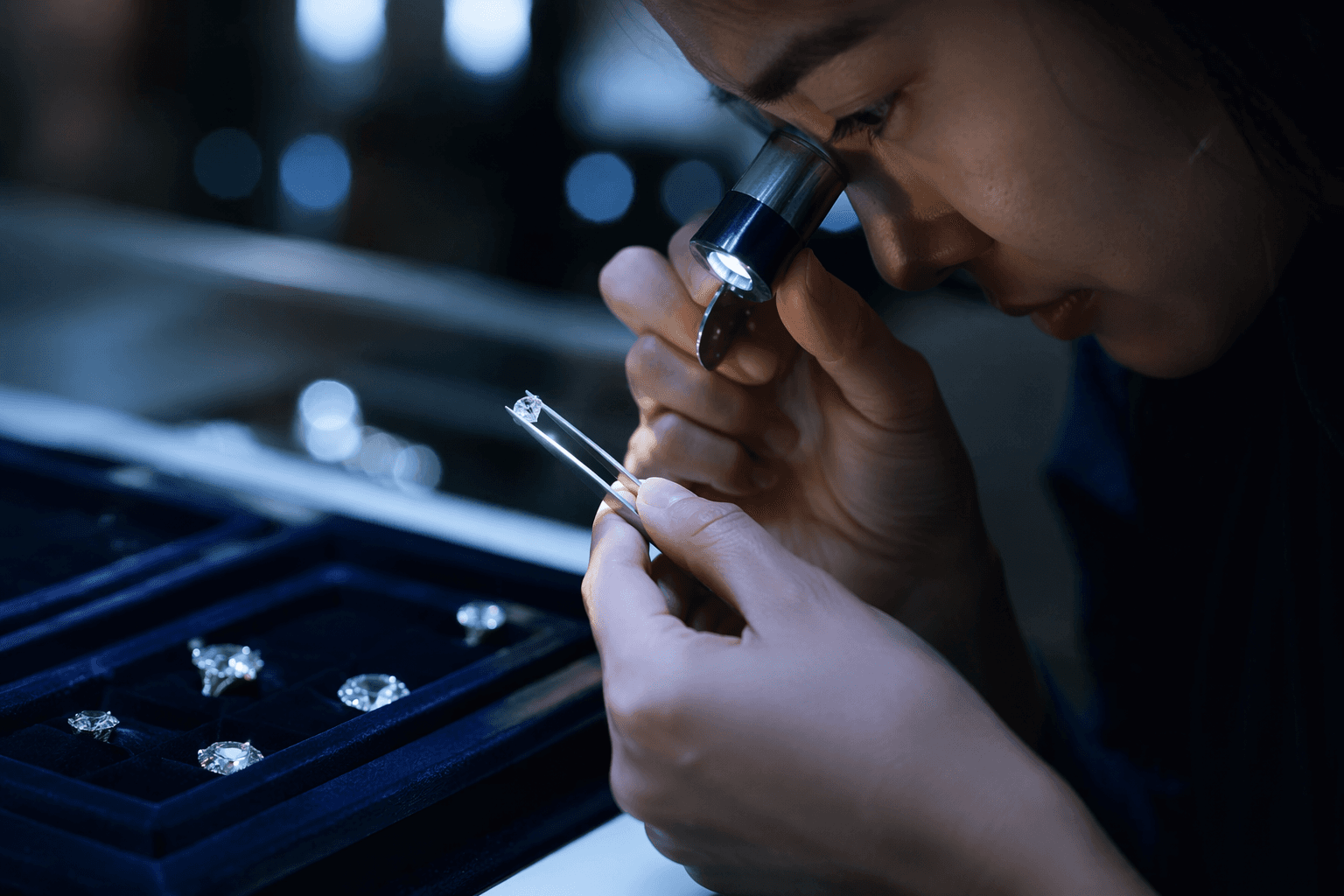
GIA puts the share of diamonds with some fluorescence at about 25% to 35%, and more than 95% of fluorescent diamonds are blue. A diamond with fluorescence can look like a quiet bargain on paper and a better face-up stone in real light, or it can raise a legitimate pause if the glow comes with haze. The trick is to read the report, compare the stone in daylight, and understand when the market is overreacting to a feature that usually does very little.
What fluorescence actually means
Fluorescence is the glow a diamond can emit under long-wave ultraviolet light, and in diamonds it is usually blue.
It is not part of the standard 4Cs; it sits outside the familiar color, clarity, cut, and carat framework, yet it can still affect how a stone looks and how it is priced.
How to read it on a grading report
On a GIA Diamond Grading Report or Diamond Dossier, fluorescence is listed as None, Faint, Medium, Strong, or Very Strong. When fluorescence is Medium or stronger, the report also names the color, giving you a direct line of comparison when you are looking at two otherwise similar diamonds and wondering why one is marked differently from the other.
The important part is not the label alone, but how the label travels with the rest of the stone. For the overwhelming majority of diamonds, fluorescence strength has no widely noticeable effect on appearance, and in many instances observers prefer the appearance of diamonds with medium to strong fluorescence.
When fluorescence can be a smart buy
Fluorescence can become a real value lever. In the trade, diamonds in the D to H color range with bluish fluorescence are often viewed as less desirable, which can create room for a sharper price on an otherwise solid stone. If you are comparing two diamonds that match on cut, color, clarity, and carat, the fluorescent one may be priced more aggressively simply because buyers still carry old assumptions about the glow.
That is the moment to look closely rather than reflexively pass. If the stone still faces up bright and clean in daylight, fluorescence can be a sensible way to stretch the budget without moving down the ladder on the qualities that matter most. The better bargain is not the stone with the most fluorescence, but the stone whose fluorescence does not change the way it looks on the hand.
There is another lane where fluorescence can even work in a buyer’s favor: lower-color stones in the I to N range. Some trade professionals believe bluish fluorescence can make those diamonds appear slightly whiter in UV-rich light, and those stones may command a slightly higher per-carat price than similar diamonds without fluorescence.
When fluorescence should give you pause
The place to slow down is the D to H range, where buyers and sellers often worry about a hazy or oily appearance. GIA found that blue fluorescence has little to no impact on transparency except in extremely rare cases, and fewer than 0.2% of fluorescent diamonds submitted to GIA exhibit the hazy or oily effect sometimes associated with very strong fluorescence. Inspect the specific diamond in the light you will actually wear it in.
If a seller leans on fluorescence as if it were inherently desirable, push past the slogan and into the stone itself. A report cannot tell you whether a diamond looks crisp at the window, under office lighting, or at dinner. If the glow is paired with any softness, cloudiness, or visual heaviness, the stone deserves a second look no matter how flattering the paperwork seems.
How to judge it in real life
The best test is simple: compare stones side by side in daylight and in mixed indoor light. Fluorescence can look different depending on the lighting environment, and the perceived effect depends on the specific stone. A diamond that seems perfectly lively in one light may look less appealing in another.
The report language is also part of the shopping strategy. If you are deciding between two nearly identical stones, a line that reads Medium Blue or Strong Blue is not a warning by itself; it is a prompt to inspect the stone more carefully and ask whether the market is discounting it for a feature you can barely see. That is especially useful when the rest of the diamond, including cut quality, is strong.
Why gem labs still care about it
This topic has been studied for decades. GIA published research on blue fluorescence and diamond appearance in 1997. More recent GIA work by Sally Eaton-Magaña, Yun Luo, David Nelson, Troy Ardon, and Christopher M. Breeding has focused on fluorescence and phosphorescence as analytical tools, including their value in detecting impurities, natural versus synthetic gems, and treatments.
Natural fluorescent diamonds tend to glow brighter under long-wave UV than under short-wave UV, while laboratory-grown diamonds often show the opposite pattern. The De Beers Institute of Diamonds says its DiamondView instrument uses short-wave ultraviolet light to create a surface-fluorescence image that helps distinguish natural diamonds from synthetic ones.
This article was produced by Prism’s automated news system from verified source data, official records, and press releases, then run through automated quality and moderation checks before publishing. The system is built and supervised by the people who set the standards it runs under. Read our full AI policy.
Did this article answer your question?