Elvis’s Priscilla engagement ring hid 20 detachable diamonds and design innovation
Priscilla Presley’s ring was more than a star stone: its 20 detachable baguette diamonds made one of Elvis’s most inventive, transformable jewels.
The hidden engineering inside a famous sparkle
Priscilla Presley’s engagement ring was built to do something clever: make a 3.5-carat center diamond look even larger, brighter, and more architectural through 20 detachable baguette-cut accent diamonds set into an interlocking band. That hidden flexibility is what gives the ring its lasting edge, because it was not just a solitaire with glamour around it, but a transformable design that could shift in appearance depending on how it was worn.
That idea still feels sharp today. Long before modern brides began asking for modular settings and ring stacks that can be reconfigured, Elvis Presley had already chosen a piece that played with scale, movement, and visual drama. The result was a ring that read as opulent from across a room, yet revealed its ingenuity up close.
A Christmas Eve proposal with serious sparkle
Elvis proposed on Christmas Eve in 1966, and Priscilla Presley was 21 when she accepted. The ring reportedly came from Memphis jeweler Harry Levitch, and one account says Elvis’s secretary, Becky Yancey, paid nearly $4,000 for it. In today’s dollars, that figure is often described as roughly $40,000, which feels especially notable once you remember how much construction was packed into the piece.
The center stone was the headline, but the side stones were the plot twist. Those 20 detachable diamonds, described as baguette-cut accents, were set so they could be worn in more than one configuration. That kind of versatility made the ring unusually innovative for the 1960s, when most engagement rings were still conceived as fixed forms rather than adaptable jewels.
Why the design works so well
What makes the ring so memorable is not only the size of the diamond, but the way the setting manipulates perception. The baguette accents act like a frame, extending the visual footprint of the center stone and giving the whole ring a broader, more commanding silhouette. Instead of letting the diamond float in isolation, the design builds a small stage around it.
That is a smart move in jewelry design because it changes how the eye reads proportion. A 3.5-carat stone is already substantial, but the interlocking band and detachable side diamonds create the sense of a larger, more elaborate jewel without relying on one oversized stone alone. It is a lesson in balance: the ring achieves impact through structure, not just carat weight.
There is also a pleasing contradiction at the center of the design. It is both showy and practical, extravagant and modular. The detachable diamonds meant the ring could be reimagined, which is a very modern instinct. Today’s fine jewelry often celebrates pieces that can be styled multiple ways, but Elvis and Priscilla’s ring was already doing that work decades ago.
A love story the ring had to carry
The ring matters because the relationship it marked was one of the most recognizable celebrity romances of the 20th century. Elvis and Priscilla had met in 1959 in West Germany, when she was 14 and he was 24, and by the time of the proposal their story was already loaded with myth, distance, and fascination. The ring had to function as a symbol, but also as a piece of design that could hold up under the glare of that public attention.
Priscilla later wrote in Elvis and Me that the proposal was “the most beautiful and romantic moment of my life.” That sentiment helps explain why the ring endures as more than a prop from a famous courtship. It became part of the visual language of their relationship, a jewel that carries both sentiment and engineering in the same breath.
From engagement ring to matching wedding jewelry
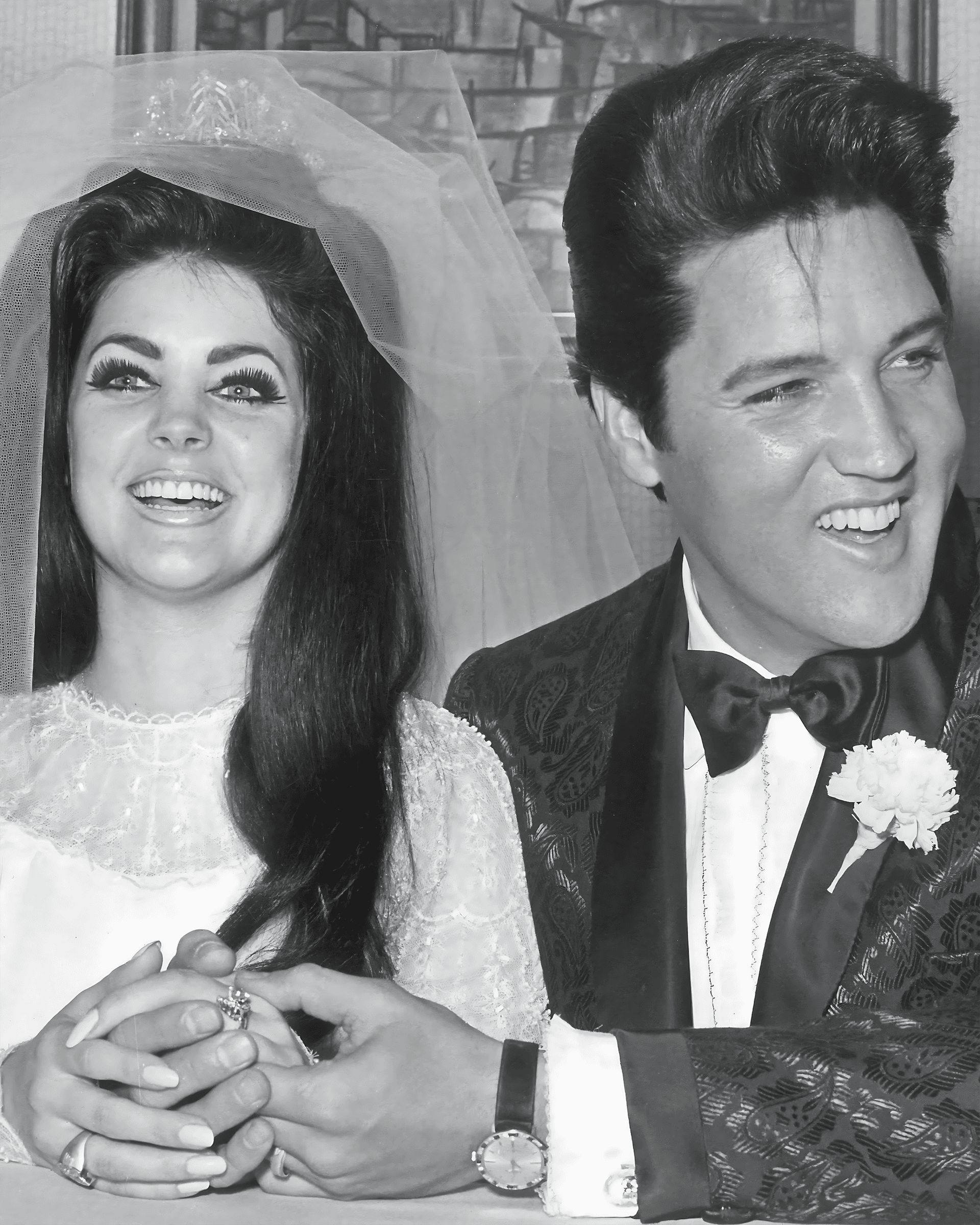
The story did not stop with the proposal. Elvis and Priscilla married on May 1, 1967, at the Aladdin Hotel in Las Vegas, and the couple later wore matching horseshoe-shaped wedding rings. That detail deepens the design story, because it shows how their jewelry was conceived as a set of related objects rather than isolated one-offs.
Seen together, the engagement ring and the wedding rings formed a coherent jewelry narrative. The engagement piece was dramatic and transformable; the wedding bands were matching and symbolic. That pairing gave their jewels a kind of visual continuity, which is one reason they remain so recognizable in photographs and on screen.
Why the ring still feels fresh now
The ring’s modern appeal comes from the same quality that made it special in the first place: it was designed with intention. The 20 detachable baguette-cut diamonds were not decorative clutter. They were part of a larger concept, one that used engineering to heighten beauty. That is still the mark of a strong fine-jewelry design: when the mechanics serve the emotion rather than distracting from it.
Its afterlife in film has only sharpened that reputation. The engagement ring and wedding jewelry were recreated for Baz Luhrmann’s 2022 film Elvis and Sofia Coppola’s 2023 film Priscilla, bringing the piece to a new generation of viewers who may have known the love story but not the design details. Recreated for the screen, the ring’s layered construction once again became part of the conversation.
In the end, Priscilla Presley’s ring remains compelling because it refuses to be only one thing. It is a love token, a celebrity artifact, and a remarkably smart piece of jewelry design. The 3.5-carat center stone may be what first catches the eye, but the 20 detachable diamonds are what make the ring unforgettable.
This article was produced by Prism’s automated news system from verified source data, official records, and press releases, then run through automated quality and moderation checks before publishing. The system is built and supervised by the people who set the standards it runs under. Read our full AI policy.
Did this article answer your question?