Forbes Vetted highlights budget-friendly engagement rings under $5,200
Engagement-ring budgets are sliding, and Forbes Vetted’s guide shows how far below $5,200 shoppers can go, with starts as low as $180 for diamonds and $498 for rings.

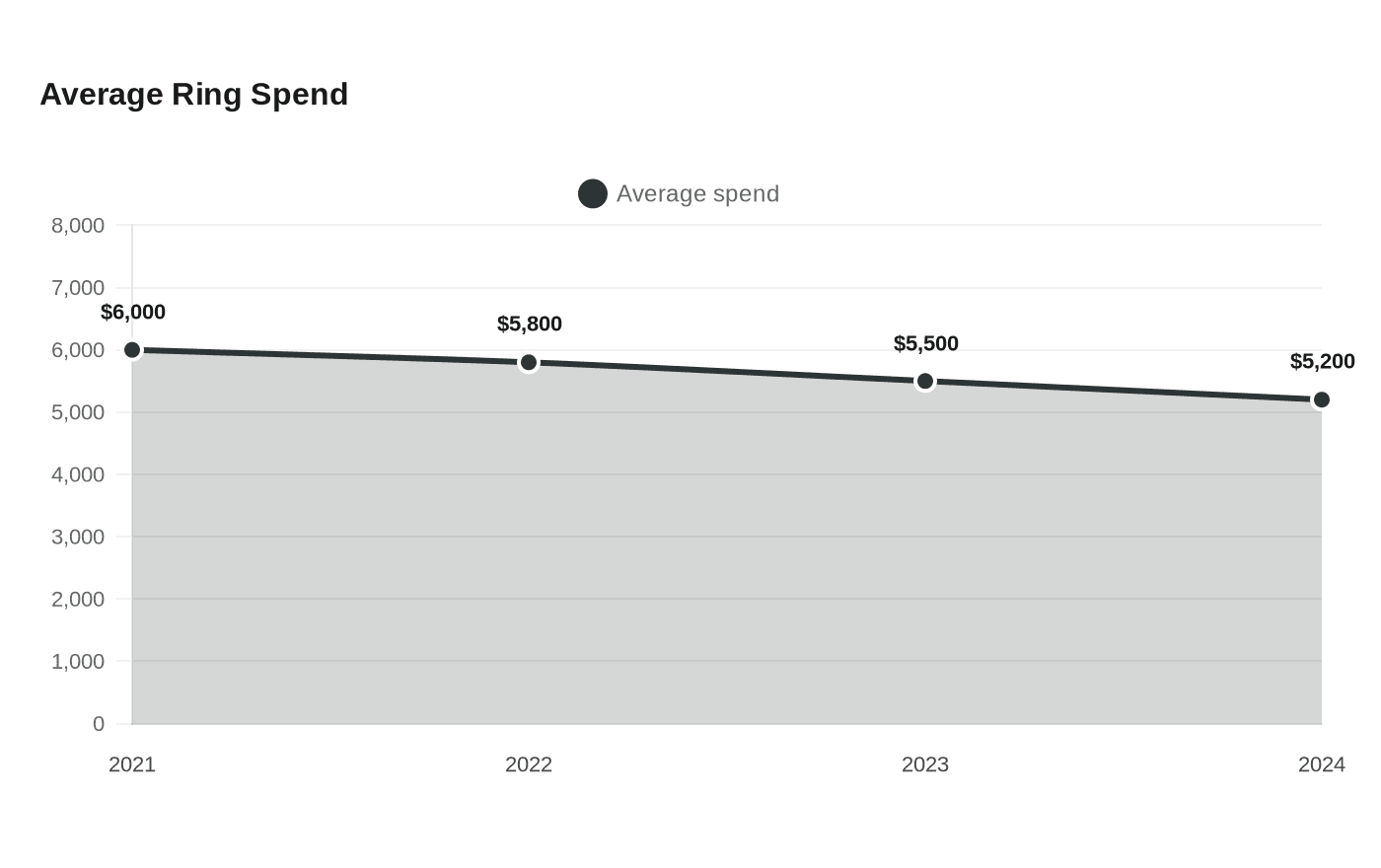
The most revealing number in engagement rings right now is not a carat weight but $5,200. That is The Knot’s average ring spend in its 2024 Jewelry & Engagement Study, yet the same company’s calculator, updated March 23, 2026, puts 2025 spending at $4,600. Forbes Vetted has turned that gap into a shopping story about pressure, not prestige: how to find a ring that still feels substantial while the market keeps nudging prices lower.
The new benchmark for “affordable”
The Knot’s numbers show a steady retreat from the peak of recent years. Average engagement-ring spending fell from $6,000 in 2021 to $5,800 in 2022, then $5,500 in 2023 before landing at $5,200 in the 2024 study. That is not a collapse, but it is a meaningful reset, especially in a category where buyers often assume the social script demands a much bigger outlay.
Forbes Vetted’s affordable-rings guide uses that $5,200 figure as its reference point, but the real message is that shoppers can go far lower without leaving the category behind. Some rings in the guide start well below $1,000, and the entry-level pieces at the low end are no longer niche exceptions. They are part of the mainstream online engagement-ring market, where price, customization and delivery speed now compete directly with traditional notions of prestige.

Blue Nile, Quince and Brilliant Earth set the tone
Blue Nile sits at the center of that reset because it combines service language with aggressive pricing. Its site offers free shipping, free returns and free ring sizers, while its Wedding Event advertises up to 30% off everything needed for the wedding day. That mix matters because it signals how online jewelers are trying to reduce friction at the exact moment shoppers are comparing settings, stones and timelines.
Quince pushes the affordability story even further. Its current entry-level engagement rings start at $498, and the guide notes lab-grown and natural diamond rings starting at that price point. That is a striking reminder that the lower end of the market has moved from “starter” territory into a genuinely competitive segment, especially for shoppers who want the look of a polished engagement ring without the traditional markup.
Brilliant Earth shows a different version of value. Its settings start at $750 and its diamonds start at $180, which separates the ring into modular pieces and makes the entry point look lower than a fully finished ring would. That structure can be useful for buyers who want to build gradually, but it also demands attention: the headline number is only the beginning, and final spend still depends on metal, center stone size and the level of finish a shopper chooses.

The comparison shopping crowd is now the story
Forbes Vetted also points to Ritani, Etsy, Nordstrom, Zales, With Clarity, Friendly Diamonds and Rare Carat as places shoppers can compare price, customization and delivery speed. That lineup is telling. It includes heritage jewelry names, marketplace-style options and retailers built around lab-grown and online comparison models, which means the market is no longer organized around a single idea of what an engagement ring retailer should be.
The presence of so many different channels also shows how buyers are shopping now. Some want custom work, others want ready-to-ship convenience, and many are trying to hold those two priorities together. In that environment, retailers are being judged less by romance than by how clearly they explain what is included, how quickly they can deliver it and how much room they give shoppers to personalize without blowing past budget.
What the price reset signals
This is not just a story about cheaper rings. It is a story about price pressure spreading across the engagement-ring market, with online retailers responding by making their starting prices visible and their promotions harder to miss. Blue Nile’s sale messaging, Quince’s sub-$500 entry point and Brilliant Earth’s low starting prices all reflect the same reality: consumers are more sensitive to cost, and brands have to prove value at the top of the funnel instead of assuming it.
The Knot’s differing averages, $5,200 in one measure and $4,600 in another, reinforce that the benchmark itself is moving. For shoppers, that means the old sense of a fixed “right” spend is fading. For the industry, it means the most persuasive rings are the ones that can look polished, feel substantial and still leave room beneath the average for the buyer to breathe.
This article was produced by Prism’s automated news system from verified source data, official records, and press releases, then run through automated quality and moderation checks before publishing. The system is built and supervised by the people who set the standards it runs under. Read our full AI policy.
Did this article answer your question?