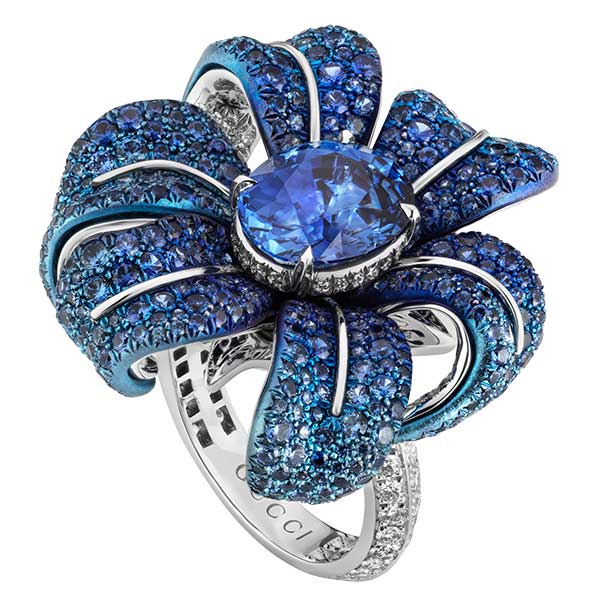
Hidden halos add subtle sparkle to engagement rings
Hidden halos give a solitaire the secret lift of a halo, adding sparkle from the side and in close-up without changing the ring’s clean top view.

Hidden halos are the kind of detail that only reveals itself once the ring moves. From above, the silhouette stays calm and classic, but a circle of pavé diamonds tucked beneath the center stone throws off a flash of light from the side, in proposal photos, and any time the ring catches. That is the appeal: a quiet upgrade that delivers more brilliance without turning the design into a full halo.
The quiet architecture of a hidden halo
A hidden halo is a modern take on the traditional halo setting. Instead of surrounding the center stone with a visible ring of diamonds at the top perimeter, the smaller pavé stones sit beneath it, where they are mostly seen in profile or at close range. The effect is subtle but deliberate, and it keeps the ring closer to the clean read of a solitaire while adding a layer of sparkle that feels more private than performative.
That privacy is part of why the style resonates now. Natural Diamonds describes hidden details such as concealed halos, engraving, and secret gemstones as a way to add intimacy to engagement-ring design, and that is exactly how this setting behaves. It gives the wearer a small design secret, something that is felt as much as seen.
Why hidden halos feel like a smart upgrade
The hidden halo earns its place when the goal is contrast rather than reinvention. A solitaire stays pared back, but a hidden halo adds a second register of light underneath the center stone, so the ring has more fire without losing its essential shape. For buyers who love classic lines but want one thoughtful twist, that is often the sweet spot.
The payoff is especially strong in side views. A hidden halo can make the ring look more intricate from the profile, which matters in candid photographs and close-up shots, even if the top-down view remains restrained. It is a clever use of ornament: the extra sparkle is there, but it does not crowd the face of the ring.
Hidden halo vs. solitaire vs. traditional halo
The difference between these three settings comes down to visibility and visual weight. A solitaire is the most distilled option, with the center stone standing alone on the band. A traditional halo, by contrast, frames the center stone with a visible circle of smaller diamonds at the top, which enlarges the look and pushes the design into a more decorated, more obviously sparkling category.
A hidden halo sits between those poles. It keeps the top view cleaner than a traditional halo, but it is more dimensional than a solitaire, and that middle ground is what gives it such broad appeal. The Knot says hidden halos can work with many stone shapes and offer a more discreet version of the halo look, which makes them adaptable for buyers who want sparkle without losing the ring’s original character.
Why the style is gaining ground
The numbers suggest that this is not a niche flourish anymore. In The Knot’s 2024 Jewelry and Engagement Study, hidden halos appeared on 18% of engagement rings, while classic halo settings accounted for 13%. That gap says something important about where taste is heading: shoppers are still drawn to brilliance, but they increasingly want it delivered with a softer hand.
Shelley Brown, who brings more than 15 years of editorial experience and formerly served as senior fashion editor at The Knot, is one of the experts cited in Natural Diamonds coverage of engagement-ring trends. Her presence in that conversation reflects the broader shift toward rings with hidden character, where the appeal lies not only in the headline stone but in the small architectural surprise underneath it.
A setting with real history behind it
Although the hidden halo reads as contemporary, halo settings themselves have a long lineage. Brilliant Earth traces them to the early Georgian era, from 1714 to 1837, and notes that they surged in popularity during the Victorian era, from 1837 to 1901. The hidden halo is simply the modern editing of that older idea, stripping away the overt frame and moving the sparkle to a more discreet plane.
That history matters because it shows the setting is not chasing novelty for its own sake. Instead, it refines a familiar structure for a buyer who wants the romance of a halo but the restraint of a solitaire. In that sense, the hidden halo is less a trend break than a tuning of an established language.

Where the extra cost actually changes the ring
A hidden halo makes sense when you care about three things: side-profile detail, a little more brightness, and a top view that still reads as classic. If the ring will be photographed from the side often, or if you want a design that reveals itself slowly, the added pavé can feel worth it. If you want the center stone to remain the only star from every angle, the extra metalwork may matter less.
That is also where it helps to compare hidden halos with traditional halos before spending more. A traditional halo changes the ring’s outline immediately and can make the center stone look larger from above. A hidden halo gives less of that visual enlargement, but it can create a more refined finish, especially for buyers who prefer understatement to spectacle.
What retailers are calling it now
The market has also developed a vocabulary around the idea. Brilliant Earth currently offers hidden halo, hidden accent, and secret halo styles, while James Allen sells hidden halo side-stone and pavé hidden halo designs. Those variations show how far the concept has moved beyond a single template: some versions are more architectural, others lean harder into sparkle, but all keep the top view relatively restrained.
That range is useful because hidden halos do not have to read the same way on every ring. On one design, they act like a faint shimmer under the center stone. On another, they become a more visible ring of brightness in profile, especially when paired with side stones or a pavé band.
The best hidden halos understand proportion. They do not compete with the center stone, and they do not flatten the ring into a generic halo imitation. They simply add a private flash of light in exactly the places a classic ring does not usually look, which is why the setting feels so compelling now.
This article was produced by Prism’s automated news system from verified source data, official records, and press releases, then run through automated quality and moderation checks before publishing. The system is built and supervised by the people who set the standards it runs under. Read our full AI policy.
Did this article answer your question?