How to care for your engagement ring and keep it sparkling
A ring stays brightest when care is routine, not reactive: wash it gently, watch for loose prongs, and make annual jeweler checks non-negotiable.
Lotion, soap film, impact, and tiny knocks can soften a stone’s fire long before the metal shows its age. An engagement ring is meant to live on the hand, which is exactly why it needs more than the occasional polish. The smartest care routine is simple: clean lightly at home, inspect the setting on a schedule, and treat a jeweler visit as part of ownership, not an emergency.
Why a ring loses its sparkle
A diamond may be hard, but hardness is only one part of durability. Durability rests on hardness, toughness, and stability, which is why a ring can still suffer from impact, repeated friction, chemicals, and ordinary wear even when the stone itself is strong. Most engagement rings fail quietly, not dramatically. A prong loosens, a mounting wears thin, or grime settles into the setting until the stone looks dimmer and the metal starts to look tired.
Dirt and grime accumulate on jewelry. Left alone, that buildup can cultivate bacteria, irritate skin, worsen allergies, and contribute to scratches and metal degradation. A ring that looks cloudy may also be the ring that needs attention.
The weekly reset that preserves the shine
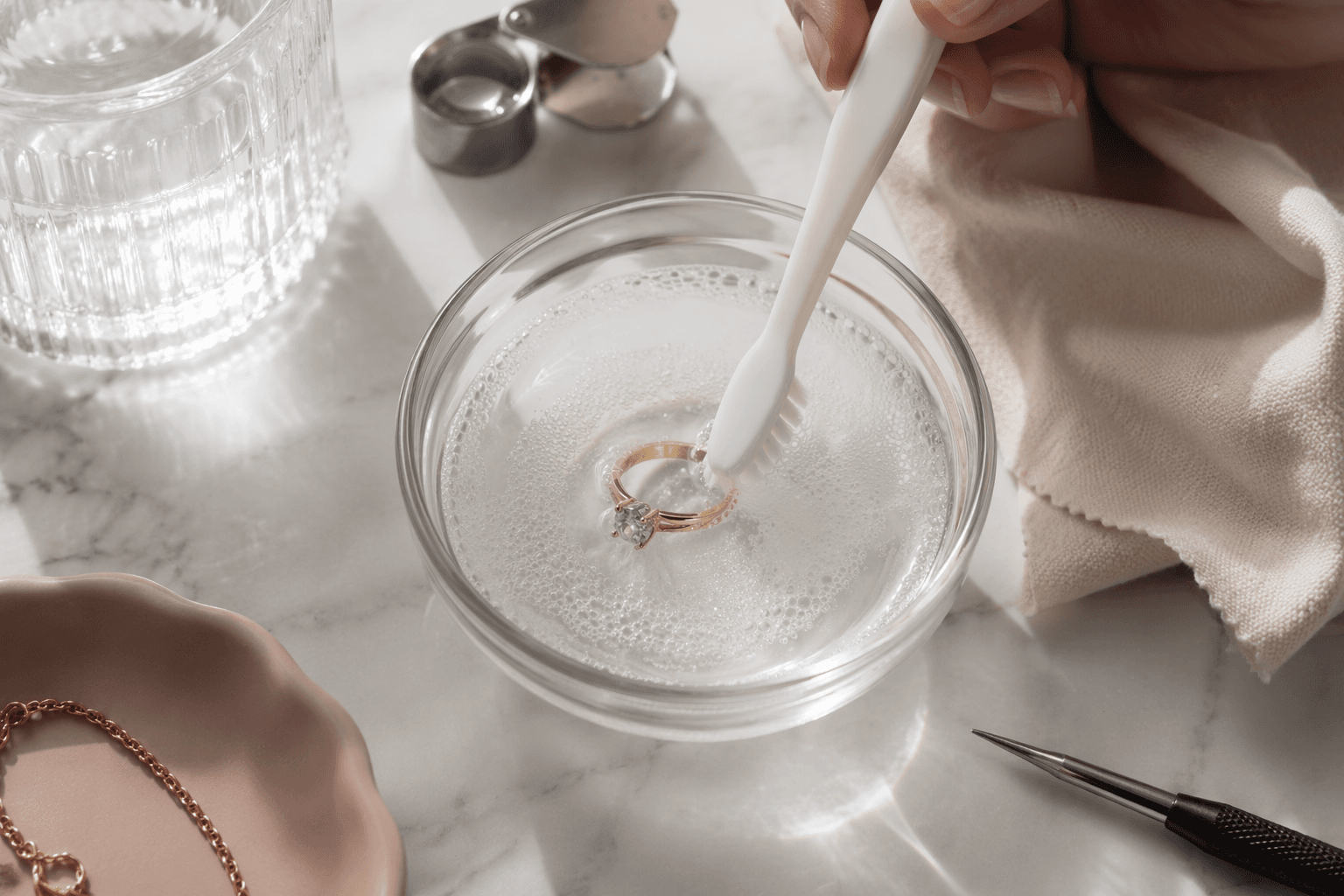
At home, the safest cleaning method is also the least glamorous. Warm water, mild dish soap, and a soft-bristle toothbrush lift lotion residue, body oils, and everyday film without the abrasives that can cloud a polished surface or roughen delicate edges.
A good weekly routine is concise:
- Mix a small bowl of warm water with a drop of mild dish soap.
- Let the ring soak briefly, then brush gently around the stone, under the crown, and along the underside of the setting.
- Rinse it carefully and dry it with a lint-free cloth.
- Clean over a closed sink or in a bowl, not over an open drain.
The American Gem Society warns against cleaning over an open drain, because a slippery ring and a fast-moving faucet can turn a five-minute wash into a permanent loss. Toothpaste is also off-limits. Its abrasives can scratch stones and bands, and a polished ring should never be treated like a sink fixture.
The small habits that do the most damage
Most ring damage happens in the mundane moments between cleanings. Sleeping in a ring can bend prongs against sheets and pillow seams, while gym sessions invite impact from weights, grips, and repeated pressure. Jewelers of America advises removing fine jewelry before activities that expose it to stress, and specifically flags gloves, swimming, snorkeling, and other sports as risk points.
Lotion and hand cream are another quiet culprit. They do not usually harm the stone, but they can leave a film that settles into pavé, halos, and the undersides of settings, where small stones and metal beads trap residue. If a ring has pavé, those tiny stones demand particular respect because they are held by many minute contact points rather than a single stout mount.
Travel deserves the same caution. A ring is safest in a dedicated pouch or case, not tossed into a toiletries bag or left on a hotel vanity. The mistake is rarely dramatic. It is the stone that loosens during packing, the band that gets scuffed against metal zippers, or the ring that slips off while your hands are cold and dry in transit.
What to watch for once a month
A monthly check takes only a minute, but it catches the problems that home cleaning cannot. Look closely at the prongs first. They should appear even, secure, and free of obvious bending. If a prong catches on fabric, feels sharp to the touch, or appears lower than the others, the setting needs attention.
Then study the mountings and any pavé or side stones. A secure stone should sit firmly, not shift when tapped lightly. Worn mountings often show themselves in the faintest ways: a stone that seems less centered, a setting that looks slightly thinned, or a tiny gap where metal once hugged the stone more tightly.
Why annual service is not optional
Jewelers of America recommends having fine jewelry checked by a jeweler at least once a year for loose prongs, worn mountings, and general wear and tear. A jeweler can tighten hardware, inspect the underside of the mount, and professional-clean pieces that home washing cannot fully restore.
Jewelers of America cites Jewelers Mutual Group claims data showing that more than half of jewelry insurance claims are partial losses, and one of the most common is losing a stone from a ring. A loose stone can disappear long before a wearer notices anything is wrong.
The rules that matter most around water and chemicals
Chlorine and salt water are hard on fine jewelry. Jewelers of America advises removing fine jewelry before hot tubs or swimming pools. Chemicals can be unkind to metal finishes, and water pressure, temperature changes, and movement in the pool all add unnecessary stress to a setting that should be protected, not tested.
If a ring has a particularly delicate setting, the caution should be even stricter. Prongs, pavé rows, and slender bands are designed for elegance, but elegance comes with exposure. The more open the setting, the more important it is to keep the ring out of environments where it can be knocked, snagged, or chemically stressed.
This article was produced by Prism’s automated news system from verified source data, official records, and press releases, then run through automated quality and moderation checks before publishing. The system is built and supervised by the people who set the standards it runs under. Read our full AI policy.
Did this article answer your question?