Marquise engagement rings, symmetry, security, and the ratio that defines style
Marquise rings deliver the most visual drama per carat, but only when the ratio, symmetry, and prong protection are right. Its pointed silhouette is all about precision.
Why marquise still reads as modern drama
The marquise is the cut that lengthens the hand before it ever reaches for sparkle. Its long, tapered silhouette gives a ring an immediate sense of motion, which is exactly why it stands apart from the safer default of oval. GIA traces the name to 1745, when the shape was linked to the Marquise de Pompadour, Jeanne-Antoinette Poisson, the influential mistress of Louis XV and a noted patron of the arts, and that courtly origin still gives the cut a whiff of aristocratic polish.
The marquise has also lived a full fashion cycle. GIA notes that it was especially popular in bridal jewelry in the 1970s, then slipped out of favor as princess-cut diamonds rose by the beginning of the 21st century. Today, the shape is coming back with a more design-savvy audience, one that values outline as much as glitter. GIA’s 2024 research on oval, pear, and marquise shapes reinforces that face-up appearance and outline appeal are central to how fancy shapes are judged, not secondary details.
The ratio that defines the look
With marquise, ratio is not a technical footnote, it is the silhouette itself. The length-to-width ratio determines whether the stone reads as sleek and lean, softly broad, or somewhere in between, and that change is visible the moment the ring lands on the hand. The Knot says experts generally agree that a 1.85 to 2.00 ratio looks best for marquise diamonds, while width still comes down to personal taste.
That range is useful because it gives the stone enough length to create elegance without making it look unnaturally narrow. A lower ratio in that band tends to feel fuller and more substantial, while a higher one stretches the eye further down the finger. If you want maximum visual drama without defaulting to oval, this is the number that decides whether the marquise feels tailored or merely long.
What perfect symmetry really looks like
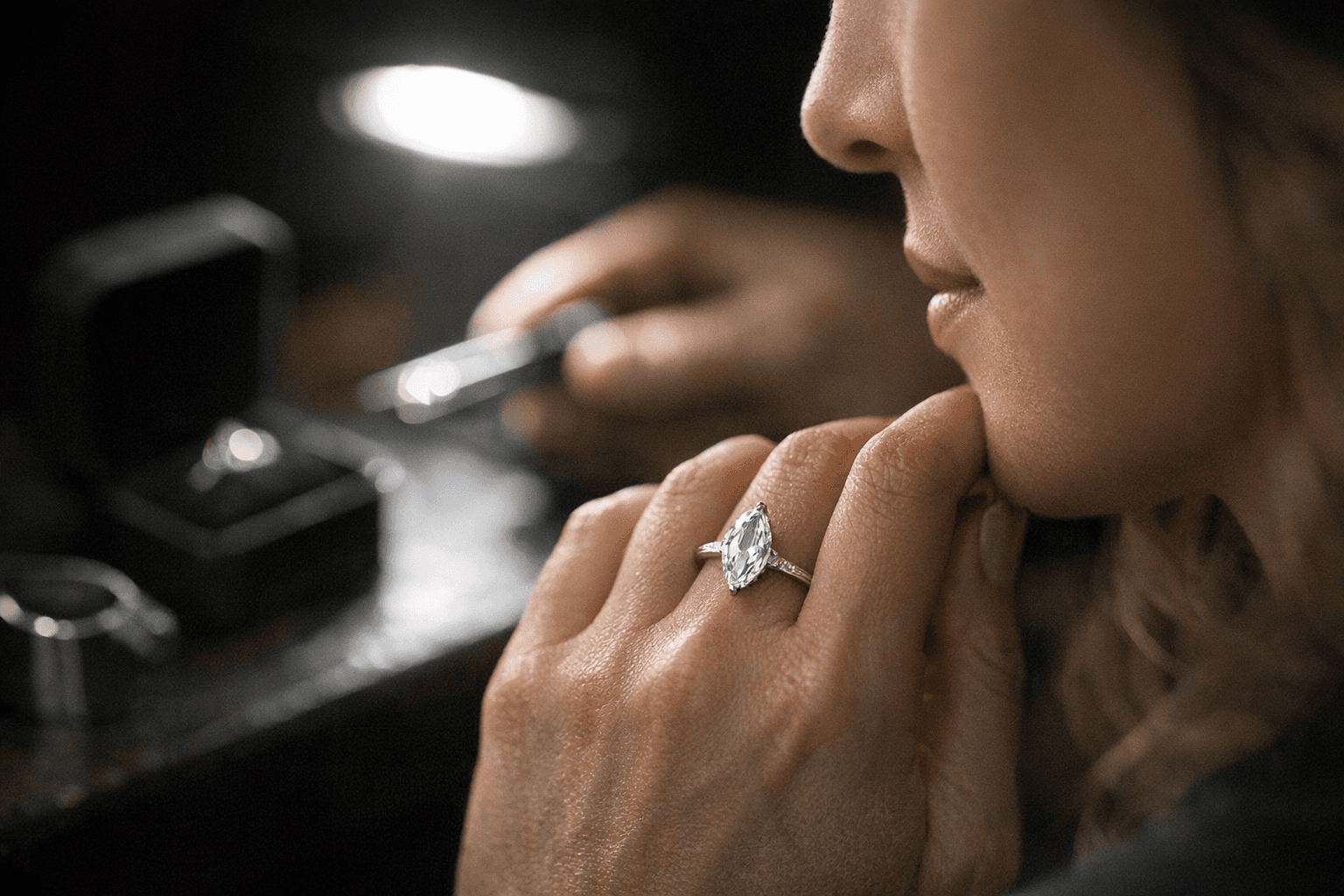
A beautiful marquise should look balanced from the first glance, with both pointed ends aligned on a single axis and the curves mirroring each other from side to side. The center should feel composed, not pinched, and neither end should appear heavier than the other. That symmetry matters because the shape’s power comes from tension between the points and the body of the stone.
When the outline is off, even slightly, the eye notices. A lopsided belly, uneven shoulders, or tips that do not meet the same visual level can make the stone feel less elegant and less finished. In a cut this linear, symmetry is not just a grading detail, it is what preserves the crisp, elongated look that makes marquise so compelling in the first place.
Why size appears to stretch on the hand
The marquise has one of the most persuasive visual tricks in diamond buying: it often looks larger face-up than a round diamond of the same carat weight. The International Gem Society says marquise diamonds can appear about 15% larger than an equivalent-carat round stone, which is a serious advantage if you care about presence per carat. That illusion also helps explain why the cut is so effective as a finger-lengthening shape.
This is where marquise outshines many other styles for readers who want drama with restraint. The outline draws the eye outward and upward, so the finger looks longer and more slender without requiring a bigger stone. The result is not just size, but shape-led impact, a ring that looks deliberate from across the room and even more composed up close.
Security is non-negotiable at the pointed ends
For all its elegance, marquise is not a carefree shape. The two pointed ends are vulnerable, which is why the setting matters as much as the diamond itself. The International Gem Society warns that those tips can snag or chip if they are not properly secured and covered, and The Knot recommends six prongs for a prong setting to protect them.
That advice is especially important because the setting changes both the safety and the aesthetic. A bezel wraps metal around the edge and offers maximum protection, but it also softens the silhouette and can mute the airy, elongated feeling that makes marquise distinct. A prong setting leaves more of the stone visible and preserves the shape’s sharp outline, but only if the prongs are placed with discipline, especially at the points. For this cut, prongs are not decorative extras, they are part of the architecture.
Why marquise is reappearing now
The shape’s renewed energy makes sense in a market that has grown more receptive to fancy cuts. National Jeweler has reported that fancy-shaped diamonds have been increasing in popularity in recent years, and marquise keeps appearing in contemporary bridal designs and trend forecasts. That shift is not only aesthetic, it is evaluative: a more educated buyer now cares about outline, spread, and how a stone performs in the hand, not just its certificate line.
There is also a practical reason marquise has regained attention. In December 2024, GCAL by Sarine expanded its 8X Ultimate Diamond Cut Grade to include marquise diamonds, a sign that the trade is treating the shape with more precision and seriousness. When a grading system gives marquise deeper scrutiny, it signals that buyers are no longer choosing it as an eccentric alternative. They are choosing it because it delivers a specific visual language that no round or oval can quite replicate.
The final measure
If oval is the quiet classic, marquise is the one that knows how to pose. Its history gives it old-world cachet, its ratio determines its style, and its pointed ends demand real craftsmanship. When those elements are handled well, the cut does what the best engagement rings should do: it flatters the hand, commands attention, and turns proportion into presence.
This article was produced by Prism’s automated news system from verified source data, official records, and press releases, then run through automated quality and moderation checks before publishing. The system is built and supervised by the people who set the standards it runs under. Read our full AI policy.
Did this article answer your question?