Meghan Markle's ring stack puts her engagement ring in focus
Meghan Markle’s ring stack is less a scandal than a design lesson: move the bands, and the same stones tell a different marriage story.

The controversy is really about hierarchy
Meghan Markle’s ring stack has become one of those rare jewelry stories that is not really about carats at all. The debate is about placement, which ring sits at the center, which band gets visual breathing room, and which one carries the most authority when the hand is in motion. That is why the conversation keeps returning to her engagement ring: in a stack, prominence is a message.
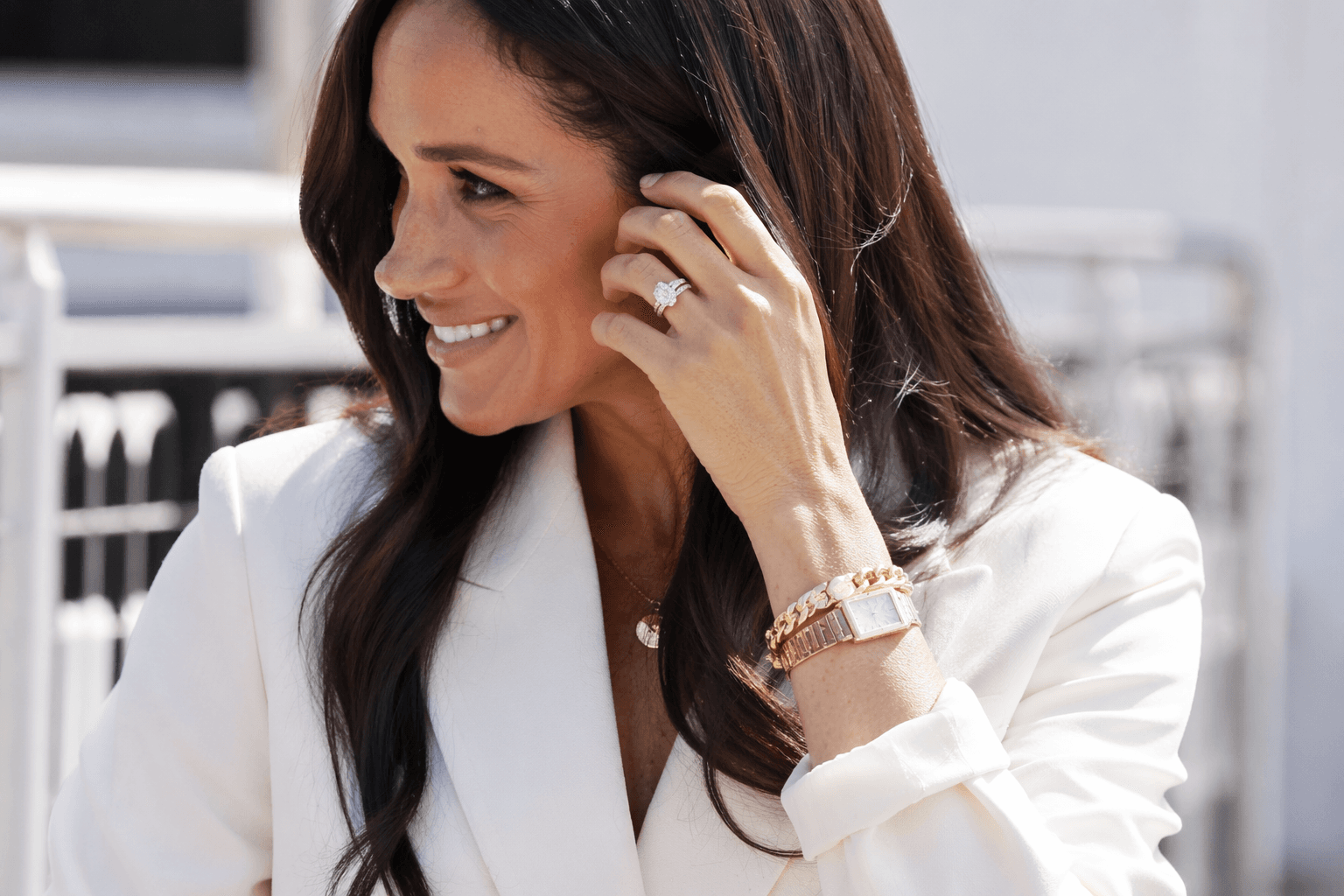
Her choice has made the set feel less like a fixed bridal formula and more like a living arrangement. The engagement ring, wedding band, and eternity band do not simply sit together; they negotiate with one another. Change the order, the spacing, or the ring that reads first, and you change the story the hand tells.
A wedding that turned the hand into a public symbol
The public intensity around the rings began before the first band ever entered the stack. Prince Harry and Meghan Markle’s engagement was announced on November 27, 2017, and their wedding followed on May 19, 2018 at St George’s Chapel, Windsor Castle. The royal family says 2,640 people were invited to watch from inside the castle grounds, including more than 1,200 nominated by Lord Lieutenants, a scale that made every visual detail of the day feel consequential.
That context matters because Meghan’s jewelry was never private in the usual sense. From the moment the engagement became official, her rings were being read not only as ornaments but as symbols of a closely watched modern royal marriage. The wedding ring itself was made from Welsh gold, which gave the set a distinctly traditional foundation even as her later styling choices pushed the look in a more personal direction.
The original ring carried family symbolism before stacking ever did
Meghan’s engagement ring began as a three-stone design, with diamonds chosen for their family symbolism. That kind of architecture already carries narrative weight: a center stone framed by two companions suggests balance, continuity, and the idea that a relationship is held together by more than one chapter of life. Before any additional band entered the picture, the ring already said something about memory and meaning.
Once the wedding band and later the eternity band were introduced, the symbolism became layered rather than static. Each new ring did not replace the original meaning, but it altered the way the eye moved across the hand. In fine jewelry, that is no small thing. The same stones can read as ceremonial, intimate, or fashion-forward depending on how they are grouped.
How Meghan’s stack evolved
In 2019, Meghan first publicly showed an eternity band at Trooping the Colour on June 8, 2019. Us Weekly reported that Prince Harry worked with Lorraine Schwartz to create the piece as an anniversary-and-family gift, and that the underside carried birthstones for Meghan, Harry, and Archie. That detail is especially revealing because it turns the band into something more private than its glittering surface suggests.
The same report said Harry had Meghan’s engagement ring resized and reset with a new delicate diamond band. That modification is the sort of change jewelry lovers notice immediately, because it changes the proportion of the whole set. A ring that once stood alone becomes part of a trio, and the original center stone no longer dominates in quite the same way.
The result is a stack that feels deliberately edited rather than simply accumulated. The Welsh gold wedding ring keeps the marriage reference intact, the eternity band adds a second layer of sentiment, and the engagement ring remains the anchor. Yet the balance among those three pieces can shift from appearance to appearance, which is exactly why the look keeps inviting scrutiny.
Why order and spacing change the message
Stacking is never neutral. When the engagement ring is visually centered and the bands sit tightly against it, the set reads as a unified bridal statement, almost architectural in its discipline. When the bands are spaced apart or one ring carries more visual weight, the set becomes looser, more modern, and more personal. The eye begins to read movement rather than symmetry.
That is the heart of the Meghan conversation. A ring stack can suggest reverence for tradition, but it can also suggest a woman curating her own symbolism in real time. The same three rings can feel formal one day and fashion-led the next, depending on which band takes precedence.
For a jewelry editor, that is precisely why the stack is interesting. It shows how a wedding set can move beyond the old assumption that the engagement ring must always be the star. In Meghan’s case, the wedding band and eternity band are not supporting actors so much as co-authors.
Why the fascination endures
Royal style commentary has kept returning to Meghan’s hand because the rings reflect the broader shift in how marriage is worn. Tatler described a “much-altered engagement ring stack” in behind-the-scenes content from With Love, Meghan season two in September 2025, confirming that the conversation has not faded. The continued attention is not just gossip; it is a sign that her jewelry still functions as a visual shorthand for how contemporary couples think about commitment.
That is what makes this stack so legible. It preserves the formality of the original engagement ring, honors the wedding band made from Welsh gold, and folds in the sentimental vocabulary of the eternity ring with its hidden birthstones. But it also refuses to stay frozen in one ceremonial arrangement.
Meghan’s ring stack ultimately says that bridal jewelry no longer has to behave like a fixed emblem. It can be edited, rebalanced, and restaged, and each adjustment changes the tone of the whole. In that sense, the controversy is not about whether the rings are being worn correctly. It is about the fact that modern marriage, like modern style, is increasingly expressed through nuance, and nowhere is that nuance more visible than at the hand.
This article was produced by Prism’s automated news system from verified source data, official records, and press releases, then run through automated quality and moderation checks before publishing. The system is built and supervised by the people who set the standards it runs under. Read our full AI policy.
Did this article answer your question?