New Zealand Detectorist Recovers Lost Diamond Engagement Ring From Creek
Kaela Ivory-Taranaki thought her diamond ring was gone forever after it sank in a Waikato creek. Then Garth Walton showed up with a snorkel.
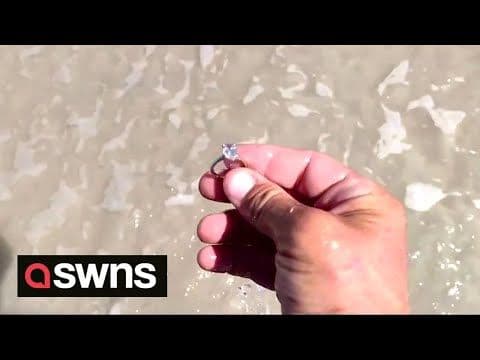
Kaela Ivory-Taranaki had given up. Her diamond engagement ring had sunk into a cold Waikato creek, buried by shifting sand, and she was convinced it was gone. "I honestly didn't think that it would be returned," she said. "Like I thought, it was gone forever."
Then Garth Walton grabbed a snorkel.
Walton, who bought his first metal detector in 2018 after falling into a YouTube rabbit hole of hobbyist finds, heard about Ivory-Taranaki's ring going missing at a swimming hole along the Kaniwhaniwha Track. He spoke to the couple, got rough whereabouts, and waded in. Kaniwhaniwha Reserve sits inside Pirongia Forest Park roughly 30 kilometres west of Hamilton via Limeworks Loop Road, a popular cold-water destination with pools dropping to around two metres. Walton, who usually detects at night to avoid crowds, found himself working the creek bed in front of a packed public swimming area. "I don't usually like to detect in front of lots of people," he said, "but I tend to go out at night and detect so that I'm not getting in anybody's face or anything."
He had never done an underwater search before and came without proper gear. "I've actually never underwater detected before, so I didn't have the gear. I just had some goggles and snorkel and my detector can detect underwater." For about an hour he worked the sandy creek bottom, struggling to hear the machine while submerged, surfacing with nothing but a few laundry tokens. At one point the water was around seven feet over his head. When the cold finally won, he turned for the bank, then doubled back for one last pass, and the detector locked on. The ring was buried in the sand exactly where Ivory-Taranaki had dropped it.
"I just still can't believe it," she said.
What the Kaniwhaniwha creek demonstrated is how quickly cold water takes an engagement ring. Fingers shrink in the cold, sometimes by a full ring size, and a solitaire with a prong-set stone, or a halo setting with its raised centre, catches on towels and swimsuit straps in ways a flat band never does. The taller the setting, the more leverage there is to torque a ring off a cold-narrowed finger. The safest practice: leave the engagement ring on shore and swim with a plain, fitted band or nothing at all.
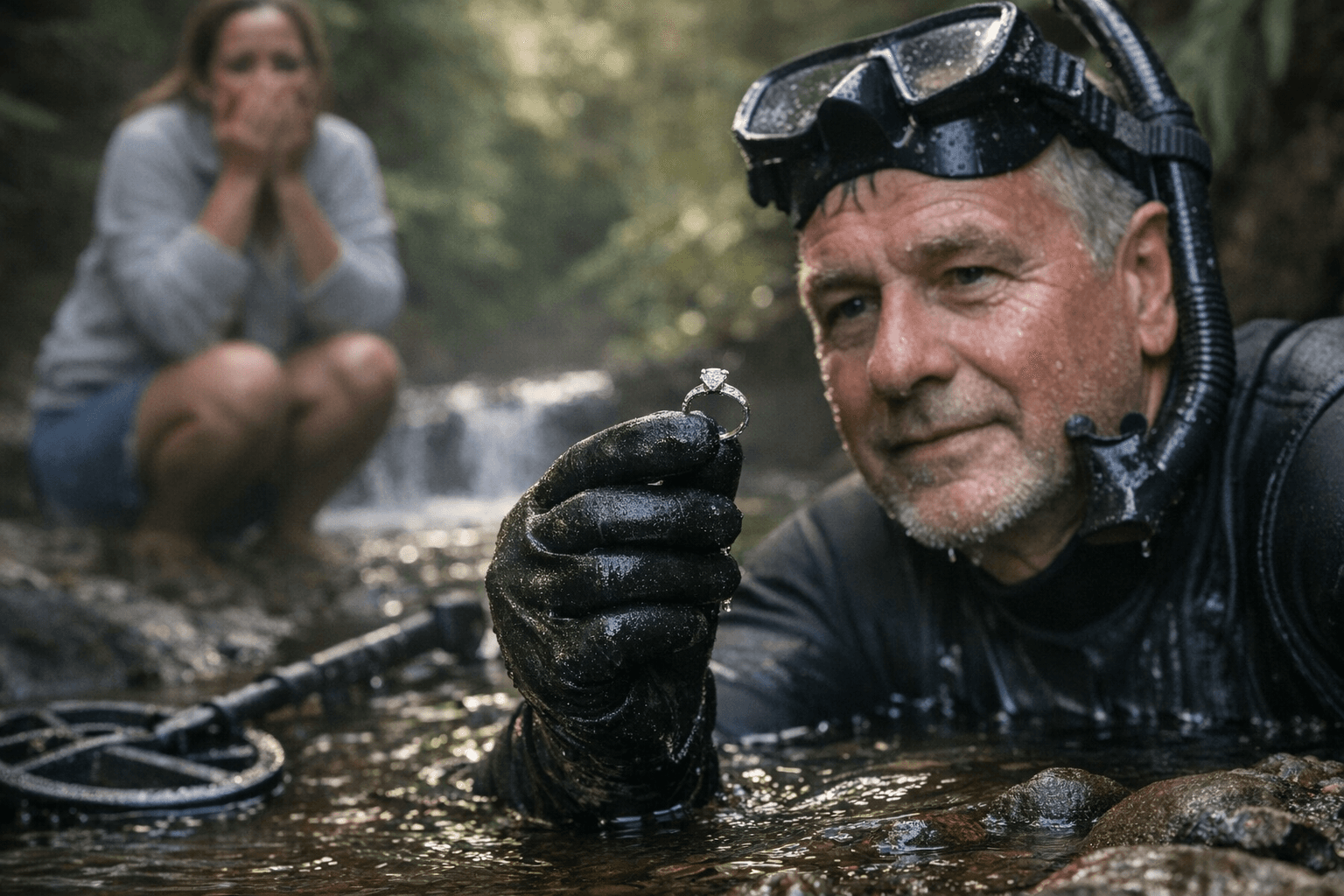
The technical difficulty of Walton's search also bears noting. Shifting sand moves a ring metres from where it fell between the time of loss and the start of a search. Cold limits endurance. And working a creek bed means reading audio signals through a submerged mask while managing buoyancy on uneven substrate.
The wider New Zealand detectorist community operates through the Auckland Metal Detecting Club, the Wellington Metal Detecting Club, and the Christchurch Metal Detecting Club, as well as through NZ Ring Finder, which routes requests to the nearest available hobbyist. Internationally, The Ring Finders directory serves the same function across multiple countries. Fellow New Zealand detectorist Harding advises newcomers to start at home, especially at clotheslines, where "for hundreds of years people have been hanging stuff... with coins and pockets and rings."
On prevention: size a ring at the end of the day, when fingers are at their widest, and revisit the fit each winter when the cold reliably narrows the knuckle. Switch to a plain band for any swim or hike. And photograph the ring from every angle, noting any engraving, because if a ring surfaces in a creek months later, that documentation is the difference between proof of ownership and a prolonged dispute.
The average New Zealand couple spent approximately NZD $5,800 on an engagement ring in 2024, up from around NZD $3,500 in 2011. The widely cited "two months' salary" rule is, as New Zealand jewellers note consistently, a De Beers marketing invention rather than a cultural benchmark. Ivory-Taranaki's ring was not worth what it cost: Walton's hour in a cold creek makes clear it was worth considerably more.
This article was produced by Prism’s automated news system from verified source data, official records, and press releases, then run through automated quality and moderation checks before publishing. The system is built and supervised by the people who set the standards it runs under. Read our full AI policy.
Did this article answer your question?