Spanish Police Arrest Six After Ram-Raid Gang Hit 27 Jewellers
Six suspects arrested after a gang used stolen cars to ram through 27 Spanish jewellery shops, stripping over €1 million in natural diamond rings and watches in just four months.

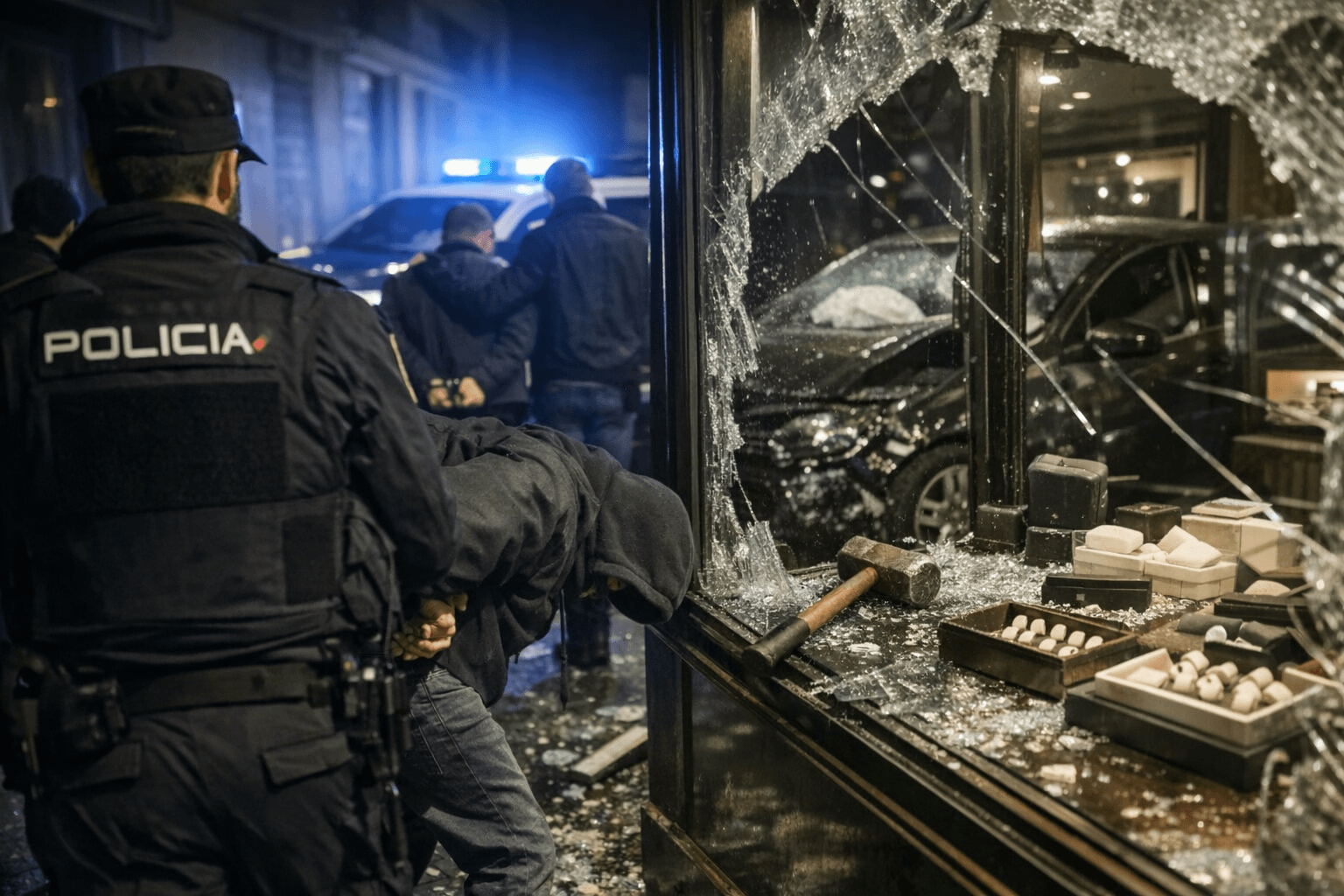
The steel bollard now bolted to the kerb outside certain Spanish jewellers arrived as a receipt for over €1 million in natural diamond rings and watches, stripped from 27 shop fronts between November 2024 and March 2025 by a gang whose organisers had surveilled each target in advance.
In early April 2025, the Guardia Civil and Mossos d'Esquadra, Spain's national and Catalan regional police forces, arrested six suspects aged 27 to 60 following a joint investigation into the campaign. The raids spread across multiple provinces; the involvement of the Mossos d'Esquadra confirms that Catalonia was among the affected regions. The names of those detained were not released.
The gang's method was methodical. Stolen high-performance cars fitted with cloned plates were driven into shop fronts. Team members then removed the highest-value display pieces, identified during earlier surveillance runs, before disappearing. Stolen goods were immediately fenced to pawn shops, a step the Guardia Civil specifically highlighted as complicating recovery: diamonds and watches move quickly through secondary markets that retain the appearance of legitimacy.
The targeting logic is straightforward. Natural diamond engagement rings represent one of the densest concentrations of portable value in retail. The average engagement ring costs $6,504 in the US in 2025, down from a five-year high of $9,025 in 2022, with natural diamonds typically priced between $4,000 and $10,000 per carat. A single display tray in an independent boutique can hold well into six figures of inventory. Lab-grown diamonds, now priced 40 to 60 percent below natural stones, have expanded access at the mid-market but have done nothing to reduce the appeal of premium natural-diamond pieces to organised networks.
The Spanish case is a concentrated version of a pattern running across the continent. A study of nearly 100 German retailers found 2024 to be the worst year on record for shoplifting, with losses reaching €4.95 billion; organised crime accounted for roughly €1 billion of that total. Globally, organised retail crime rose 28 percent in 2025, with retailers recording a 93 percent rise in daily shoplifting incidents compared to pre-pandemic levels, according to security firm Rocateq. Spain is structurally exposed: as of 2020, it ranked second in Europe for robbery rates, a figure that reflects its geography as a transit hub and the scale of its informal economy.
For couples shopping at independent jewellers this year, these dynamics have a tangible form. Security experts advise retailers to reinforce shopfronts with bollards, limit the value of display pieces left unsecured overnight, restrict viewing of high-carat pieces to appointment settings, and install monitored CCTV. Insurance specialists warn that jewellery theft claims spike after high-profile organised crime campaigns, as copycat networks exploit vulnerabilities before security upgrades are complete, a cycle that drives premiums higher and tightens the inventory independents are willing to put in the case.
Anyone buying a second-hand natural diamond ring or watch through informal channels should request provenance documentation. The goods fenced by this gang entered exactly those markets, and they did so fast.
Know something we missed? Have a correction or additional information?
Submit a Tip