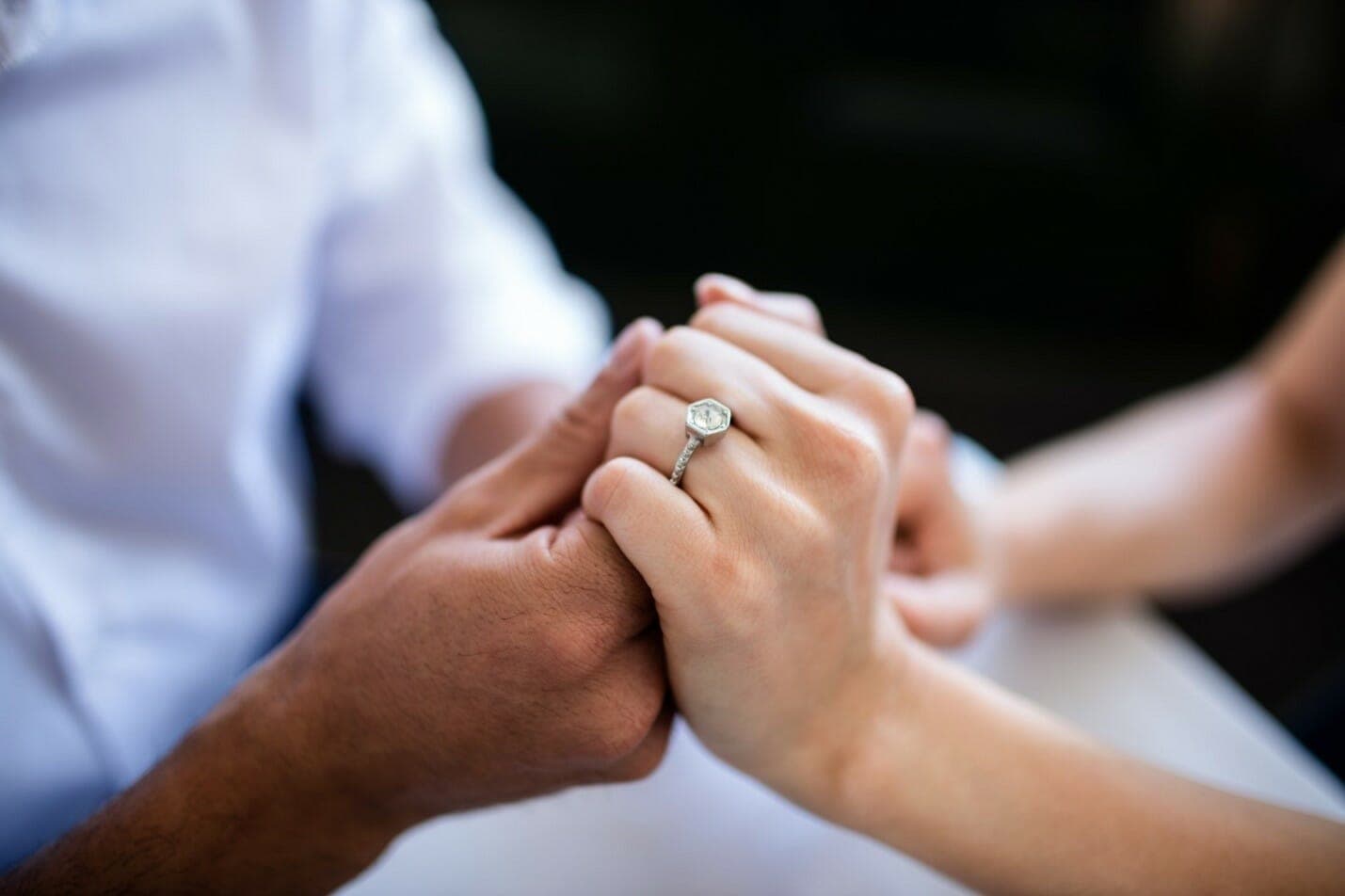
Rough diamond engagement rings gain favor as buyers seek unique looks
Raw stones are turning heads, but the trade-off is plain: less brilliance, more character. This is a ring for buyers who prize singularity over sparkle.

Rough diamonds are having a moment because they tell a different story than the polished solitaire. Demand for rough-diamond jewelry at Roughdiamonds.dk has more than tripled in the U.K. and U.S. since 2022, a sign that some buyers are moving toward stones that look more organic, less standardized, and unmistakably individual.
The anti-perfection shift
That appetite is surfacing just as bridal jewelry keeps tilting toward value-driven size and lab-grown stones. The Knot said 52% of couples chose a lab-grown center stone in 2024, while the average lab-grown engagement ring came in around $4,900 compared with $7,600 for a mined-diamond ring. At the same time, the average center stone grew to 1.8 carats from 1.7 carats the year before, a small jump that still says a lot: buyers are using lower-priced alternatives to reach greater visual scale.
Rough diamonds sit outside that bargain equation. They are not about maximizing carat weight for the money, and they are not trying to mimic the clean perfection of a brilliant-cut diamond. Their appeal is more emotional than numerical, which is exactly why they are beginning to feel like an anti-perfection statement in a market that increasingly rewards bigger stones, lower prices, and highly legible value.
What a rough diamond changes on the hand
A rough diamond is a natural diamond in its raw, uncut state. The Natural Diamond Council describes these stones as unique records of the geological conditions deep within the Earth where they formed, and that definition is central to their appeal. Faceting is what turns a diamond into a sparkle machine, so leaving the crystal uncut preserves texture, asymmetry, and the sense that the stone was found rather than engineered.
That is the trade-off buyers are making. A rough stone gives up the mirror-like brilliance and precise symmetry that make a round brilliant or an oval sing under light, but it offers something polished diamonds cannot: a surface and silhouette that feel singular. In the right setting, the stone can read as sculptural rather than merely rustic, with a quiet, almost talismanic presence.
The setting matters here because rough diamonds are often visually strongest when the metal frames the stone instead of competing with it. A bezel can be especially persuasive, since it cradles irregular edges and makes the composition feel intentional. A prong setting can work too, but it tends to emphasize the stone’s raw outline, which is a better fit for buyers who want the unrefined look to remain fully visible.
Why the market is open to this look now
This is not just an aesthetic whim. De Beers said rough-diamond trading conditions remained challenging in 2024 because of high midstream inventories and weak demand in China, even as U.S. demand stayed steady and India remained robust. The company has also said global rough-diamond production is expected to decline, which adds another layer to the story: scarcity and differentiation are becoming more important just as the market is sorting out what counts as a natural diamond and what does not.
That distinction matters because consumer confidence depends on it. De Beers has argued that clearly differentiating natural diamonds from lab-grown stones is essential, and rough diamonds sit squarely in that conversation because they are unquestionably natural. For some shoppers, that fact carries more weight than the tidy look of a polished stone. For others, it is the opposite, a reminder that the allure lies in the stone’s imperfect surface rather than in conventional polish.
Who rough diamonds are really for
This style is for the buyer who wants a ring to feel personal before it feels classic. It suits someone drawn to texture, symbolism, and a sense of discovery, not someone chasing the highest possible brilliance or the easiest resale logic. A rough diamond can make a ring feel intimate and emotionally charged, but it is a deliberately different kind of luxury, one that places character above uniformity.
That makes it especially appealing to shoppers who are tired of the same visual script. The modern rough-diamond revival is often framed as a reaction against polished perfection and mass-market sameness, and that framing makes sense when you place it beside the broader bridal market. The more standardized the center-stone conversation becomes, the more a raw diamond can feel like a private choice rather than a category purchase.
A much older story than the trend cycle
There is also a deep historical resonance here. The Natural Diamond Council notes that rough, unpolished diamonds were historically traded to Europe and China, and that India was the only source of natural diamonds for more than a thousand years. In other words, the newest-looking engagement-ring idea is also one of the oldest forms of diamond appreciation: the stone valued for what it is before anyone has altered it.
That history gives rough diamonds a different emotional charge from the contemporary lab-grown boom. Lab-grown stones answer a modern demand for size and value, and the numbers make that clear. Rough diamonds answer a different hunger entirely, one for rarity of form, not just rarity of price. They are not the ring choice for everyone, but for the buyer who wants a one-of-a-kind texture with real geological meaning, they feel less like a rebellion than a return to the diamond’s most elemental state.
This article was produced by Prism’s automated news system from verified source data, official records, and press releases, then run through automated quality and moderation checks before publishing. The system is built and supervised by the people who set the standards it runs under. Read our full AI policy.
Did this article answer your question?