2026 chart shows lab-grown diamond prices plunged 68% then stabilized versus naturals
A mid‑February chart shows lab‑grown diamond prices plunged ~68% from 2020 through 2024, then largely settled by early 2026.
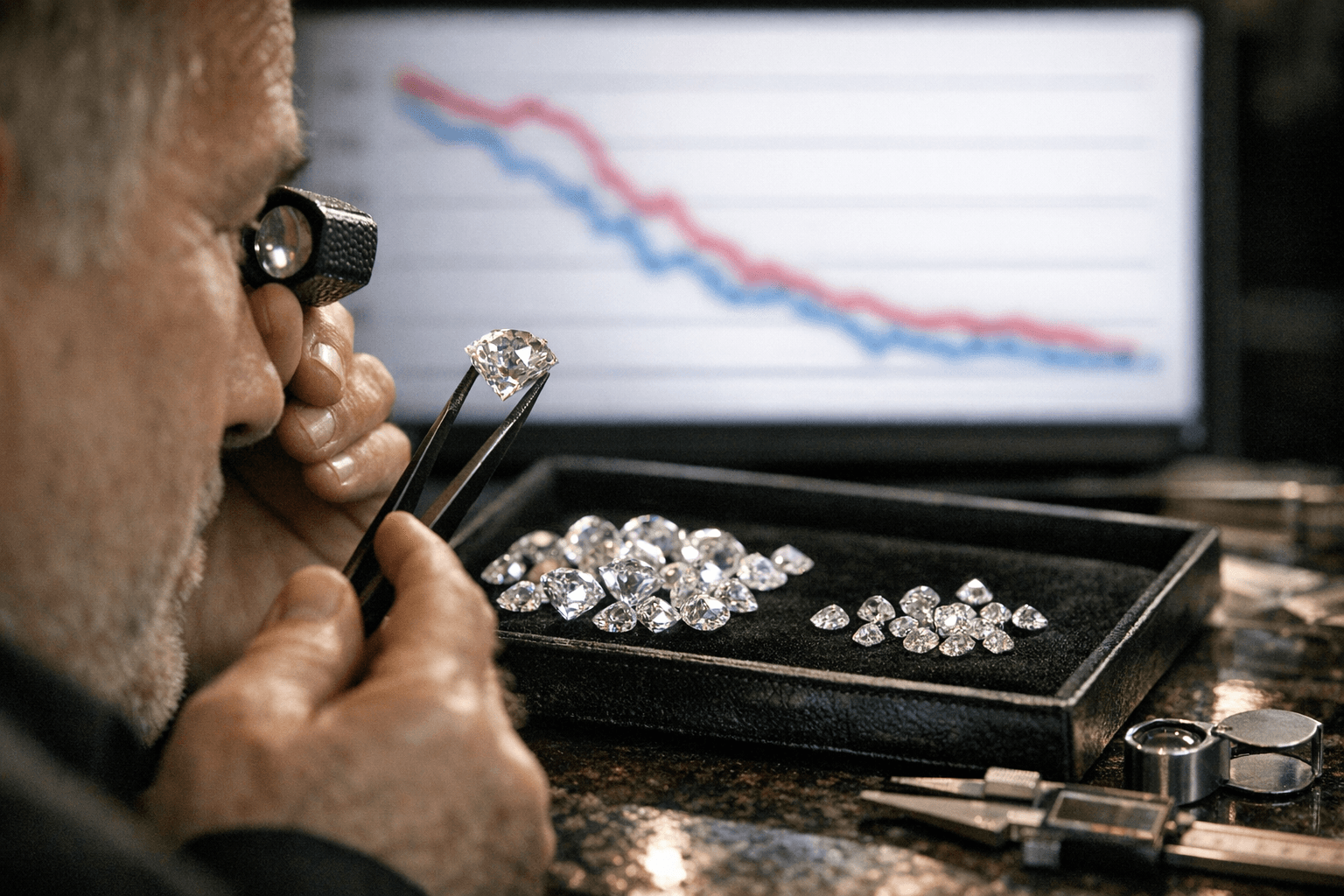
A data‑driven price chart published mid‑February 2026 shows lab‑grown diamond prices plunged dramatically from 2020 through 2024 and then largely settled in early 2026, with a peak‑to‑trough decline for certain lab‑grown categories of as much as ~68% since 2020. That macro movement frames a market where point‑in‑time indices and retailer listings now read as stability after a multiyear collapse.
Stonealgo’s Diamond Price Snapshot, as of 02/13/2026, gives concrete, current price indices by shape: Round 1 ct $810, 2 ct $1,652, 3 ct $2,378; Oval 1 ct $835, 2 ct $1,496, 3 ct $2,339; Emerald 1 ct $766, 2 ct $1,516, 3 ct $1,946; Princess 1 ct $769, 2 ct $1,553, 3 ct $2,260; Cushion 1 ct $751, 2 ct $1,710, 3 ct $2,688; Pear 1 ct $808, 2 ct $1,658, 3 ct $2,112. Stonealgo presents these as live prices and dates the snapshot 02/13/2026.
Retail snapshots published earlier in January echo the broad pricing band. Monarch Jewelry, published Jan 14, 2026 and authored by Kristen Toole, reports 1‑carat lab‑grown rounds at approximately $725 and ovals at approximately $800, with 2‑carat rounds near $1,700 and 2‑carat ovals near $1,720. Monarch states its methodology is “based on current market indexes compiled from hundreds of thousands of online listings” and sums up that “pricing is steady, not inflated” and that “1–2 carat options offer exceptional value.”
The longer view on natural stones still reads differently. MadisonDia’s 2015–2026 wholesale table lists average wholesale price (HKD) at 98,000 in 2015, 86,000 in 2019, 65,000 in 2023 and 55,000 for 2026 (est.), with USD approximations of ≈12,560, ≈11,030, ≈8,330 and ≈7,050 respectively. MadisonDia states “From 2015 through 2026, the global diamond market has undergone a structural reset,” and cites Rapaport Price List, IDEX Online, Bloomberg and Financial Times while noting Bain & Company and De Beers Group findings that ultra‑high‑end stones retain scarcity value even as the broad commercial market shows weaker appreciation.
Inventory and short‑term movements remain visible in Stonealgo’s backend figures. Stonealgo lists Inventory: 238K and Inv. Change: 15.9K in its snapshot, and shows specific weight lines with month changes: “2 Carat Lab Grown Diamond Prices -4.17% (1m) $1,562; Inventory: 425K; Inv. Change: 92.1K,” “3 Carat Lab Grown Diamond Prices -4.15% (1m) $2,192; Inventory: 444K; Inv. Change: 42.8K,” and “4 Carat Lab Grown Diamond Prices 1.23% (1m) $2,954; Inventory: 134K; Inv. Change: 352.”
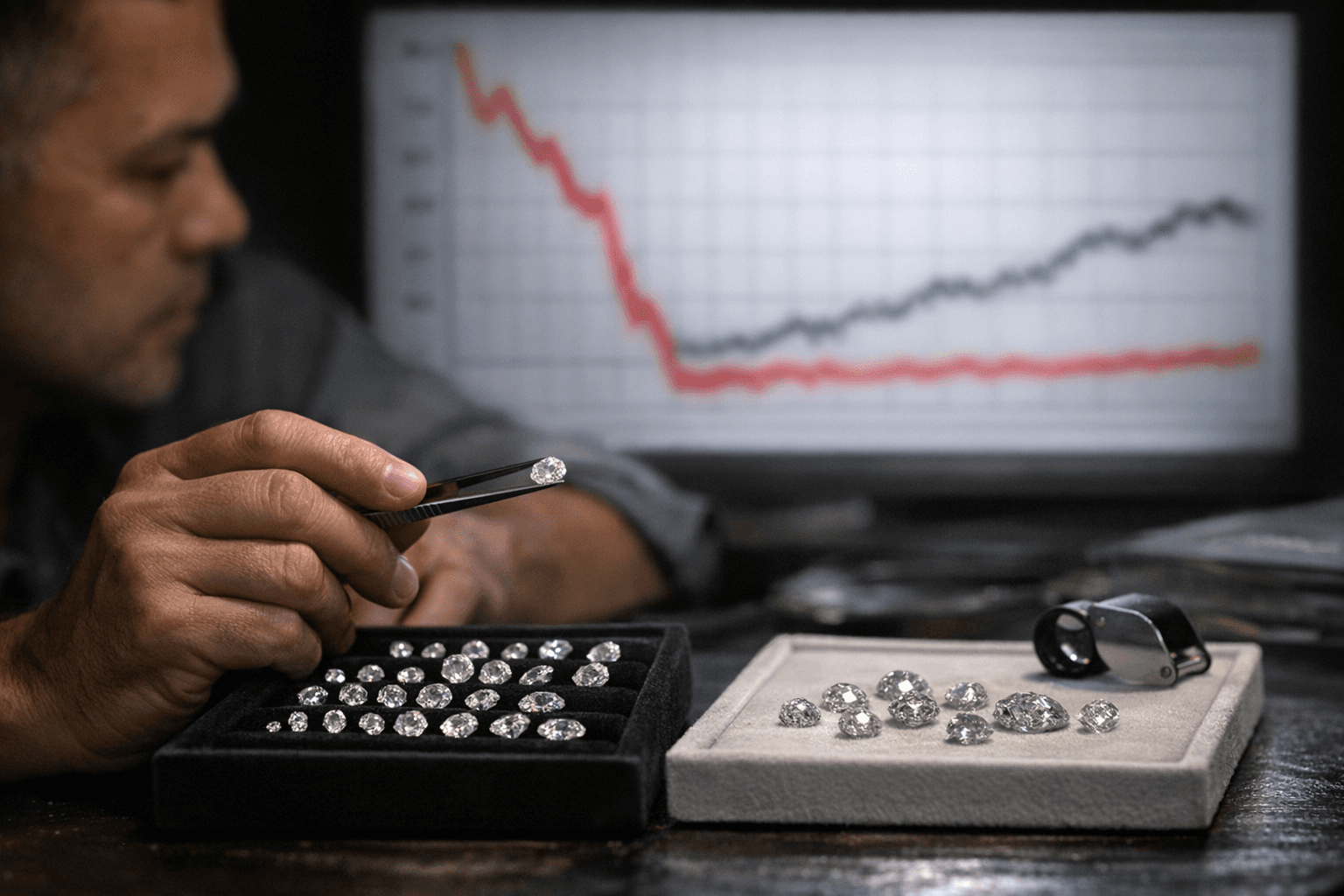
Predictions and strategic shifts published by Rapaport News reflect AI‑generated forecasting. Rapaport News turned to ChatGPT and states “The article has not been substantially edited; it reflects the artificial intelligence (AI) platform’s predictions.” ChatGPT’s lines reproduced by Rapaport include “Lab‑grown retail prices keep falling, and ‘under $1,000 center stone’ becomes normal,” “Expect continued price compression (especially for popular 1‑ to 3‑carat rounds) as production scales and retailers compete harder on ‘size for money,’” and “Lab‑grown becomes the default in value segments; naturals concentrate in ‘heritage/luxury’ lanes.” Rapaport/ChatGPT cites industry tactics such as “More big legacy jewelry groups launch (or expand) dedicated lab‑grown sub‑brands” with the example “Titan’s new lab‑grown diamond (LGD) brand,” and warns that “Natural‑diamond supply gets tighter ‘on purpose’” while midstream actors may face “thin margins and inventory hangovers.”
Value gaps and consumer implications are stark in published comparisons. Humandesignshop states “1 carat: 60–90% cheaper than natural diamonds” and that “2–3 carat diamonds: Thousands of dollars less for the same visual quality,” adding that “natural diamonds can cost three to ten times more” for the same cut, color and clarity. Humandesignshop also answers the visual question plainly: “To the naked eye, no.” The site notes both lab‑grown and natural stones can be certified by GIA or IGI and lists ethical advantages for lab‑grown: require less land disruption, use fewer natural resources and are fully traceable and conflict‑free.
Stonealgo’s Q&A frames why prices may now be settling: “Eventually, lab grown diamond prices will likely stabilize since there is a theoretical minimum cost to producing a lab grown diamond,” while also noting it is “unclear at this point where that minimum price point will be, since the technology for growing lab grown diamonds is getting cheaper over time and the diamond cutting process may become more efficient through automation.”
Retailers and industry players are already shifting emphasis from origin to documentation. Rapaport/ChatGPT predicts a retail marketing move “from ‘what it is’ to ‘proof’: papers, provenance, and warranties,” and that provenance debates will intensify with India chairing the Kimberley Process in 2026. Taken together, the mid‑February chart’s ~68% plunge and the February price snapshots indicate the lab‑grown sector has moved from collapse to a new, lower baseline where scale, inventories and proof of origin will decide how both lab‑grown and natural diamonds are bought, sold and positioned through 2026.
Know something we missed? Have a correction or additional information?
Submit a Tip