6 consumer shifts redefining luxury jewelry buying in 2026
Luxury jewelry is becoming more personal, more practical and more price-aware. Gen Z, TikTok and the value debate are changing what buyers reach for first.
Luxury is losing its old uniform. Jewelry buyers still want sparkle, but they are now weighing meaning, wearability and price with a new kind of precision, and that is changing everything from the stones they choose to the stories attached to them.
Gen Z is rewriting what luxury means
The youngest serious luxury buyers are no longer treating jewelry as a once-in-a-lifetime trophy. Gen Z is now the second-largest generation buying diamonds, and its average spend on natural diamond jewelry is almost double that of Baby Boomers, which signals a generation willing to pay when a piece feels personal enough to justify the splurge. That shift has pushed luxury away from pure status and toward self-definition, where the best pieces feel like part of an identity rather than a display case.
Bain has noted that Gen Z is split between self-expression and conformity, a tension that shows up clearly in jewelry buying. The result is a market where familiar forms still matter, but they have to carry a sharper emotional charge: a diamond pendant bought for a milestone, a pair of studs chosen as a daily signature, or a ring selected because it feels like a private declaration rather than a public signal.
Doom spending has made jewelry the acceptable indulgence
Economic pressure has not erased desire, it has changed how desire is spent. Bain says luxury spending is under pressure from economic and geopolitical headwinds, and that backdrop helps explain why some shoppers are still buying, but buying more selectively and with more emotional justification. Jewelry sits in a rare category here: it can satisfy the urge to treat oneself while still feeling lasting, not disposable.
That is part of why non-bridal occasions now account for three-quarters of overall U.S. diamond demand. The old logic of waiting for an engagement, anniversary or holiday has loosened, replaced by a more frequent rhythm of self-purchase, personal reward and value-conscious collecting. For the customer, that means luxury jewelry is increasingly expected to work harder: it should feel special, but also versatile enough to live beyond one event.
Natural diamonds still carry the strongest pull
De Beers’ June consumer research sharpens the picture. Its Diamond Report, based on a study of 18,500 women in the United States, says natural diamonds remain the most desired luxury jewelry product, and average purchase prices for natural diamonds have risen 25%. That combination of higher prices and strong desire suggests that the category is not being defined by bargain hunting, but by conviction.
The data also shows how deeply diamonds remain tied to personal spending patterns. Men spend on average 1.8 times more than women on natural diamond jewelry, and self-purchasing is higher among men than women, which undercuts the tired assumption that luxury jewelry buying is driven mainly by gift-giving. In practice, that means the modern jewelry case has to serve both romance and self-reward, often in the same afternoon.
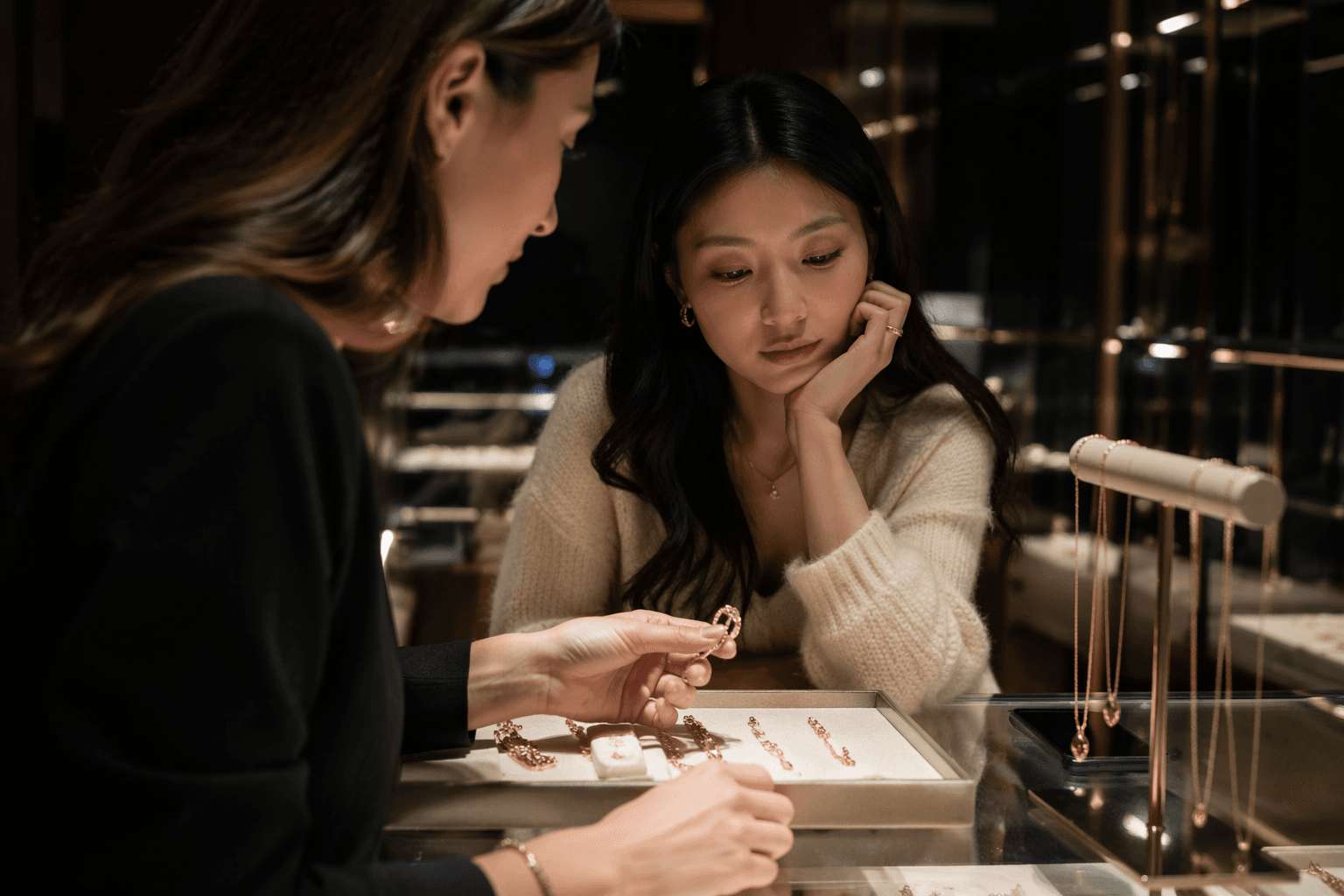
Lab-grown diamonds are redrawing the value conversation
The debate over lab-grown diamonds has not made diamonds less relevant, but it has made value much more visible. Younger consumers, especially Gen Z, continue to care about ethical assurances, branded offerings and digital retail experiences, which is why lab-grown stones can feel appealing as an entry point, particularly when shoppers are comparing size and price side by side. Social media has amplified that comparison, especially around 2-carat-plus engagement rings and diamond studs that circulate widely online.
Even so, De Beers positions natural diamonds as more desirable than synthetic lab-grown diamonds, and that desirability now carries a premium. The practical effect for buyers is a more stratified market: lab-grown can satisfy the appetite for larger silhouettes and lower upfront pricing, while natural diamonds continue to command emotional and resale gravity. The consumer shift is not simply about which stone wins, but about how clearly the buyer understands what each one says.
TikTok has become the new jewelry counter
JCK’s view of TikTok matters because it explains how jewelry is being discovered, not just sold. The platform’s trend reporting works for jewelers because the category is unusually good at communicating sentimentality and lasting value through short-form video, where a ring can be shown as a memory, a mood and a material object in a matter of seconds. For independent jewelers, that is less about chasing virality than about translating craftsmanship into feeling.
This changes the everyday buying journey in a concrete way. A shopper who once might have learned about a chain, a setting or a diamond shape from a salesperson now encounters those pieces in motion, styled on a hand, stacked on a wrist or framed as part of real life. That shift favors pieces with strong visual clarity and emotional readability, the sort of jewelry that can be understood instantly and still feel convincing when seen up close.
Nostalgia is making jewelry feel familiar again
One of National Jeweler’s clearest observations is that nostalgia now belongs inside the luxury conversation. In a market that feels unstable, buyers are gravitating toward pieces that look rooted, recognizable and emotionally legible, which gives classic silhouettes a new kind of relevance. The point is not sentimentalism for its own sake, but reassurance: a familiar form can feel like a safer place to put money.
De Beers has been tracking this evolving mindset for years. Its earlier research pointed to ethical assurances, phygital retail, branded offerings and Web3 experiences as important to younger consumers, and it said Gen Z diamond acquisitions rose from 11 percent in 2021 to 15 percent in 2022. Put together, these trends show that the modern luxury jewelry buyer is not rejecting tradition, but asking tradition to adapt, and the pieces that endure will be the ones that can carry both memory and utility with equal grace.
This article was produced by Prism’s automated news system from verified source data, official records, and press releases, then run through automated quality and moderation checks before publishing. The system is built and supervised by the people who set the standards it runs under. Read our full AI policy.
Did this article answer your question?