Brilliant Earth's Guide to Building an Ethical, Versatile Everyday Jewelry Wardrobe
Brilliant Earth's capsule jewelry framework asks the right question before every purchase: where did this come from, and will it last? Here's how to build a wardrobe that answers both.

The Capsule Idea, Translated Into Jewelry
When Susie Faux, the owner of a London boutique called "Wardrobe," coined the capsule wardrobe concept in the 1970s, she was solving a specific problem: too many clothes, not enough outfits that actually worked. Donna Karan sharpened the idea in 1985 with her "Seven Easy Pieces" collection, built around a black bodysuit and a handful of mix-and-match separates designed for the working woman's daily life. The logic was ruthlessly practical. Own less, wear more, choose well.
That same logic translates precisely to jewelry. A capsule jewelry wardrobe is not a minimalist aesthetic choice. It is a purchasing philosophy: a small set of pieces with maximum versatility, made well enough to survive daily wear for years, sourced in ways you can actually defend. Brilliant Earth, the fine jewelry company founded in August 2005 by Beth Gerstein and Eric Grossberg after the two met at Stanford Graduate School of Business, has built its entire business around the question of what "choosing well" actually means in fine jewelry. Their capsule guide makes the stakes explicit from the first recommendation.
The Core Four Pieces
Any honest capsule jewelry wardrobe starts with the same building blocks, regardless of budget:
- Small hoop or stud earrings. These are the highest price-per-wear pieces in most jewelry boxes, worn daily without a second thought. Huggies in 14-karat gold or simple diamond studs reward the investment in solid metal.
- A medium-weight chain. The workhorse of a capsule wardrobe. Worn alone, it reads clean and modern; layered over a pendant or stacked with a delicate second chain, it shifts the register entirely.
- A simple bracelet. A thin bangle or fine tennis bracelet occupies the wrist without demanding attention. The key is weight: too heavy and you feel it all day; too delicate and it won't survive a year of daily wear.
- Stackable rings. Thin bands in solid gold, worn alone or stacked across multiple fingers, offer the most versatility per dollar of any jewelry category. They also happen to be the easiest entry point for someone building a wardrobe gradually.
Four pieces, correctly chosen, cover nearly every context from desk to dinner.
Decoding the Materials
This is where most guides go soft, and where buyers most often get burned. The Federal Trade Commission's Jewelry Guides (16 CFR Part 23) draw clear legal distinctions between gold product types, and understanding them is the difference between a piece that lasts a decade and one that shows base metal within a year.
Solid karat gold, whether 10k, 14k, or 18k, means the alloy runs throughout the piece. There is no plating to wear through. A 14-karat piece is 58.3 percent pure gold alloyed with metals like silver and copper for durability; 18 karat is 75 percent gold with a warmer, slightly softer finish.
Gold vermeil occupies a legitimate middle tier under FTC rules: the base must be sterling silver (92.5 percent pure silver, marked 925), the gold coating must be at least 10 karat in fineness, and the plating must be a minimum of 2.5 microns thick throughout. That thickness requirement is what separates vermeil from standard gold plating, which has no minimum karat or thickness requirement under federal law. A manufacturer can apply a microscopically thin wash of low-karat gold over any base metal and, as long as they don't call it vermeil, they are operating legally. The practical consequence: always ask whether a plated piece meets vermeil standards before assuming the finish will hold.
Gold-filled pieces sit between vermeil and solid gold in durability terms: a layer of at least 10-karat gold is mechanically bonded, rather than electroplated, onto a base metal. If the gold layer represents at least 1/20 of the item's total weight, the piece can be marked "gold filled" or "GF." The bond is more durable than electroplating under normal wear conditions.
For everyday pieces subjected to daily friction, solid gold remains the most defensible choice. Vermeil makes practical sense for statement pieces worn occasionally or for budget-conscious buyers who understand the limitations and care for pieces accordingly.
The Sustainability Imperative
Brilliant Earth's founding premise, the one that sent Beth Gerstein and Eric Grossberg from their Stanford classroom into the jewelry business, was that most consumers had no way of knowing whether the diamonds in their rings had funded conflict. Their answer was what they call a "Beyond Conflict Free" standard, which extends sourcing scrutiny beyond the minimum required by the Kimberley Process to include labor practices and environmental impact, and using recycled precious metals throughout their metal supply chain.
Lab-grown diamonds are now central to that sustainability argument, and the market data reflects a significant shift in consumer behavior. According to BriteCo's analysis of proprietary appraisal and insurance data, lab-grown diamonds accounted for more than 45 percent of US engagement ring purchases by 2024, up from roughly 1.7 percent just five years earlier. By 2025, some data suggests lab-grown stones crossed the 50 percent threshold for the first time. The price differential is now dramatic: a 1-carat lab-grown diamond averaged under $1,000 in 2025, compared to approximately $4,200 for a comparable natural stone.
The chemical and optical properties are identical between lab-grown and mined diamonds. They are graded by the same gemological standards. What the lab-grown category lacks is the geological narrative of a stone formed over billions of years; what it offers in return is full supply-chain transparency, a significantly lower environmental footprint per carat, and a price point that allows buyers to allocate more budget toward the metal setting and craftsmanship of the piece itself.
For buyers committed to recycled metals, look for pieces marked as using recycled gold or silver from certified suppliers, and ask brands specifically whether their recycled metal claims are third-party verified, not just self-reported.
Maintenance That Actually Matters
The best capsule piece is useless if it tarnishes in a drawer. Fine metal requires less maintenance than most people assume, but a few specific habits make a measurable difference:
- Rinse solid gold and sterling silver pieces with warm water after wearing; soap residue and sweat accelerate tarnish and can dull the finish of set stones.
- Remove all jewelry before entering chlorinated pools or hot tubs. Chlorine reacts with gold alloys and can permanently damage the metal's surface and weaken prong settings over time.
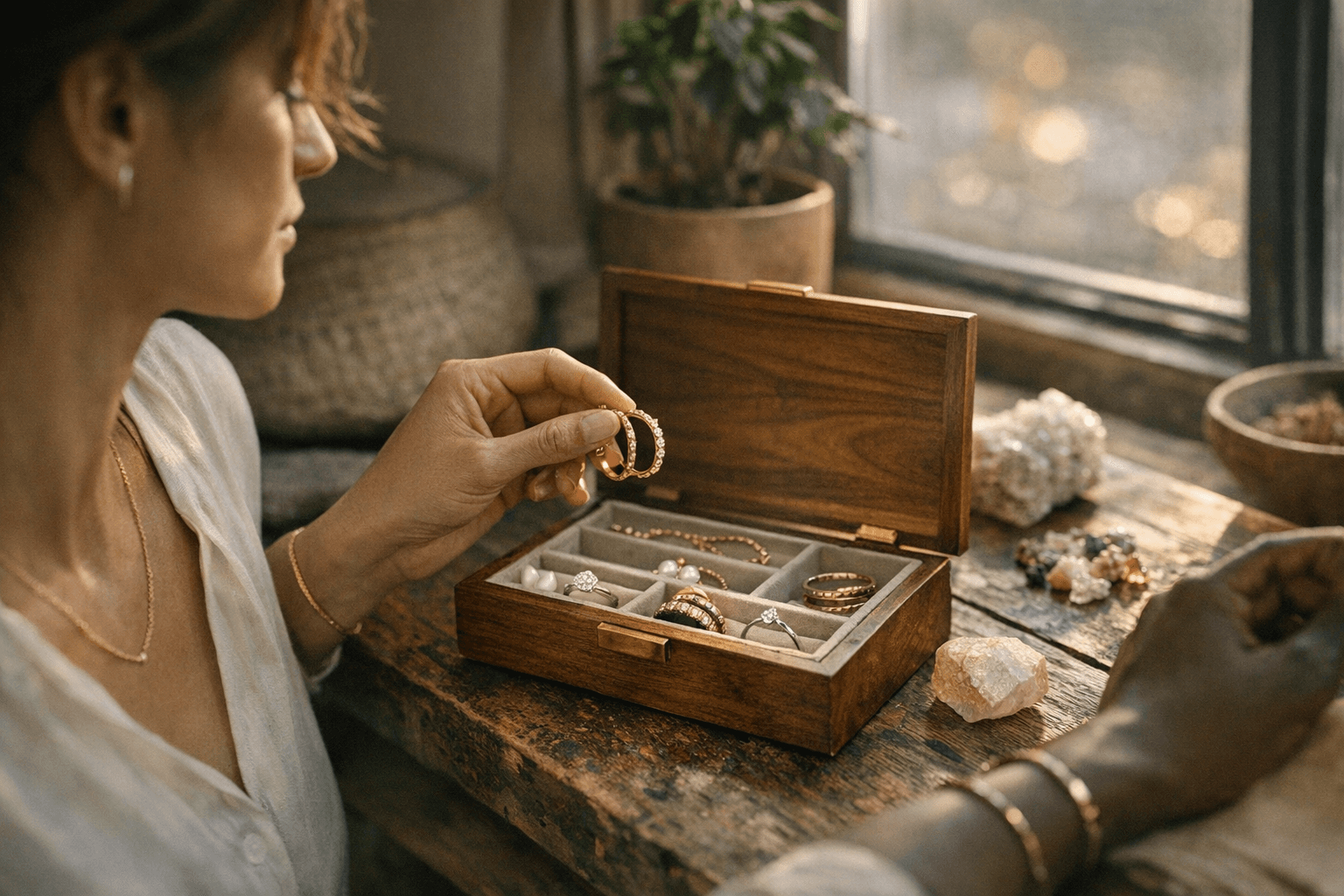
- Store pieces individually in soft pouches or compartmentalized boxes. Sterling silver and gold worn together can cause surface scratching; store them separately when possible.
- For set diamonds and gemstones, a soft toothbrush and mild dish soap solution is the most effective at-home cleaning method. Avoid ultrasonic cleaners for stones with inclusions or treated surfaces unless the jeweler confirms the stone is stable.
The Price-Per-Wear Calculation
The most useful framing for a capsule jewelry purchase is not the sticker price but the cost per day of wear. A $400 pair of 14-karat gold hoops worn daily for five years costs roughly 22 cents per wearing. A $40 plated pair that loses its finish after six months costs more than twice that per day and contributes to the waste cycle that made Brilliant Earth's founding pitch so legible to its first customers.
Repairability is the second axis of that calculation. Solid gold can be resized, re-polished, and re-tipped on prongs. A plated piece typically cannot be economically repaired once the finish fails; it becomes waste. When evaluating any fine jewelry purchase, ask the retailer directly: can this be serviced? What does re-polishing cost? Is the prong work done in-house or sent out? The answers tell you whether a brand is building for longevity or for turnover.
Building a jewelry wardrobe around those two questions, where did this come from and how long will it last, is not a luxury exercise. It is the most practical approach to a category that rewards patience, specificity, and a willingness to ask the supply chain what it would prefer you not know.
This article was produced by Prism’s automated news system from verified source data, official records, and press releases, then run through automated quality and moderation checks before publishing. The system is built and supervised by the people who set the standards it runs under. Read our full AI policy.
Did this article answer your question?