Dainty Studs, Delicate Chains, and Affordable Picks for Daily Wear
The gap between jewelry you love and jewelry you actually wear every day comes down to three things: setting, material, and weight — and knowing which affordable picks actually survive real life.
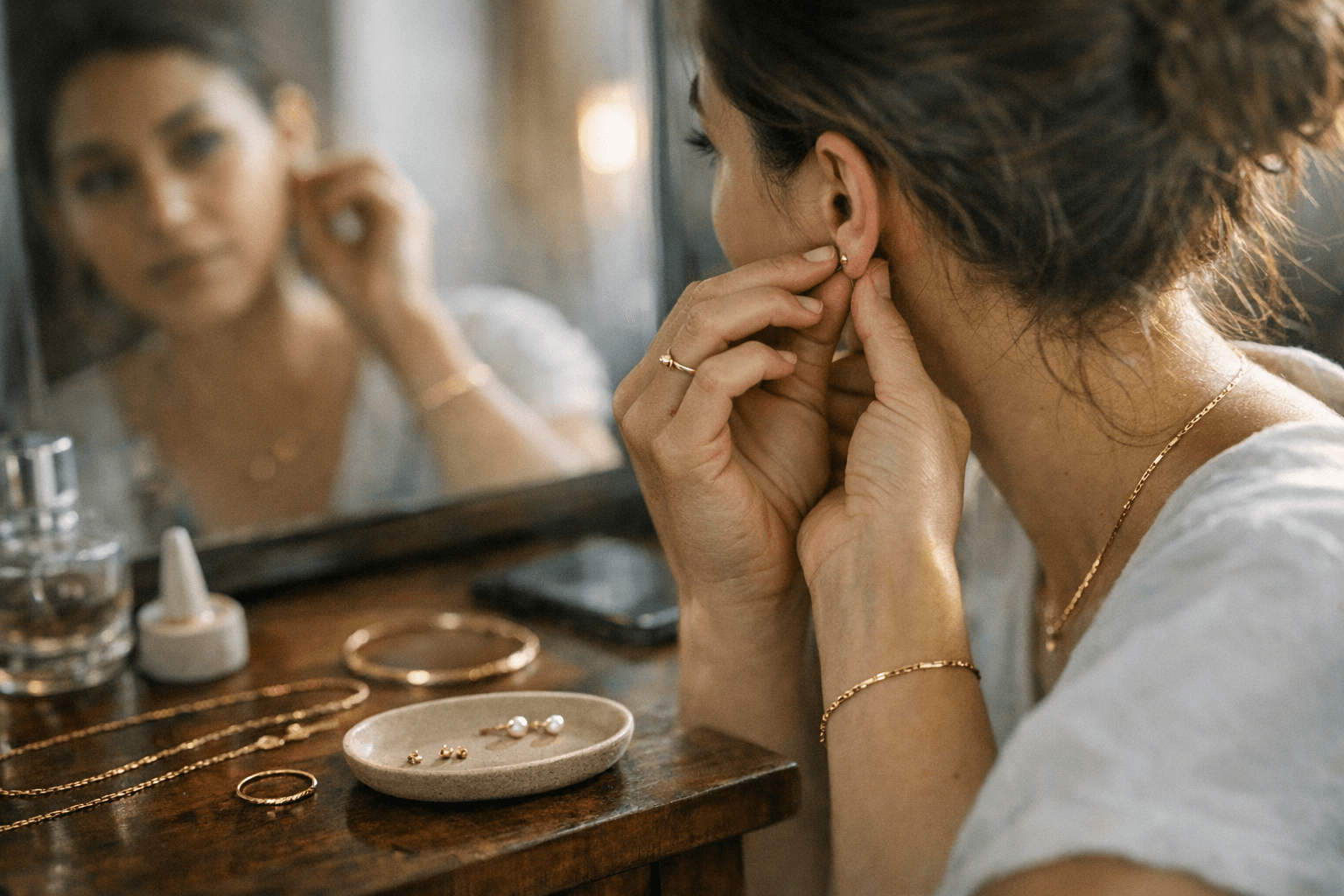
There is a drawer in most people's lives dedicated entirely to jewelry that never leaves it. The chandelier earrings that require a special occasion, the cocktail ring too bulky to type in, the layered set that takes ten minutes to untangle. Everyday jewelry exists in deliberate opposition to all of that: it is the category you reach for at 7 a.m. without thinking twice, the pieces that survive hand-washing, gym bags, and the accumulated friction of a full life. Getting it right requires more than a low price point. It requires understanding what you're actually buying.
The Stud: Small, but Not Simple
A stud earring seems like the most uncomplicated object in jewelry. A post, a back, a stone or metal top. What gets overlooked is the setting, and for daily wear, it is the single most consequential detail. A prong setting holds a stone with thin metal claws, maximizing the light that reaches it and giving even a modest cubic zirconia real sparkle. The tradeoff: prongs can snag on hair, scarves, and pillow fabric, and over time they bend or wear down, risking stone loss. For genuinely abusive daily use, a bezel setting, where a thin wall of metal wraps around the entire girdle of the stone, offers considerably more protection. The stone sits flush, the edges are smooth, and there is nothing to catch.
For stones, the everyday-wear hierarchy starts with diamonds and sapphires (hardness of 10 and 9 on the Mohs scale, respectively), moves to topaz and quartz, and ends with softer materials like pearls and opals, which scratch easily and do not belong in a daily rotation unless they are treated with obsessive care. For most mass-market studs, the stone will be cubic zirconia or crystal glass, both visually appealing and entirely acceptable at the price points where affordable everyday jewelry lives.
Small Hoops: The Huggie Question
The small hoop category has been quietly dominated for years by the huggie, a hinged hoop with enough inner diameter to sit snugly against the earlobe without dangling. Its genius is architectural: because it moves with you rather than swinging freely, it avoids the catching and pulling that standard hoops cause during exercise or while wearing scarves. At diameters of 8 to 12 millimeters, a huggie reads as refined rather than understated. Pair one with a complementary stud in the same ear for a curated ear stack that looks considered without requiring a piercing appointment.
Mixing small hoops with studs is one of the most accessible styling moves in everyday jewelry: a thin gold huggie in the first hole with a 3mm ball stud or tiny geometric shape in a second piercing creates instant intentionality. The key is keeping the metal tone consistent, or at minimum keeping the finishes in the same family (brushed with brushed, high-polish with high-polish).
Delicate Chains: The Architecture of Layering
A delicate chain worn alone is jewelry at its most confident: a single 1mm cable chain in gold at 16 or 18 inches, nothing else. It catches light without demanding attention. But the real versatility in this category comes from layering, and layering has a logic that prevents it from looking chaotic.
Start with a choker or a 14-to-16-inch chain as your foundation. This sits high on the collarbone and anchors everything below it. The second layer should fall at 18 inches, ideally with a small pendant, an initial disc, a tiny stone, or a simple charm that gives the eye somewhere to land. A third chain at 20 to 22 inches pulls the composition down toward the chest, and at this length a slightly heavier link or a more substantial pendant reads as a deliberate finishing weight rather than an afterthought.
The practical concern with layering multiple delicate chains is tangling, which is a materials and clasp problem as much as a styling one. Chains with lobster clasps hold their position more reliably than spring-ring clasps, which can migrate and allow chains to cross. Checking clasps before putting on a layered set, and periodically inspecting them for wear, is a care habit that pays dividends.
Thin Stacking Rings: Proportion and Mix
A single thin band in sterling silver or gold-filled metal sits almost invisibly on the finger, which is exactly the point. Stack three or four of them and the effect becomes architectural. The proportional rule that makes stacking work: bands should be close in width (1mm to 2mm) so no single ring overwhelms the others. Mixing a smooth polished band with a lightly hammered or twisted one adds texture interest without breaking the visual scale.
The material choice matters enormously for rings because they endure the most mechanical abuse of any jewelry category. Hands encounter cleaning products, hand sanitizer, water, and friction all day. Gold-filled metal, in which a layer of karat gold is mechanically bonded to a brass core under heat and pressure, contains at least 1/20th gold by weight and holds up through daily exposure far better than gold-plated pieces, where an electroplated layer as thin as 0.5 microns can wear through in months. Sterling silver (marked 925 for its 92.5% silver content) is a strong everyday choice for rings, with the caveat that it will tarnish with consistent exposure to moisture and sulfur compounds in the air, requiring occasional polishing.
Materials: What Actually Holds Up
The most consequential decision in affordable everyday jewelry is not the design, it is the material beneath the finish. The practical hierarchy for daily-wear durability:
- 14k or 18k solid gold: The most durable choice, and the most expensive. A thin solid gold chain will outlast anything in the affordable category, but solid gold in fine jewelry starts well above mass-market pricing.
- Gold-filled: The best affordable option for longevity. The mechanically bonded gold layer resists tarnish and wear better than plating and is typically safe for sensitive skin.
- Gold vermeil: Sterling silver base with a thick karat gold plating (at minimum 2.5 microns). More durable than standard gold-plating, especially on pieces with limited contact friction like pendant necklaces.
- Sterling silver: Excellent base metal with real durability, but requires active tarnish management. Anti-tarnish pouches and occasional polishing with a soft cloth keep it looking sharp.
- Gold-plated brass or base metal: Affordable entry point but the plating wears through quickest, especially on rings and bracelets. Best for earrings, where contact friction is lowest.
Care: The Non-Negotiable Habits
The single most effective thing you can do to extend the life of affordable everyday jewelry is to put it on last. Perfume, moisturizer, and hairspray all contain alcohol, acids, and oils that accelerate tarnishing and can damage softer stones. Chlorine is the most destructive common chemical that jewelry encounters: remove rings before a pool or hot tub without exception. Bleach and household cleaners cause permanent discoloration in precious metals.
For cleaning, a soft cloth handles most maintenance. For chain links and setting crevices where oils and debris accumulate, a very soft baby toothbrush with a small amount of mild diluted soap, followed by a thorough rinse and complete drying before storage, is sufficient for both sterling silver and gold-filled pieces. Never store silver in humid areas; moisture accelerates tarnishing significantly. Separate compartments or small zip-seal bags prevent chains from tangling and protect surfaces from contact scratches.
Putting It Together
The accessible everyday stack that actually holds up tends to follow a simple formula: a pair of bezel-set studs or snug huggies in gold-filled or sterling silver, a 16-to-18-inch cable chain worn alone or anchoring a two-piece layered set, and two or three thin stacking bands mixed across one or two fingers. The total investment at mass-market and online-retailer price points can sit well under $100 for a complete, cohesive set. What separates a set that lasts from one that tarnishes in a season is less the design and more whether you knew to choose gold-filled over plated, lobster clasps over spring rings, and bezel over prong for the pieces that matter most. The pieces you reach for without thinking are almost always the ones that were built to be worn.
This article was produced by Prism’s automated news system from verified source data, official records, and press releases, then run through automated quality and moderation checks before publishing. The system is built and supervised by the people who set the standards it runs under. Read our full AI policy.
Did this article answer your question?