Casey Perez’s Loma pendant blends fluted forms with everyday wearability
A fluted teapot and a scalloped lampshade became a pendant built for everyday wear. Casey Perez keeps the shape soft, sculptural, and quietly easy to live in.
A pendant that looks considered, not precious
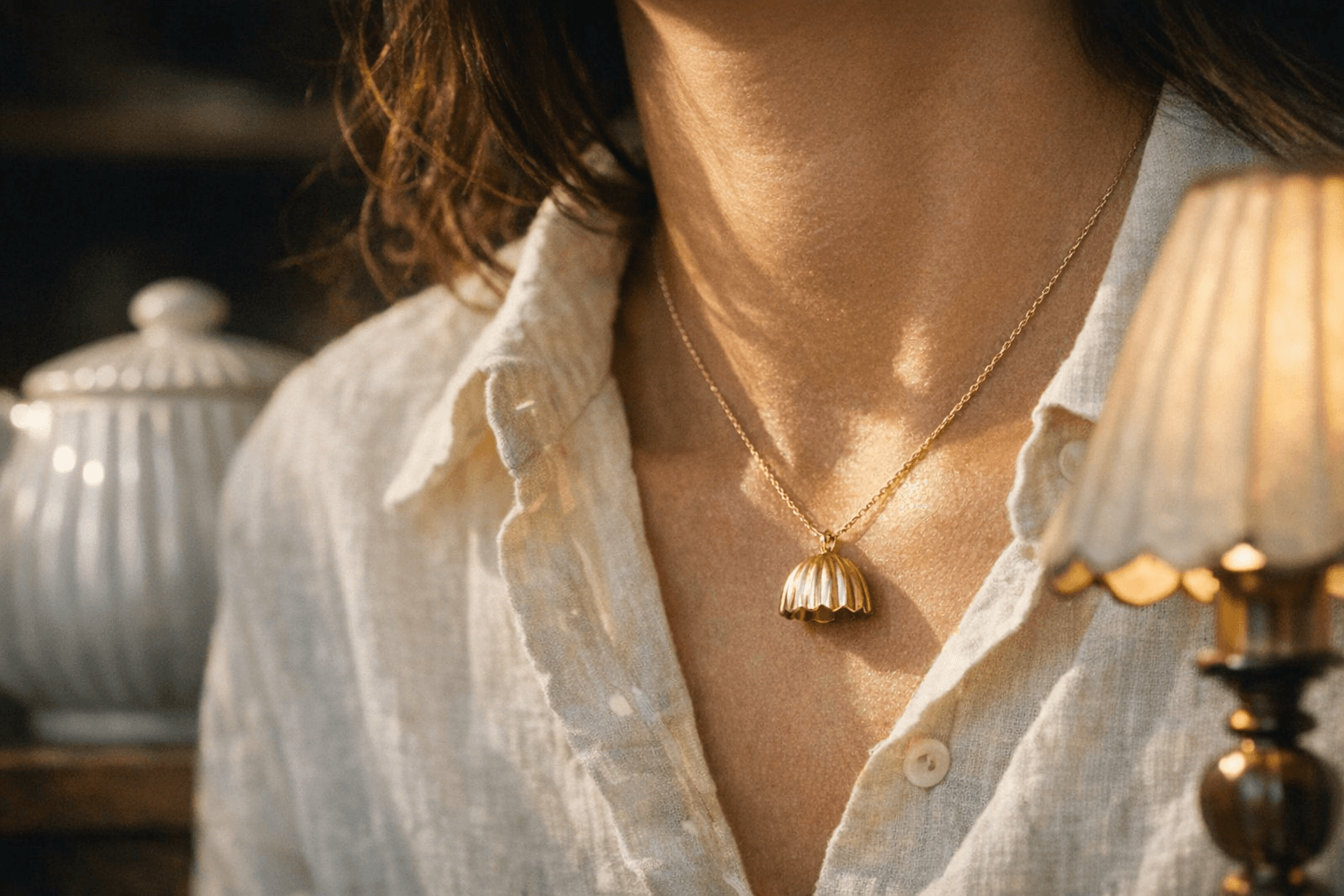
Casey Perez’s Loma pendant lands in that rare jewelry category that feels distinct the moment you see it, yet never so dramatic that it leaves the daily rotation. Its fluted surface gives it rhythm and depth, but the overall effect is soft, compact, and wearable, the kind of pendant that can move from a T-shirt to a button-down to an evening blouse without feeling overdesigned.
The inspiration is part of the appeal. Perez drew the shape from the curves of a fluted teapot and a vintage scalloped lampshade, two domestic objects that naturally suggest warmth, repetition, and form. That reference point matters because it keeps the pendant grounded. Instead of chasing sculptural novelty for its own sake, Loma translates familiar lines into something that reads as personal and easy to live with.
Why the silhouette works so well on the body
The Loma pendant is built around soft radial fluting, which gives it a repetitive silhouette that feels comforting rather than aggressive. That repetition is what makes it interesting from across a room and reassuring up close. The piece has enough structure to hold its shape visually, but it does not rely on sharp angles or oversized volume to make its point.
That balance is exactly why it fits everyday wardrobes so well. A pendant like this sits neatly with crewneck tees, fine knits, and simple tanks, where the fluting catches light without fighting the fabric. It also makes sense over an open-collar shirt or a blouse with a modest V-neck, where the pendant can rest in the negative space and become part of the line of the outfit rather than interrupting it. Even when paired with a slip dress or a tailored blazer, the shape stays quietly present instead of becoming costume-like.
The materials tell the real story
Perez’s brand language is clear about the material approach: the jewelry is made using recycled gold and responsibly sourced stones. For readers who care about provenance, that is the most meaningful part of the story, because it gives the pendant a concrete ethical framework rather than a vague sustainability gloss. The Loma pendant also includes a natural white diamond, which adds a small note of brightness without pushing the piece into high-drama territory.
That material combination reinforces the pendant’s daily-wear logic. Recycled gold is a useful signal for buyers who want precious metal with less mining dependence, and responsibly sourced stones remain one of the most important questions in fine jewelry. The Loma pendant does not try to overwhelm with carat weight or flash; instead, it relies on the integrity of the metal, the light-catching fluting, and the restrained presence of a single white diamond.
Perez’s background gives the design more depth
Perez is a first-generation Mexican-American designer who came to jewelry through an unexpected route. She moved to New York to study at New York University, discovered metalsmithing in a course there, and later became a self-taught designer. That path shows up in the work: there is a sense of formal curiosity, but also a hand-built intimacy that keeps the pieces from feeling too remote or precious.
Her broader studio philosophy centers on jewelry that means something, holding emotion, memory, and personal connection. She also draws inspiration from architecture, sculpture, and the natural world, and stays closely involved in making, including prototyping, soldering, polishing, and setting stones. Those details matter because they explain why a pendant like Loma feels polished without losing its human scale. It is not just designed to be seen. It is designed to be worn, handled, and folded into a life.
Where Loma fits in Perez’s growing language
Loma does not appear in isolation. It extends the same design vocabulary Perez has been building through her line, including the Tierra pendant, which JCK covered in 2025 and which was priced at $3,600 with 0.53 carats total weight of diamonds. That earlier piece set a precedent for Perez’s mix of gold, diamonds, and sculptural form, while Loma sharpens the focus on softness and repeatable wear.
Her inclusion in the Couture Diversity Action Council’s 2024 Luminaries program, one of six BIPOC designers selected for the cohort, adds another layer of context. It places her among a small group of designers being watched closely by the industry, not simply for aesthetic flair, but for the way they are reshaping what fine jewelry can look like when heritage, material discipline, and modern wearability are all treated as equally important.
Why this pendant feels like the next step for everyday jewelry
The pendant trend works best when it stops trying to be a statement and starts solving a wardrobe problem. Loma does that by offering texture instead of bulk, character instead of noise, and enough structure to feel intentional without becoming precious or fussy. It has the sort of silhouette that can become habitual, which is the highest compliment everyday jewelry can earn.
For readers building a small but serious jewelry rotation, that is the key appeal. Loma looks sculptural, but it wears like a familiar object with a little more light in it. That is what makes it feel less like a fashion accessory and more like a piece that settles into daily life and stays there.
This article was produced by Prism’s automated news system from verified source data, official records, and press releases, then run through automated quality and moderation checks before publishing. The system is built and supervised by the people who set the standards it runs under. Read our full AI policy.
Did this article answer your question?