Chokers return as the fastest way to sharpen minimalist outfits
Chokers are back as the quickest way to fix a bare neckline, from crewneck tees to slip dresses, with modern versions leaning on proportion, not nostalgia.

A choker can do what a great hemline does: make the whole outfit look considered. The strongest versions in 2026 are not trying to resurrect the 1990s whole cloth; they are using a tight line at the throat to sharpen everything around it.
Why chokers feel current again
A recent Editorialist update frames the choker as "redefin[ing] proportion" and "transforming minimalist necklines into intentional, face-framing statements." That is the modern logic in a sentence. The best examples in the edit move from slim metal chains to graduated pearls with architectural spacing, then out to sculptural collars and crystal-leaning versions, which means the category now covers both restraint and drama without losing its shape.
Sotheby’s has put that shift into a wider fashion context, calling collar-length chokers part of the broader return of maximalism. The detail that made the point feel especially contemporary was Noah Lyles wearing a vintage choker necklace when he won gold in the 100-meter dash at the 2024 Paris Olympics. A necklace that reads clearly on a track victory lap is not a fragile trend piece; it is an object with enough graphic force to survive scrutiny.
The appeal is emotional as much as visual. Vogue Singapore described statement chokers as a major comeback after several seasons of quiet luxury, and that tracks with the mood around dressing now. The Jewellery Editor has gone even further, saying chokers can communicate "submission, dominance, allure, and rebellion." That range explains why the same silhouette can feel intimate on bare skin and sharply assertive under tailored cloth.
Crewneck tee: the fastest fix for a blank neckline
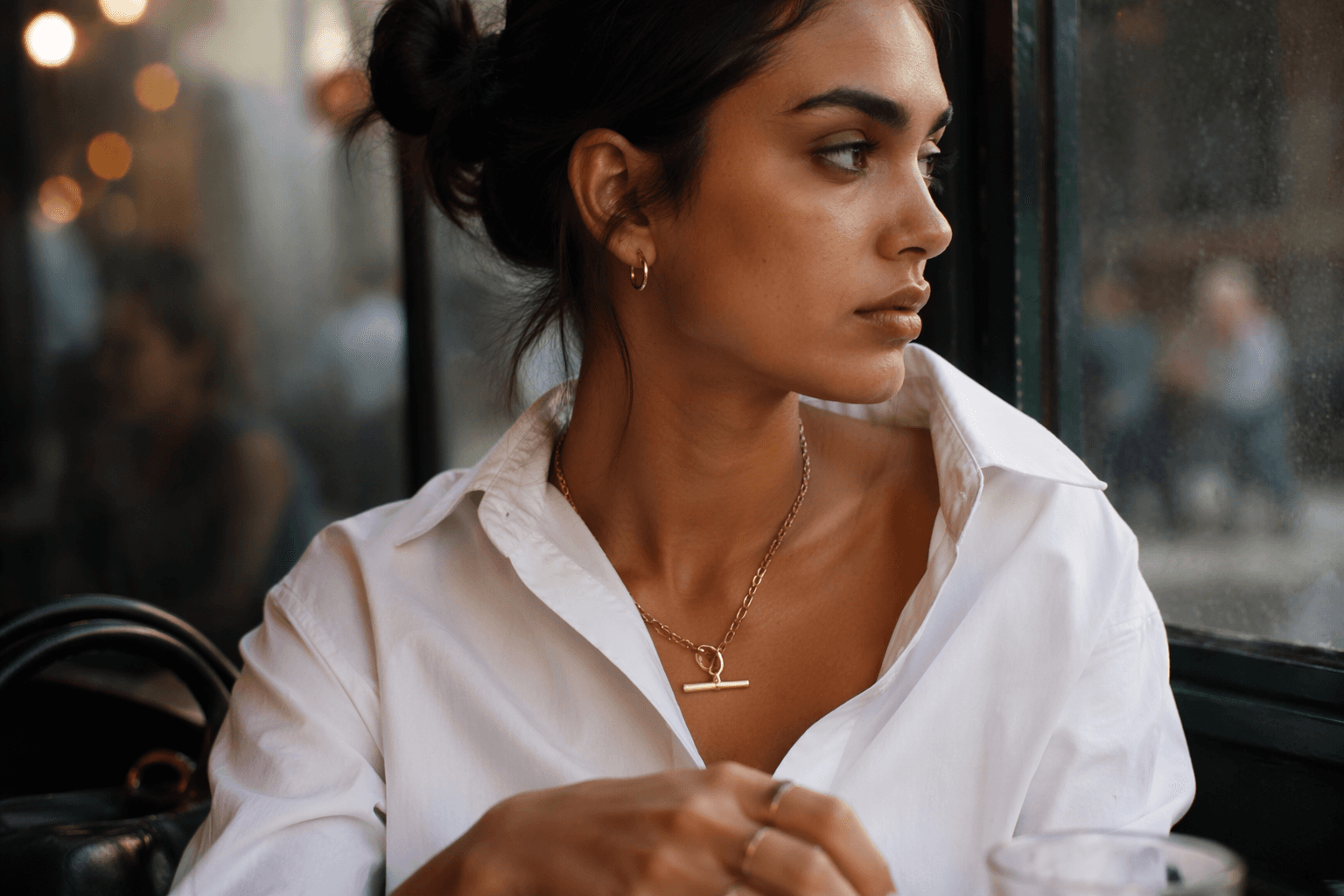
A crewneck tee is the most ordinary canvas in a wardrobe, which is exactly why a choker works so well with it. The neckline already makes a circle around the face, so the best choker is one that tightens that geometry rather than crowding it. A slim metal chain is the cleanest answer here, especially in polished gold or silver that catches light without reading precious or fussy.
For a minimalist dresser, this is the easiest place to start because the shirt does most of the work and the necklace only needs to sharpen the line. A plain tee with a choker turns from off-duty into deliberate in one move. Keep the rest spare, and the piece feels contemporary rather than nostalgic.
Open button-down: where spacing matters most
An open button-down gives you a vertical line down the center, so a choker should act like punctuation at the throat. This is where graduated pearls with architectural spacing make the most sense, because the gaps keep the necklace airy while still reading as a designed object. The effect is cleaner than a dense strand and less predictable than a single chain.
With two or three buttons undone, the shirt creates enough negative space for the choker to read clearly, which is what keeps the look from feeling overworked. A pearl choker here should feel disciplined, not bridal. If the pearls are too uniform and the shirt too prim, the result can drift backward in time; if the spacing is intentional, the whole look looks edited.
Slip dress: let the necklace supply the structure
A slip dress is all fluidity, so it is the easiest place for a choker to become the line that holds the look together. Sculptural collars are especially strong here because they introduce architecture against fabric that otherwise slides and pools. Crystal or embellished chokers can also work, but only when they are used as a single flash, not as part of a crowded jewel story.
This is the scenario where a choker can do the work of both necklace and framing device. The dress gives you sheen; the choker gives you edge. In 2026, the polished version avoids the over-layered Y2K mood and keeps the attention on one object near the throat, not a whole pile of sparkle.
Strapless top: go bolder, but stay clean
A strapless top leaves the collarbone and shoulders open, which makes it the most natural setting for a collar-length choker. That is where a more sculptural or embellished piece can step in, because the neckline needs a visual anchor and the bare skin gives the jewelry room to breathe. The boldest versions still work best when they look precise rather than overloaded.
This is also where the maximalist side of the choker story makes sense. A structured collar or crystal-studded shape can give a strapless top the sort of finish that feels intentional from across the room. The key is restraint in the styling around it: one strong necklace, not a competition between the choker, the earrings, and the dress.
What keeps the 2026 version from feeling dated
The difference between current and costume is mostly proportion. The 2026 choker looks polished when the line is exact, the materials are disciplined, and the piece has a clear purpose on the body. Chain chokers, pearl and beaded chokers, and crystal styles all fit the moment, but only when each one feels resolved rather than decorative for decoration’s sake.
Ribbon chokers and velvet versions still belong to the style’s history, and CNA Lifestyle notes that more accessible ribbon versions helped spread the look beyond royalty and runway. That history matters, because chokers have always moved between class signals, rebellion, and mass culture. Still, the freshest interpretations now lean away from anything that looks overly soft or costume-like unless the rest of the outfit is stripped back enough to balance it.
A piece with a very long memory
The choker is older than any of its current fashion cycles. CNA Lifestyle traces the style back to around 2500 BC, when the Sumerians wore chokers as amulets, and the lineage reaches into ancient Egypt as well, where the necklace carried protective meaning. Later, Anne Boleyn became linked with a pearl choker marked by a "B" pendant, while Queen Alexandra of Denmark popularized opulent chokers in the late 19th century to conceal a neck scar.
That arc from amulet to court jewel to countercultural accessory is why the choker keeps coming back with new emotional meanings. CBC Life has followed it through royal courts, counterculture, and fashion weeks, and the pattern is clear: every generation finds a reason to tighten something around the neck and call it new. In this one, the reason is simple, a choker solves the neckline before the rest of the outfit has even had a chance to explain itself.
This article was produced by Prism’s automated news system from verified source data, official records, and press releases, then run through automated quality and moderation checks before publishing. The system is built and supervised by the people who set the standards it runs under. Read our full AI policy.
Did this article answer your question?