Common Era’s Fragments collection turns ancient relics into wearable gold
Ancient fragments become intimate talismans in Common Era’s first five 14k-gold pieces, where broken forms meet daily wear.
From relic to daily ritual
Common Era’s Fragments collection lands at a moment when polished perfection feels less compelling than jewelry with a trace of memory. The line translates ancient relics, partial figures, and mythic symbols into 14k gold pieces that read as small heirlooms rather than precious objects sealed away for special occasions. That shift matters: the collection is not chasing symmetry for its own sake, but the emotional pull of what has survived.
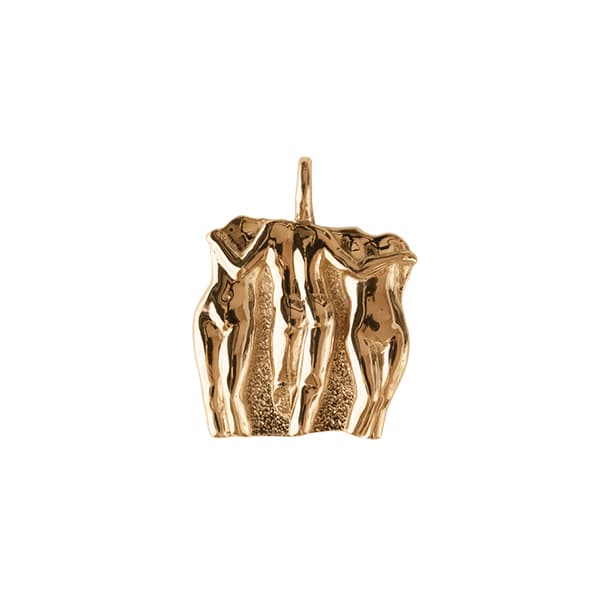
Torie Tilley built the line around historic forms she encountered in Paris and in museums, including the Louvre. The first five pieces take cues from the Three Graces, an Ionic column, a sculpture of two lovers, a loyal hound on a funerary relief, and an inscribed tablet. Together, they make a strong argument for imperfect heirloom jewelry, the kind that feels more alive when it has edges, fragments, and story built into the design.
Why the broken look feels right now
The appeal of Fragments is not simply that it references antiquity. It is that the collection treats incompleteness as a virtue. A fragment suggests touch, loss, endurance, and time, which gives the pieces more emotional charge than a perfectly polished symbol ever could. In daily wear, that translates into jewelry that feels intimate on a white shirt, layered over a fine knit, or tucked into a chain stack where the silhouette can do the talking.
Tilley has said the collection was inspired by a January trip to Paris with her husband and their baby boy. They arrived just before a major snowstorm, spent more than 20,000 steps touring the Louvre with the stroller, and watched their 8-month-old son reach toward a Three Graces fragment behind glass. That detail gives the line its beating heart: the idea that broken things can still move us, and that beauty often comes from what remains, not what is untouched.
The pieces and the mythology behind them
Fragments debuted with five pieces in 14k gold, and the motifs are carefully chosen rather than decorative for decoration’s sake. The Three Graces reference classical beauty and companionship. The Ionic column brings architecture into the mix, turning a structural element into a wearable form that can sit neatly against a chain or stand alone as a quiet statement.
The sculpture of two lovers introduces the softer side of the collection, while the hound motif, inspired by ancient Greek and Roman funerary reliefs, carries the symbolism of fidelity and memory. The inscribed tablet rounds out the group with the feel of a record, a surface meant to preserve language, ritual, or name. Tilley has also described the Orphic tablet in the collection as a ritual object tied to the afterlife, which deepens the line’s connection to belief systems that treated objects as carriers of meaning.
That mix of references makes Fragments especially strong for everyday jewelry because it is not trying to be loud. The pieces can sit close to the body, where their symbolism becomes personal rather than performative. A collection like this works best when it feels discovered, not announced.
How to wear ancient-history jewelry now
The most convincing way to wear Fragments is with restraint. These are the kinds of pieces that sharpen a simple wardrobe instead of competing with it. A pendant based on the Three Graces or an inscribed tablet looks cleanest against a buttoned white shirt, where the gold can catch light without needing embellishment. The hound and lovers motifs feel especially good with a ribbed knit or a wool crewneck, where the texture of the clothes echoes the tactile quality of the designs.

Layered chains give the collection room to breathe. A fragment-inspired charm or pendant can sit between a longer chain and a shorter collar, creating the sense of an assembled personal archive rather than a matched set. That is where the “imperfect heirloom” idea becomes practical: the jewelry does not need to be reserved for special events, because its power comes from being worn often enough to gather its own patina of life.
- A single motif pendant works best when the neckline is clean and uncluttered.
- A hound or column detail can anchor a mixed chain stack without overpowering it.
- The more spare the outfit, the more visible the ancient references become.
What Common Era says about sustainability and craft
The collection is not only about symbolism. Common Era says Fragments is about “what survives,” and its solid-gold pieces are rendered in solid gold, made by hand in the brand’s New York City studio using the lost-wax method. That production choice matters because lost-wax casting allows for sculptural detail, which suits fragment-inspired forms better than flat, generic shapes would.
The brand also says its solid-gold pieces use 100% recycled gold and that all production facilities are RJC certified. Those are the details worth watching when a jewelry label talks about responsibility. Recycled gold reduces dependence on newly mined material, while RJC certification signals a production framework tied to responsible business and supply-chain standards. It is a stronger sustainability story than vague language about consciousness or care, and the specificity gives the collection more credibility.
Common Era also says it donates 3% of all profits to the Animal Welfare Institute. That detail extends the brand’s values beyond materials alone, and it helps place Fragments in a corner of fine jewelry where ethics are part of the product narrative, not an afterthought.
Why this collection feels collectible
Tilley founded Common Era in 2019, and she has said she prefers to make collections when she is genuinely moved rather than on a fixed retail calendar. That slower rhythm suits Fragments, which is presented as a collection in progress, one that will grow over time the way a museum grows its holdings. The result is less seasonal drop, more living archive.
That approach gives the line unusual depth for everyday jewelry. It feels personal because the inspiration came from a family trip. It feels collectible because the references are drawn from documented sources and historic relics rather than generic motifs. And it feels wearable because the scale, material, and restraint make room for daily use. In a market crowded with neat perfection, Common Era is making a strong case for pieces that carry cracks, memory, and gold all at once.
This article was produced by Prism’s automated news system from verified source data, official records, and press releases, then run through automated quality and moderation checks before publishing. The system is built and supervised by the people who set the standards it runs under. Read our full AI policy.
Did this article answer your question?