Daily Care Habits That Keep Your Fine Jewelry Looking New
Most jewelry damage happens not from wearing your pieces but from the five minutes before and after. A material-specific routine changes everything.
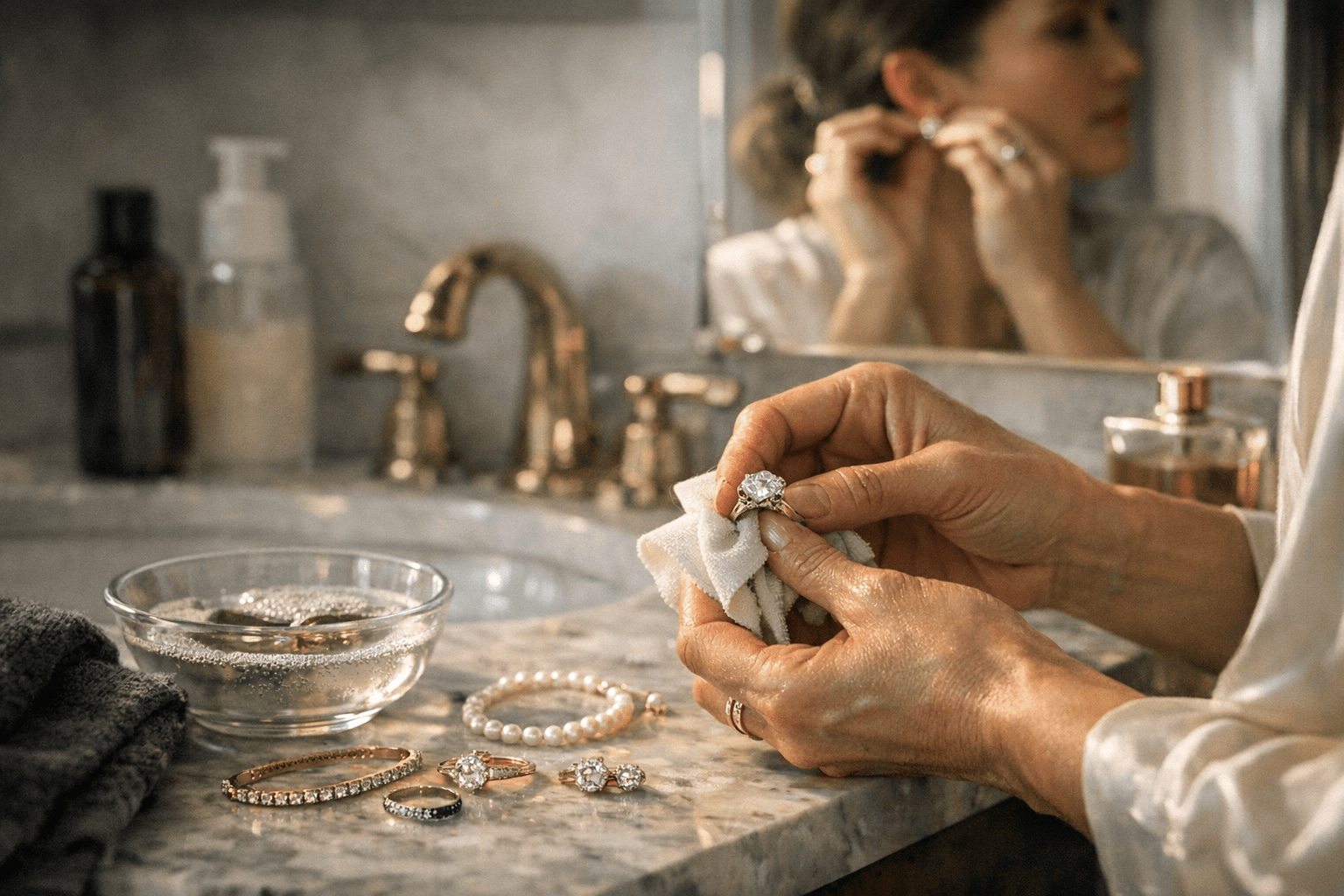
The gold ring that loses its mirror polish, the pearl strand that dulls to a chalky finish, the white gold band that slowly warms to yellow: these are not stories of inferior craftsmanship. They are stories of preventable neglect. The habits that protect fine jewelry are not elaborate, expensive, or time-consuming. Most take under five minutes. The gap between jewelry that lasts a lifetime and jewelry that deteriorates within a few years has almost nothing to do with price point and nearly everything to do with what happens between wearings.
The 10 Most Common At-Home Mistakes
Understanding what damages jewelry is the fastest path to stopping it. These are the errors that jewelers see most often:
1. Putting pieces on before getting dressed. Perfume, hairspray, and lotion contain chemicals that permanently damage the surface of pearls and other porous or delicate stones, including turquoise.
The rule is simple: jewelry goes on last, always.
2. Wearing fine pieces in chlorinated water. Chlorine bleach and pool water can pit and damage gold alloys, a fact the Gemological Institute of America documents clearly.
Remove rings and bracelets before swimming, every time.
3. Reaching for the ultrasonic cleaner without checking the stones first. Consumer ultrasonic cleaners, available for under $150, have become a household staple, and that accessibility is part of the problem.
Ultrasonic vibrations can cause chips, cracks, or complete breaks in softer gemstones. More critically, they are unsafe for any stone that has been treated: fracture-filled diamonds (where a lead glass-like substance fills the break) will lose their clarity enhancement, and emeralds, which are almost universally filled with oil, resin, or wax, will lose that treatment entirely. The machine cannot tell a treated stone from an untreated one.
4. Cleaning pearls with anything other than a dry or barely damp cloth. Soaking pearls even briefly accelerates surface erosion.
5. Using ammonia-based cleaners on vintage or delicate pieces. Many household glass cleaners contain ammonia.
These are too harsh for antique settings and fragile gems.
6. Leaving white gold unserviced as it yellows. The bright white appearance of white gold comes entirely from a thin rhodium plating, not from the gold itself.
As that layer wears, especially on the underside of rings and high-friction surfaces, the warmer yellow of the underlying alloy shows through. This is not damage; it is normal wear. But leaving it unaddressed year after year compounds the problem.
7. Storing chains loose in a jewelry box. Unclasped chains tangle against one another and scratch softer stones.
This is purely a storage problem, not a quality problem, and it is entirely preventable.
8. Exercising while wearing fine jewelry. Sweat is mildly acidic, and the physical impact of workouts can bend prongs and loosen stones.
This is how diamonds get lost.
9. Cleaning with toothpaste. The internet has kept this myth alive for decades.
Toothpaste is abrasive. It scratches metal surfaces, loosens stones in their settings, and is particularly destructive to pearls and opals, stripping both of their surface color and shine.
10. Ignoring the rinse. Even gentle soap left in the crevices of a prong setting will dull a diamond and trap moisture.
A thorough rinse and complete dry are non-negotiable finishing steps.
Material-by-Material: A Quick Reference
| Material | Clean With | Avoid | Notes |
|---|---|---|---|
| Solid gold (14k/18k) | Warm water, mild dish soap, soft brush | Bleach, chlorine | Safe for gentle ultrasonic if no treated stones |
| Sterling silver | Warm water, mild soap; anti-tarnish strips for storage | Rubber, wool, latex | Tarnishes from oxidation; store with anti-tarnish strips |
| Pearls | Soft dry or barely damp cloth only | Water soaking, all chemicals, perfume | Wipe after every wear; store in soft cloth pouch flat |
| Opals | Soft damp cloth | Heat, chemicals, perfume, lotion, sports | Can crack, brown, or lose play-of-color from chemical exposure |
| Gold-plated pieces | Barely damp soft cloth; no soaking | Harsh chemicals, humidity, abrasives | Plating is thin; every scrub removes it faster |
| Costume/fashion pieces | Dry cloth only | All moisture where possible | Base metals corrode; keep dry and stored separately |
Your Weekly and Monthly Routine
A sustainable routine takes the guesswork out of care.
Every week:
- Wipe all pieces you wore during the week with a soft, lint-free cloth before returning them to storage. This removes the skin oils, lotion residue, and environmental buildup that accelerate tarnish and dullness.
- Check clasps and closures. A loose clasp caught early is far less expensive than a lost pendant.
- Close every necklace clasp before storing. This single habit eliminates the vast majority of tangling.
Every month:
- Wash gold and diamond pieces in warm water with a drop of mild dish soap, using a soft-bristled brush (a baby toothbrush works well) to work gently around prongs and under settings. Rinse thoroughly in clean water, and pat completely dry with a lint-free cloth before storing.
- Check silver pieces for tarnish and replace anti-tarnish strips in storage pouches or boxes if they have changed color, a sign that they have absorbed sulfur compounds and are no longer effective.
- Inspect any gold-plated or vermeil pieces for wear points, particularly on clasp areas and ring shanks, where the base metal tends to show first.
Travel and Storage Checklist
How jewelry is stored and transported determines much of its longevity. Before packing:
- Store each piece individually in its own fabric pouch to prevent stone-on-stone and metal-on-metal contact. Even diamonds scratch other diamonds.
- Pack anti-tarnish strips alongside silver and plated pieces. When traveling from a dry climate to a humid one, airborne moisture catalyzes oxidation on sterling silver and base metals faster than almost any other single factor.
- For necklaces, thread the chain through a drinking straw before fastening the clasp: it keeps the chain taut and tangle-free during transit, a trick that requires no special equipment.
- Bring only what the trip actually requires. Heirloom and high-value pieces are better left in a home safe or bank safety deposit box.
- At your destination, keep jewelry away from bathroom counters. Humidity from showers accelerates tarnish and can warp organic materials like pearls and amber over several days.
At home, temperature-controlled, dry storage is the standard: a lined jewelry box in a bedroom drawer outperforms a bathroom counter display every time.
Myths Worth Busting
*"Toothpaste polishes silver and gold."* It polishes by scratching. The abrasive particles that whiten teeth remove thin layers of metal, creating microscopic surface damage that dulls your pieces over time. It is genuinely harmful to pearls and opals.
*"Soaking jewelry in water is harmless."* For gold set with hard, untreated diamonds: probably fine. For pearls, opals, turquoise, or any porous or organic material: prolonged water exposure degrades the surface and, in the case of pearls, erodes the nacre layer that creates their luster.
*"If the ultrasonic hasn't broken a stone yet, it's safe."* Treatment damage from ultrasonic use is often cumulative and invisible until it is not. The GIA is explicit: never use an ultrasonic on fracture-filled, cavity-filled, or oil-treated stones.
*"White gold stays white on its own."* It does not. The white is rhodium; the gold beneath is yellowish. High-wear pieces like rings typically need replating every 12 to 18 months. Necklaces and pendants, which see less friction, can go longer.
When to Call a Professional
Annual inspections are not optional maintenance for fine jewelry; they are the mechanism by which small problems are caught before they become expensive ones. A jeweler checking prong integrity, re-tipping worn prongs, and rhodium-replating white gold once a year is far less costly than replacing a lost stone or repairing a broken shank. For pearl strands that see regular wear, periodic restringing prevents the loss of multiple beads when a single thread breaks.
The pieces worth wearing every day are worth protecting with the same intention. A five-minute weekly routine, material-aware storage, and one professional visit per year is the full playbook. None of it is complicated, which is exactly why so few people do it consistently.
This article was produced by Prism’s automated news system from verified source data, official records, and press releases, then run through automated quality and moderation checks before publishing. The system is built and supervised by the people who set the standards it runs under. Read our full AI policy.
Did this article answer your question?