Feng J Brings Gem-Painting Artistry From Jewelry to Museum Sculpture
Feng J's gem-painting practice reaches museum scale with Rêverie à Giverny, a titanium-and-bronze dragonfly sculpture on view through July 5 in Monet's village.
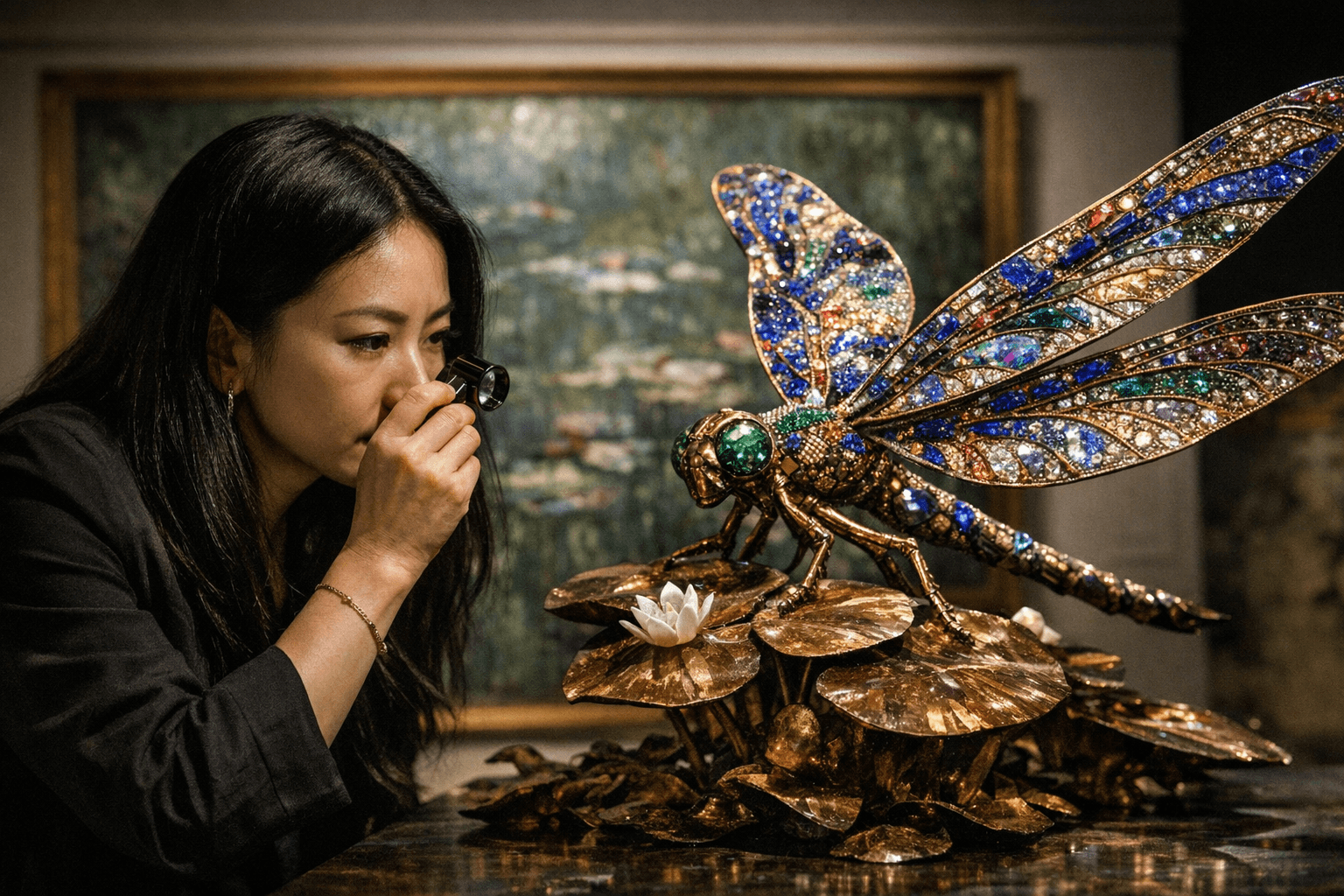
Rêverie à Giverny, a stylized dragonfly rendered in titanium and bronze and set with chalcedony, serpentine jade, and aventurine, marks Feng J's debut as a sculptor inside an art museum. The piece is on view at the Musée des Impressionnismes Giverny through July 5, 2026, as part of the museum's spring program, which includes the exhibition "Before the Water Lilies: Monet Discovers Giverny, 1883-1890" and falls in the centenary year of Monet's death.
The placement feels less like a departure than a natural homecoming. Feng J has long described her studio practice as "painting with gems," drawing a deliberate connection between her method of layering translucent, double rose-cut stones and the dappled, chromatic logic of Impressionist painting. Her gem palette, regularly compared to Impressionist watercolor, has drawn her to Giverny before: in 2020, she created "Les Jardins de Giverny," a necklace for a Phillips auction inspired by a visit to the garden where Monet painted. Rêverie à Giverny scales that vocabulary from wrist to gallery floor.
The material choice in the sculpture is instructive. Titanium, the same lightweight structural element that defines her brooch architecture, makes her signature Floating Set technique possible at any size. In her jewelry, titanium armatures allow double rose-cut stones to splay outward in up to six layers, each catching light at a different angle with minimal visible metal. The chalcedony, serpentine jade, and aventurine in Rêverie à Giverny carry that same logic: semitransparent stones whose color shifts with movement, producing at large scale the optical shimmer she has spent a decade perfecting in miniature.
That decade is itself part of the story. Feng J is marking ten years as a high-jewelry artist in 2026, a span during which she moved from her Shanghai studio to producing work at a Place Vendôme atelier, placed a Ginkgo Leaf brooch in the permanent collection of a Paris museum, and built a collector following that extends to international auction.
The architectural instinct behind her work has an unlikely origin. Feng J studied product and furniture design at China Academy of Art under Pritzker Prize-winning architect Wang Shu before earning a Master's in Jewelry Design from the University of the Arts London and completing further training at the Haute École de Joaillerie in Paris. Painting runs deeper still: her great-grandfather was a court painter in the late Qing Dynasty, the lineage she has pointed to when describing why she treats colored stones as pigment rather than adornment.
Rêverie à Giverny is on view through July 5.
Know something we missed? Have a correction or additional information?
Submit a Tip