Francesca Villa turns flea-market finds into couture jewelry
Francesca Villa’s jewels turn flea-market relics into heirlooms, proving that provenance, wit and serious craft can make vintage references feel newly collectible.

A collector’s eye, sharpened early
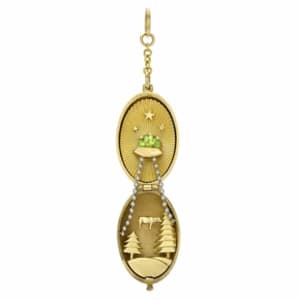
Francesca Villa has made a compelling case for jewelry as narrative object. Her pieces begin in flea markets, antique shops and the cabinets of specialist memorabilia collectors, then emerge as finely made jewels that feel intimate rather than nostalgic for nostalgia’s sake. That distinction matters: Villa is not simply borrowing old motifs, she is translating objects with prior lives into wearable forms with new emotional charge.
Her work lands in the sweet spot collectors now prize most, where provenance is part of the value and personality is not decoration but structure. A cameo, a truck pin or an Essex Crystal carving becomes the starting point for a jewel that is meant to be worn, studied and kept. In a market crowded with polished minimalism, Villa’s vocabulary is richer, stranger and far more memorable.
Memory as material
Villa’s sensibility was shaped early by family. She grew up traveling with parents who loved vintage and antiques, and she was encouraged by her grandmother to see jewelry as something more than adornment. That family education gives her pieces their emotional temperature: they are precise and refined, but they also carry the sense that they were always meant to tell a story.
Her own brand language describes that impulse as a devotion to “story and memory,” and the phrase feels apt. Villa’s jewels are built around objets trouvés, the rescued fragments and overlooked relics that become more compelling once they are removed from their original context. She founded her eponymous label in 2007 after years spent working through the Valenza atelier system and later serving as creative director for major luxury houses, a background that explains why her work has both the freedom of an independent maker and the polish of a seasoned maison hand.
The collections that make the point
Villa’s current collections show just how elastic vintage reference can be when it is handled with discipline. Change Your Stripes uses reversible rings and pendants with a cameo on one side and a small painting on the other, a simple idea that makes the jewel feel like a private object with two moods. The reversibility is clever, but not gimmicky; it extends the life of the piece and deepens its sense of ownership.
Lover’s Eye takes a more romantic path, with pendants featuring lenticular eyes. The motif has centuries of sentimental baggage, yet Villa keeps it from tipping into costume by giving it a contemporary frame and a collector’s finish. Being Crystal looks to Essex Crystal carvings, a decorative tradition that can easily become precious in the wrong hands, but here reads as meticulous and deliberate, with the sort of surface interest that rewards close looking.
Her latest collection, On the Road, is perhaps the most evocative of all. It draws on vintage American truck pins from the 1970s, the era when those pins appeared alongside trucker caps as an open-road badge of honor. Villa turns that slice of American visual culture into something surprisingly elegant, proof that a humble pin can become the architecture for a couture jewel when it is reinterpreted with intelligence.

Why it reads as couture, not costume
The reason Villa’s vintage references feel collectible rather than costume-like lies in the way she balances source material and execution. She does not freeze the found object in amber. Instead, she isolates the most potent part of its image language, then rebuilds it in precious materials with the exacting finish expected of fine jewelry.
That is where her technical credibility matters. The pieces are made in her atelier in Valenza, Piedmont, the Italian jewelry hub where craftsmanship is a way of life, not a marketing line. Her brand uses recycled gold throughout, and her workshop carries Responsible Jewellery Council certification under both Code of Practices and Chain of Custody standards, which places her firmly within the conversation about traceable, responsible luxury. In a category where buyers increasingly ask not only what a jewel looks like but where it comes from, that combination of ethics and artistry carries real weight.
The result is jewelry that feels personal without slipping into sentimentality. A flea-market find can be witty; a cameo can be sharp; a historical reference can be deeply modern if the construction is exact and the point of view is clear. Villa understands that a jewel with a story is not just one with a past, but one with enough specificity to matter now.
Why Couture is the right stage
Villa is bringing nine designs to Couture in Las Vegas, where the pieces are priced between 12,000 pounds and 29,000 pounds depending on materials. That range places her firmly in the realm of serious fine jewelry, where craftsmanship, uniqueness and narrative all influence value. These are not novelty pieces dressed up as luxury. They are luxury pieces that happen to begin with the romance of discovery.
Couture itself is an apt setting. The fair runs May 27 through May 31, 2026 at Wynn Las Vegas, beginning with opening night on May 27 at 6:00 PM, and it is positioned as an intimate destination for designer fine jewelry and luxury timepieces. For 2026, organizers are emphasizing curation, intimacy and community, while pointing to one-of-a-kind pieces, statement gold jewelry and rare work with strong storytelling as especially strong categories. Villa’s practice fits that direction with unusual precision.
That alignment is not accidental. As the trade leans toward pieces that feel edited rather than merely expensive, Villa offers a model of how heritage references can be recoded for modern collectors. She gives flea-market ephemera the discipline of high jewelry, then lets memory do the rest. In her hands, provenance is not a footnote, it is the point, and that is exactly why her work feels so current.
This article was produced by Prism’s automated news system from verified source data, official records, and press releases, then run through automated quality and moderation checks before publishing. The system is built and supervised by the people who set the standards it runs under. Read our full AI policy.
Did this article answer your question?