Layered necklaces stay fresh for casual, office and dressy looks
The smartest necklace stack is built for the neckline in front of you. Two or three well-spaced lengths usually look sharper than a crowded pile.

NET-A-PORTER folded necklace-layering into its FW24 jewelry edit and called it "not a new art form." Layered necklaces work best when they solve a styling problem: a plain sweater that needs shape, a blouse that needs polish, or an evening dress that feels too bare at the collarbone. The look is still current because it is built on proportion, not novelty.
Start with the neckline, not the necklace
Crew necks and higher necks
A crew neck gives you a compact frame, so the cleanest solution is usually one short chain close to the throat and one longer pendant that drops below the fabric line. That separation creates dimension without crowding the collarbone, which is exactly why two lengths often read more polished than four. A short necklace in the 14-16 inch range can sit above the neckline, while an 18-inch or 20-22 inch piece gives the eye a second resting point.
V-necks and open necklines
V-necks are the easiest neckline to layer because the shape already points downward. A slim chain that traces the opening, then a slightly longer pendant, echoes the garment instead of fighting it. If you want a third piece, keep it delicate and visibly spaced so the necklace stack does not collapse into one dense cluster at the center of the chest.
Button-down shirts and office collars
A button-down wants order. Leave the top one or two buttons open and build with pieces that follow the vertical line of the placket, not a stack that spreads too wide. This is where a fine chain, a small pendant, and a slightly longer cable or box chain can read as intentional rather than fussy.
Strapless and evening necklines
With a strapless dress or a wide scoop, the neckline becomes a stage, so the necklaces can work harder. One choker, one mid-length pendant, and one longer line can create a clear progression from the throat to the sternum. Chokers, pendants, and multi-line necklaces map neatly onto this kind of evening dressing because they sit at different points on the body.
Use length as your organizing principle
The most reliable formula is still the simplest: start with two or three necklaces at different lengths so each sits visibly apart. A 14-16 inch piece, an 18-inch piece, and a 20-22 inch piece solve two problems at once, tangling and visual clutter.
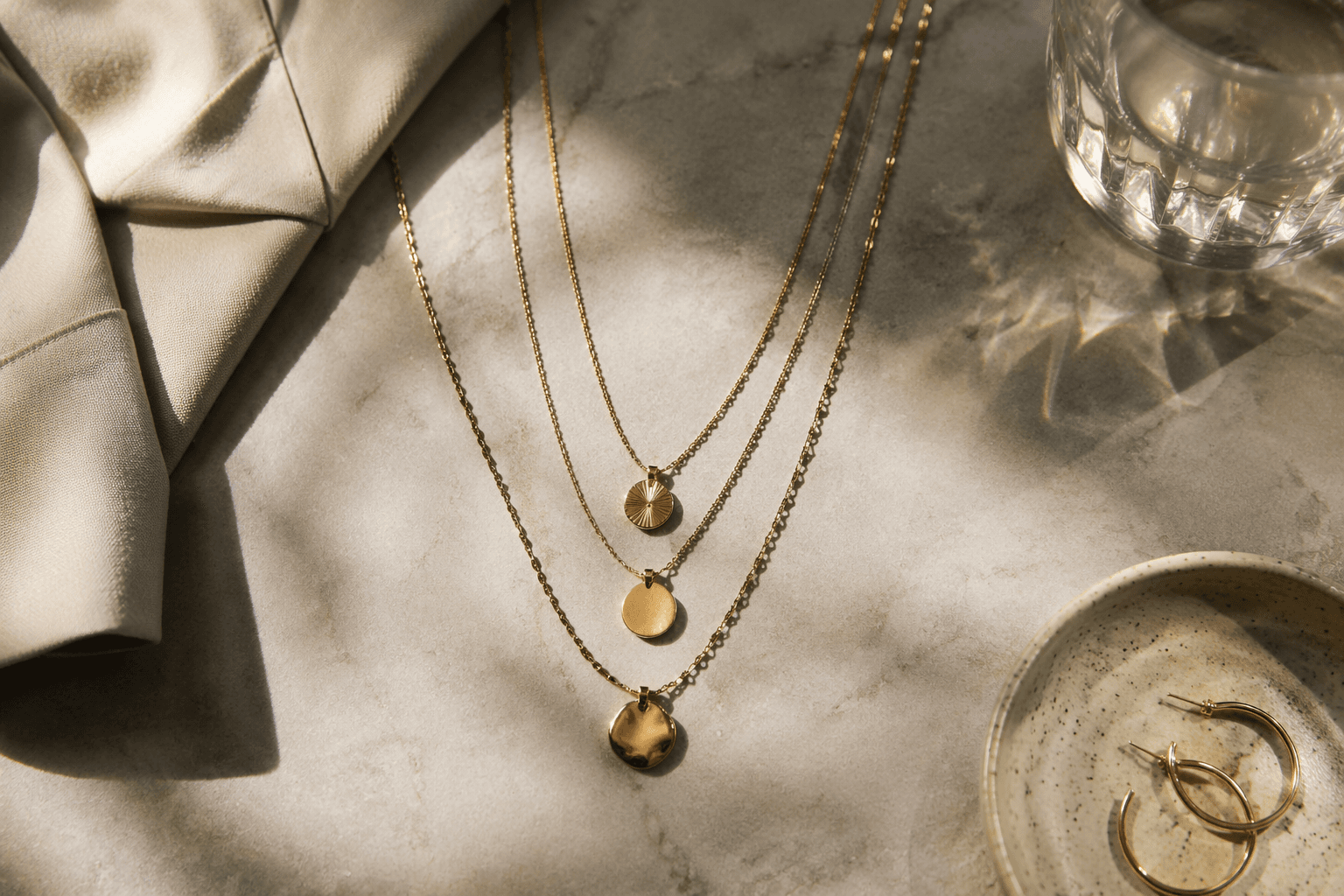
A good rule is to keep a short piece near the base of the neck, a middle layer at the collarbone, and a longer layer at or below the top of the bust. That structure gives even small-scale jewelry real presence, especially if the chains differ slightly in thickness. A whisper-thin snake chain next to a rolo or paperclip chain gives the stack texture without forcing a bigger statement.
Match the stack to the occasion
For daytime and casual wear, think of layering as a way to make a simple top feel finished. A T-shirt, knit polo, or cashmere crew gains interest from one short chain and one pendant, especially if one piece has a polished metal surface and the other has a bit of movement.
For office wear, the best stacks stay controlled. Two necklaces are often enough, particularly with tailoring, a crisp shirt, or a knit set that already has texture in the clothing. Keep the shorter layer delicate and the longer one understated, so the jewelry supports the outfit instead of competing with it.
For dressier moments, you can add a third layer, but only if the pieces are clearly differentiated. A choker, a small pendant, and a longer necklace work well when the metals, finishes, or stone settings are distinct enough to read separately.
Build dimension with texture, not excess
Layering gets interesting when the pieces differ in finish. A polished chain beside a matte surface, or a plain gold necklace beside one with a pendant, adds depth even when the color palette stays the same. Two necklaces with strong spacing and a thoughtful contrast in texture often look richer than three pieces that all compete for attention.
Stones should be chosen with the same discipline. A small diamond pendant, a bezel-set gem, or a softly colored stone can anchor the stack, but only if the rest of the necklaces are quiet enough to let it register. A bezel setting gives a stone a smoother, more modern outline than prongs do, which can matter when you want the pendant to read sleek and integrated rather than decorative and busy.
Avoid the mistakes that make layers look accidental
The most common mistake is choosing necklaces that are too close in length. If two chains sit almost on top of each other, they tangle, twist, and visually flatten into one mass. Another error is mixing too many focal points, such as three pendants of equal size, which turns the stack into a contest instead of a composition.
It also helps to avoid overloading every layer with the same level of shine. When every necklace is heavy, bright, or stone-set, nothing stands out. Better to let one piece lead and let the others support it. Jewelers of America highlighted dainty and delicate jewelry as a 2025 trend.
This article was produced by Prism’s automated news system from verified source data, official records, and press releases, then run through automated quality and moderation checks before publishing. The system is built and supervised by the people who set the standards it runs under. Read our full AI policy.
Did this article answer your question?