Polly Wales and Castro Smith unite for fantasy-driven one-of-a-kind jewelry collection
Polly Wales and Castro Smith turn molten gold, engraving, and rainbow sapphires into 16 one-of-a-kind jewels that feel talismanic enough for every day.
There is a particular kind of fine jewelry that looks most compelling once it has been worn into a life, and Polly Wales and Castro Smith understand that instinct almost instinctively. Their 16-piece collaboration pairs Wales’s cast-not-set gemstones with Smith’s intricate hand engraving, producing one-of-a-kind rings and necklaces that feel less like finished objects than like artifacts in motion.
A collaboration with two very different signatures
What makes this partnership unusually strong is the clarity of the contrast. Wales, who is based in Los Angeles, has spent more than a decade refining a cast-not-set method in which gemstones are dropped directly into molten metal during casting, while Smith, working from East London, brings a printmaker’s precision and a visual language rooted in mythology, biology, historical ornament, fantasy, sci-fi, and Asian and European traditions. Together, they have built what Wales calls a shared ecosystem of “molten landscapes,” engraved “caves,” and hidden creatures and relics.
That is not just a poetic conceit. It is the central reason the collection reads so differently from conventional fine jewelry. The pieces were introduced through a digital preview on June 4, 2026, followed by a Los Angeles pop-up at PWFJHQ on June 4 and 5, and a digital launch on June 5 at 6pm GMT, 10am PT. The sequence underscored the collection’s rarefied, artisanal character, the sense that these are not inventory-driven products but singular works that happen to be wearable.
Why cast-not-set changes the way jewelry lives on the body
Wales’s technique matters because it changes both the look and the utility of the piece. Instead of placing stones in a conventional prong or bezel setting after the metal is formed, she casts the gemstones directly into the molten gold, letting them settle into place as the jewel takes shape. The result is a surface that feels integrated rather than assembled, with stones appearing embedded in the metal as if they emerged there.
For everyday wear, that seamlessness is a quiet advantage. Cast-in stones tend to read as part of the architecture rather than additions sitting on top of it, which gives the pieces a more continuous profile and a more tactile presence in the hand. In practical terms, the jewelry feels designed for movement, for repetition, and for the kind of close contact that makes a ring or necklace become part of a daily uniform.
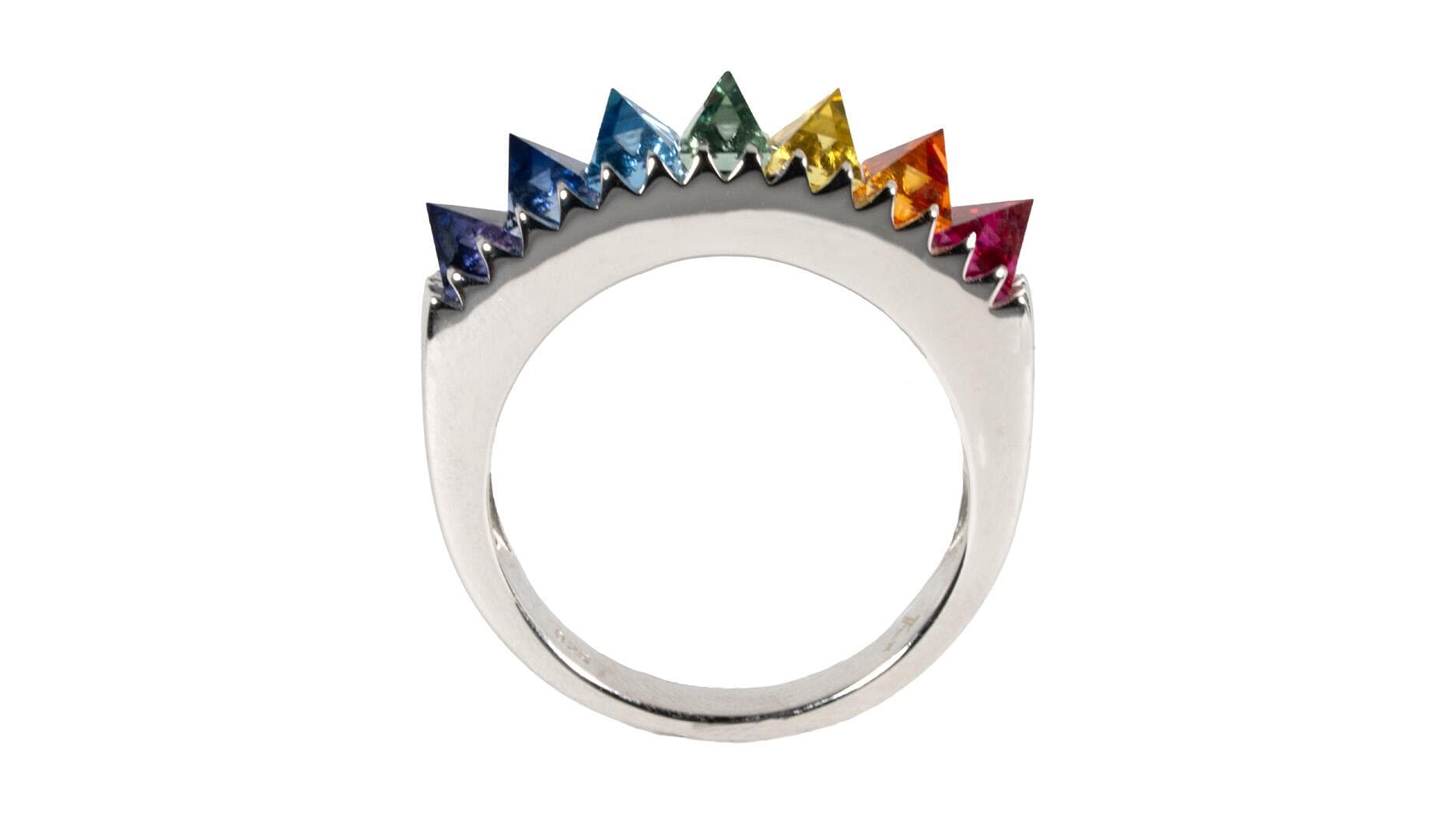
The material choice reinforces that impression. One featured piece, the Three Relics Rainbow Jumbo Signet Ring, is made in 18k recycled yellow gold with rainbow sapphires, a combination that gives the ring both heft and brightness. Recycled gold is not just a talking point here, it suits the collection’s underlying logic, because the design language is about transformation, reuse, and the idea that precious materials can be made to feel newly mythic without losing their substance.
Smith’s engraving gives the collection its narrative edge
If Wales supplies the geological framework, Smith supplies the script. His engraving cuts into the metal with a density that feels closer to drawing than decoration, adding webs, wings, ants, skulls, snakes, flowers, hidden relics, and tiny watchful creatures to the surface. That range of imagery gives the collection a layered symbolism that rewards close looking without becoming fragile or fussy.
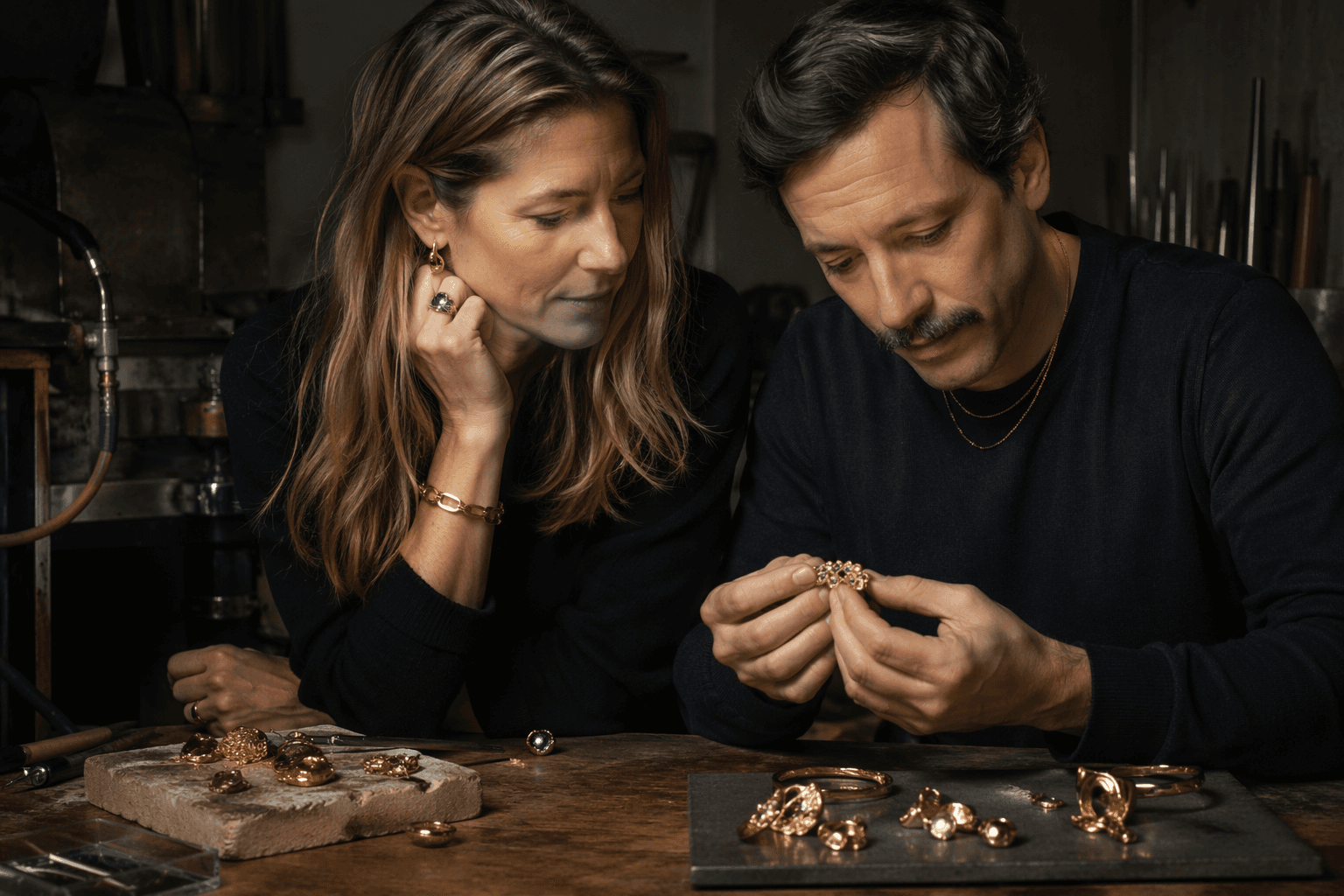
The best descriptor for Smith’s contribution may be that he turns the surface into a place to read. The collection’s own language says it plainly, with “ancient symbols colliding with futuristic textures,” and that tension is exactly what makes the pieces work as modern everyday jewelry. They are ornate, but not delicate in spirit. They are fantasy-driven, but grounded enough in craftsmanship that they can live comfortably in a wardrobe built around denim, tailoring, or a stack of plain bands.
There is also a useful friction between texture and wearability here. Engraving gives a ring or necklace visual depth, but in this collaboration it never overwhelms the form. Instead, the carved lines help the pieces catch light from multiple angles and create a tactile surface that invites touch, which is often what makes a jewel feel personal enough to reach for every morning.
The pieces that anchor a daily jewelry wardrobe
The collection centers on one-of-a-kind rings and necklaces, and that singularity is part of the appeal. These are not pieces designed to be duplicated or traded endlessly across sizes and variants. They are meant to stand as discrete objects, each with its own balance of stone, metal, and narrative, which gives them the authority collectors look for and the individuality that makes everyday wear feel more intimate.
The Three Relics Rainbow Jumbo Signet Ring is the clearest example of the collection’s thesis. A signet already carries a certain usefulness, since its broad face and grounded shape make it easy to wear often, but here it becomes something more theatrical through rainbow sapphires and Smith’s engraved treatment. The piece reads like a personal seal transformed into a talisman, substantial enough to anchor a hand of slimmer rings, yet expressive enough to wear alone.
The necklaces serve a similar function in a wardrobe, offering a way to bring the collaboration’s mythology closer to the body without needing the scale of a cocktail jewel. Because the design language is so textural, the pieces do not depend on size alone for impact. They can sit among simpler chains or beside other mixed-metal pieces, which is where their stackability begins to matter. Rather than competing with other jewelry, they introduce depth, as though a collection of everyday basics had been interrupted by something strange, beautiful, and handmade.
Why this collaboration feels built to be kept close
The strongest argument for the collection is not novelty, though there is plenty of that. It is endurance, both material and emotional. Wales’s decade-long cast-not-set practice gives the jewelry structural conviction, while Smith’s engraving turns each surface into a place where symbols accumulate meaning over time. The result is jewelry that feels personal without being precious in the fragile sense of the word.
That is what makes the collaboration distinct in real-life use. It offers texture that invites touch, silhouettes that can layer, symbols that feel charged but not costume-like, and goldwork substantial enough to withstand regular wear. In a market crowded with polished minimalism on one side and occasional statement pieces on the other, Polly Wales and Castro Smith have made something more interesting: fine jewelry that behaves like an heirloom from the beginning, but still wants to be worn now.
This article was produced by Prism’s automated news system from verified source data, official records, and press releases, then run through automated quality and moderation checks before publishing. The system is built and supervised by the people who set the standards it runs under. Read our full AI policy.
Know something we missed? Have a correction or additional information?
Submit a Tip