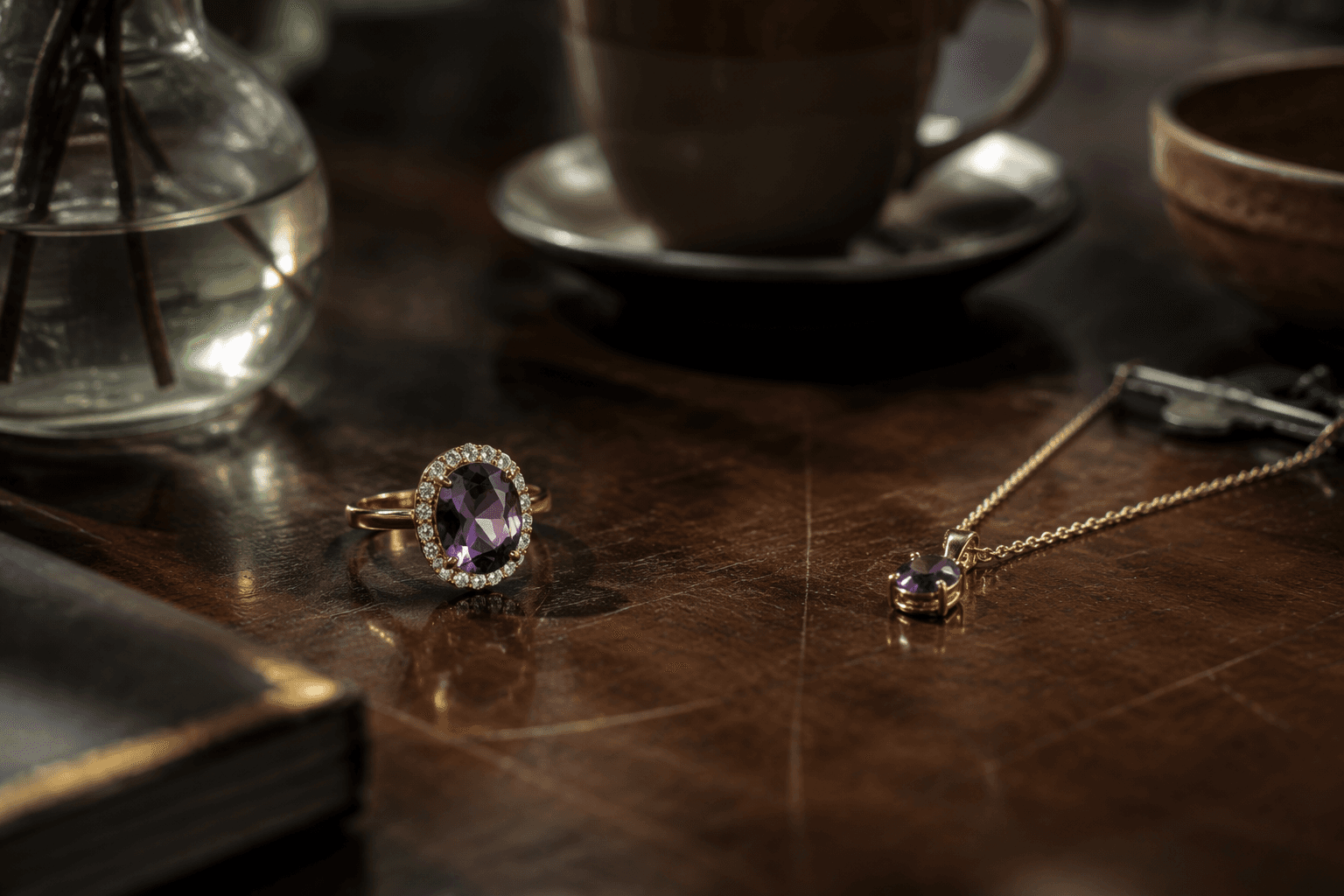
Sia Taylor's Blossom Tears collection turns blossoms into wearable sculpture
Sia Taylor turns blossoms into fading gold forms, pairing 14k to 24k tones with platinum and silver for jewelry that feels intimate, not ornamental.

Sia Taylor's Blossom Tears collection makes flowers feel less like decoration than an emotional structure. The Blossoming necklace and earrings soften 14k to 24k gold with platinum and silver, so the metal itself seems to move, fade, and settle the way a blossom does as it falls. The result is everyday jewelry with the presence of sculpture, but the ease of something you can wear often.
Blossoms, translated into movement
Taylor frames the collection around blossoms as "the tears of a tree," a phrase that gives the work its charge: joy and grief held in the same object. That idea matters because Blossom Tears does not literalize petals in the usual decorative sense. Instead, the forms feel caught mid-disappearance, with soft edges and fluid transitions that suggest motion rather than a fixed floral motif.
The Blossoming necklace and earrings are the clearest expression of that idea. JCK describes them as the designs that most closely match Taylor's original vision, and that is easy to see in the way the collection privileges atmosphere over outline. The jewelry does not shout blossom; it suggests the moment a blossom loosens, tilts, and drifts.
The fade palette is the point
Taylor's signature fade palette is the material engine of the collection. JCK says it spans 12 shades of 14k to 24k gold, a range that turns color into a gradient rather than a hard contrast. When that spectrum is paired with platinum and silver, the pieces gain a softness that keeps them from reading as overtly precious or overly polished.
That mix of metals gives Blossom Tears its tactile tension. A single tone would flatten the idea, but a fade across karats makes the jewelry feel alive, as if the metal were carrying light across different stages of bloom and loss. In fine jewelry terms, it is a more nuanced statement than a uniform yellow-gold suite, and it allows the pieces to sit comfortably in daily wear without losing their edge.
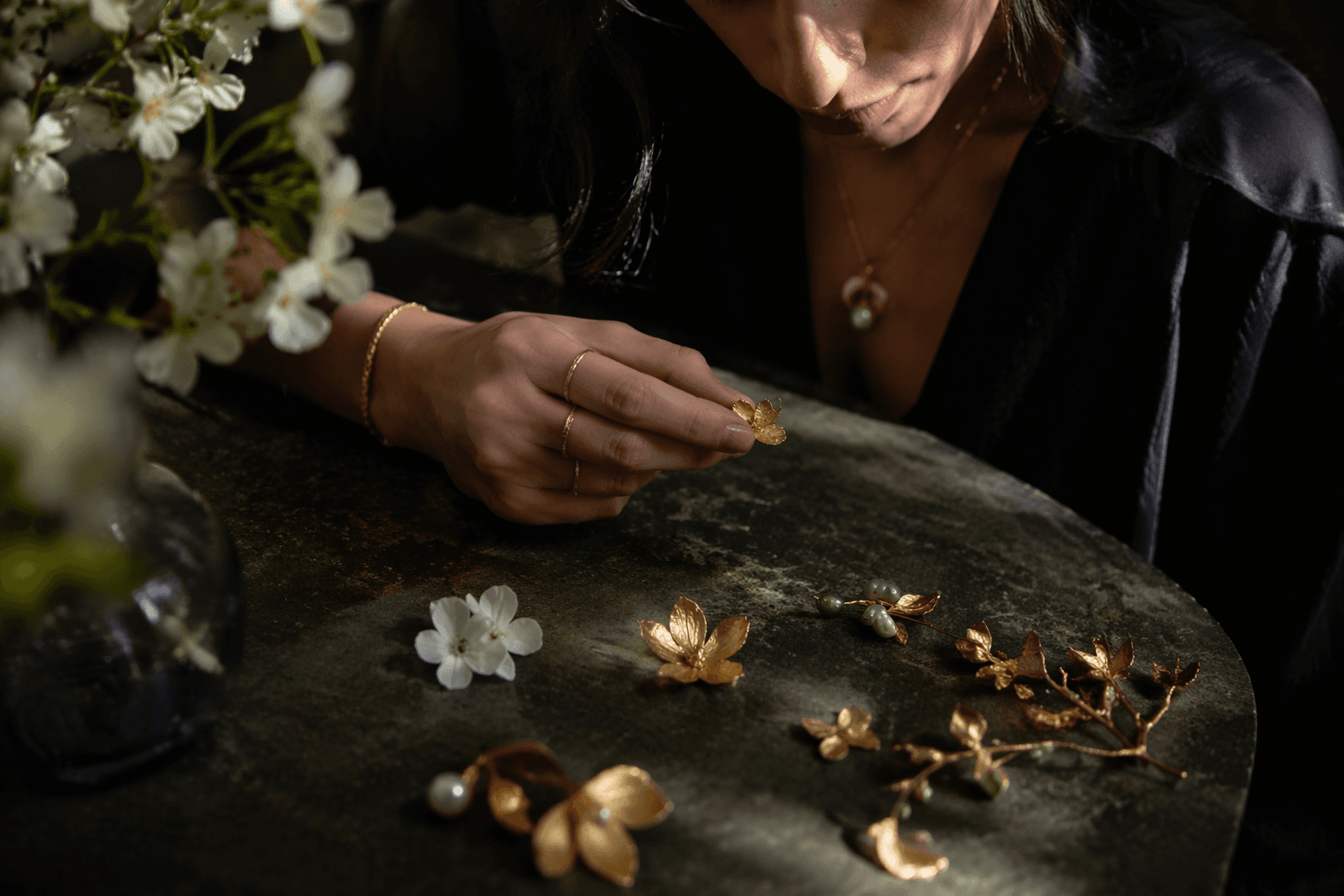
The Blossoming earrings make that balance especially clear. Listed at £2,195, or $2,950, they sit firmly in designer fine jewelry territory, but their effect is not about size for size's sake. The value is in the hand-worked complexity of the material shift and the sculptural finish, which gives them the kind of visual interest that can replace a more literal stack.
Why the collection feels personal instead of purely decorative
Blossom Tears lands because it is built around feeling, not just floral imagery. Taylor had recently come out of what she calls "creative hibernation," and the collection is shaped as a meditation on renewal, loss, and the transient nature of all things. That emotional framing keeps the work from drifting into generic garden-inspired jewelry, where blossoms often become a shortcut for prettiness.
Here, the blossom is used as a carrier for contradiction. The forms are delicate, but the concept is not fragile; the collection holds tenderness and sadness at once. That is what gives the pieces their everyday-luxury appeal: they can be worn with a shirt, a knit, or a tailored jacket, yet still feel like they say something specific about the wearer.
A practice built on sculpture and small natural forms
Blossom Tears also makes sense inside Taylor's wider practice, which has been developing for more than 15 years. She studied Fine Art at the Royal College of Art and began making jewelry while pursuing sculpture, a shift that still defines the scale and temperament of her work. Her designs have long drawn from seeds, pods, grasses, leaves, and other small forms from the natural world, so Blossom Tears does not arrive as a departure. It reads as a refinement of a language she has been building for years.
That background explains why the collection feels so sculptural. Taylor does not treat jewelry as miniature ornament; she treats it as volume, rhythm, and silhouette, translated into wearable scale. The pieces carry the intimacy of handwork and the control of an artist thinking in three dimensions.
Made in Somerset, worn far beyond it
Every piece is handmade in Somerset, England, by a team of artisan jewelers, which keeps the collection anchored in a specific place and a visible making process. That matters in a market crowded with vague artisanal language, because the work is rooted in a real workshop tradition rather than a polished but anonymous brand story. The regional base also gives the collection a quiet counterpoint to its international reach.
Taylor's stockists include Liberty London, White Bird in Paris, Greenwich St. Jewelers in New York City, and HP France. That list tells you how the work travels: from the West of England to some of the most discerning jewelry rooms in London, Paris, and New York. It is the kind of distribution that suits a collection built on restraint, because the pieces depend on close viewing rather than loud branding.
Why Blossom Tears fits the moment
The collection arrives in a market that has been rewarding jewelry with meaning, versatility, and a strong point of view. Buyers are responding to pieces that feel personal enough to live in daily rotation, but distinctive enough to stand alone, and Blossom Tears fits that appetite precisely. Its mixed metals, fading karats, and blossom forms caught in motion give it the feel of an object with an interior life.
That is the collection's lasting strength: it turns impermanence into something tactile. Instead of freezing a flower in place, Taylor lets it soften, shift, and disappear in gold, platinum, and silver, and the result is a rare kind of luxury piece that feels emotionally exact.
This article was produced by Prism’s automated news system from verified source data, official records, and press releases, then run through automated quality and moderation checks before publishing. The system is built and supervised by the people who set the standards it runs under. Read our full AI policy.
Did this article answer your question?