Sotheby’s London auction spotlights Cartier Art Deco jewels and estate treasures
A private Cartier trove from Phyllis Frank turns Art Deco geometry into the bracelets, bangles and gemstone contrasts shaping modern everyday jewelry.
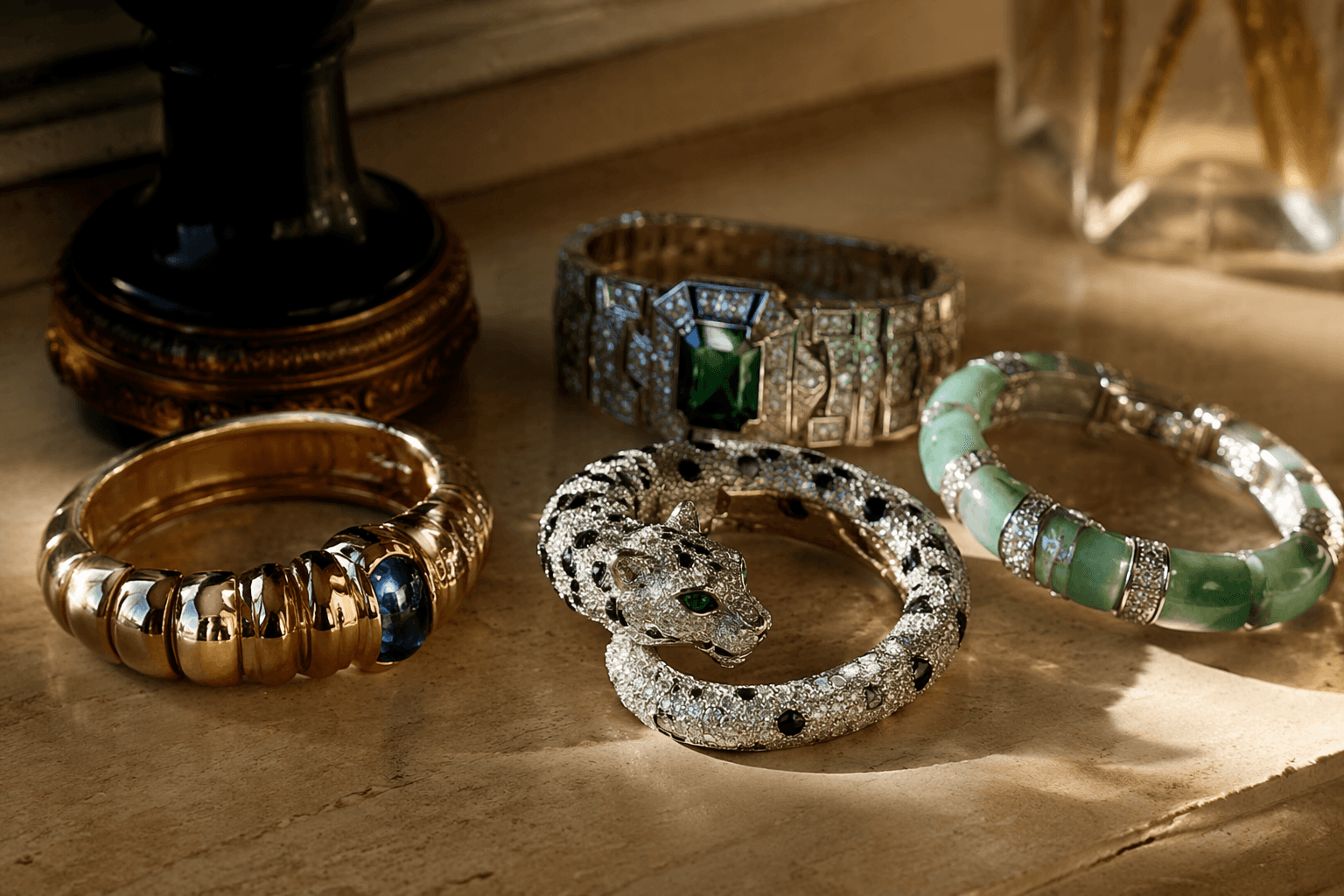
Cartier’s most persuasive modern lesson is not scale, but structure. At Sotheby’s London Fine Jewellery Sale, lots 41 to 47 traced a private group of jewels given to Phyllis Frank, née Francatelli, by her New York financier husband, Jesse Frank, during the 1920s and 1930s, and the pieces read like a compact manual for the Art Deco look that still informs what shoppers reach for now.
The sale, held online from May 20 to June 3, 2026, ranged across more than two centuries of design, from 19th-century jewels and Belle Époque works to mid-20th-century and contemporary pieces. Yet the Cartier section drew the sharpest focus because it distilled the house’s signature geometry into objects that feel made for the wrist and hand, not just for a case. Diamonds, sapphires and lapis lazuli created the kind of high-contrast palette that remains easy to wear, especially in bracelets and bangles that stack cleanly and sit close to the body.
One standout lot was a circa-1925 Cartier Paris sapphire and diamond bracelet, mounted in platinum and signed Cartier Paris. That combination tells the whole story: platinum for strength and restraint, sapphires for a hard blue pulse, diamonds for precision. It is the sort of language contemporary jewelry still borrows when it wants to look sleek rather than ornate, architectural rather than decorative.
The broader private collection reinforced that idea through bangles, clips and bracelets whose forms emphasized line, symmetry and polished surfaces. In today’s jewelry market, those same cues show up in rigid cuffs, slim diamond line bracelets and gemstone pieces that rely on graphic contrasts rather than excess. Cartier’s Art Deco vocabulary, once radical, now reads as the standard for jewelry that can move from daywear to evening without changing its character.
Sotheby’s framed the collection as part of a wider arc in design history, and Cartier’s own legacy gives the pieces their staying power. Established in 1847, the house became synonymous with iconic Art Deco design, and these jewels show why: the best of them do not chase trend so much as define the proportions, color pairings and wrist-focused silhouettes that keep returning to contemporary collections.
This article was produced by Prism’s automated news system from verified source data, official records, and press releases, then run through automated quality and moderation checks before publishing. The system is built and supervised by the people who set the standards it runs under. Read our full AI policy.
Did this article answer your question?