Summer necklace stacks work best with an easy, uneven mix
The best summer necklace stack looks collected, not matched. Start with three pieces, stagger the lengths, and let one chain lead the mix.
Why summer changes the rules
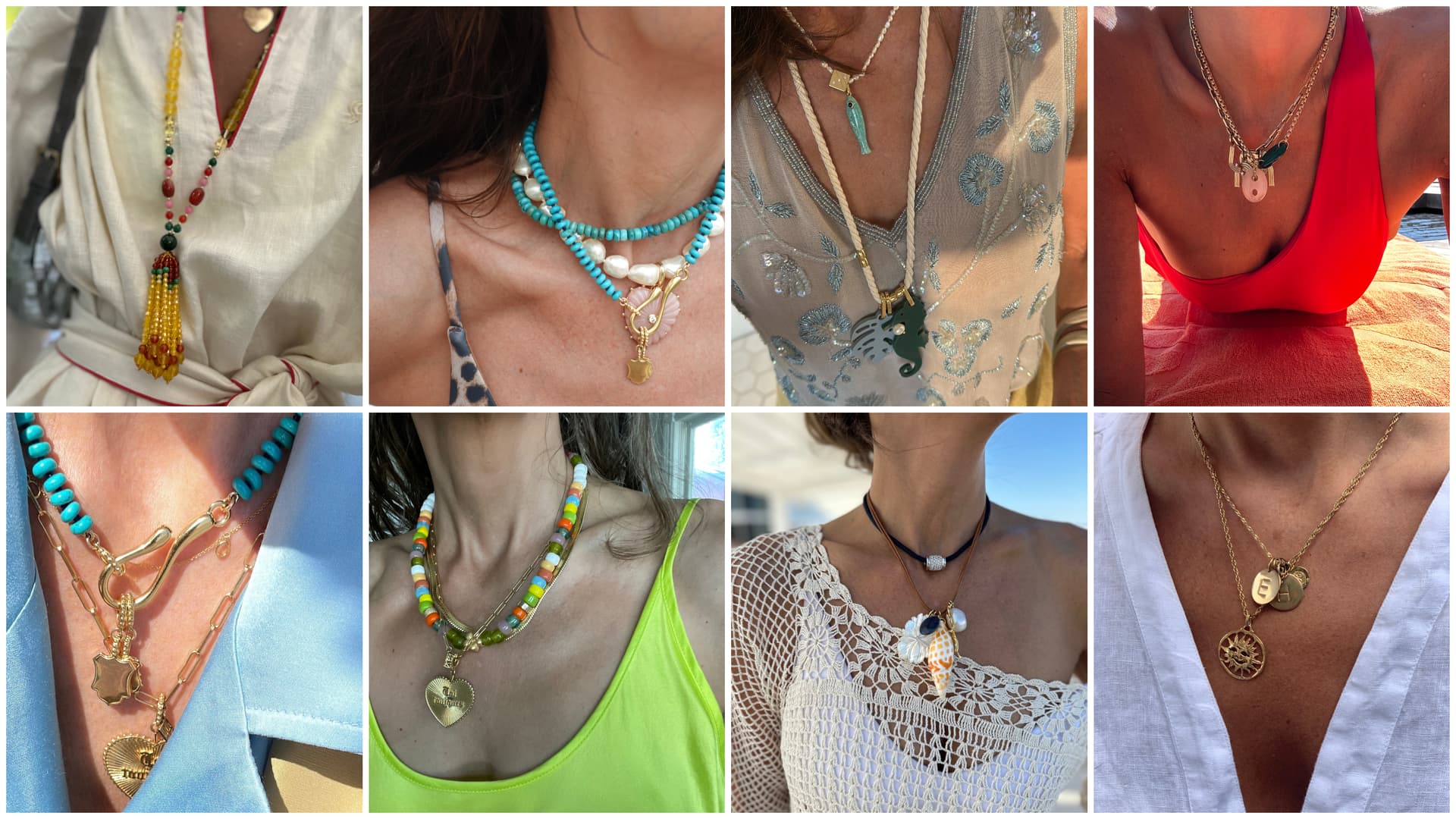
The easiest summer necklace stacks look slightly off-balance on purpose. Bare skin, scoop-neck tanks, linen button-downs, and crochet cover-ups give chains room to breathe, which is why summer is the season when necklaces feel most at home. Winter layers can swallow jewelry whole; warm weather does the opposite, turning even a small pendant into part of the outfit.
That is also why the current mood reads as “curated maximalism.” The look is more personality-driven than polished, and it is being shaped by street style in Paris, Milan, and New York, where jewelry is visible enough to carry the whole silhouette. Summer 2025 and summer 2026 coverage points in the same direction: nautical-inspired jewelry, sculptural cuffs, two-tone pieces, beaded strands, cord necklaces, and anklets all sit inside a broader push toward visible, playful accessories.
Build around three pieces first
The simplest way to make a stack look intentional is to stop thinking in pairs. Stylist Alison Bruhn recommends starting with three necklaces, and that advice holds up because three gives you enough contrast without turning the neckline into a knot. More than five necklaces can become a tangled mess, even with a layering clasp, so restraint is not a lack of style. It is what keeps the look wearable.
A strong summer stack usually works like this:
- one short piece that sits close to the collarbone and creates the base
- one mid-length necklace that carries the eye, often with a pendant or a more visible chain texture
- one longer strand that breaks up the symmetry and lets the stack fall with ease
That uneven spacing is the point. The best stacks do not look engineered. They look like they were assembled over time, with pieces picked because they felt right together, not because they match.
Let one necklace do the talking
A good stack needs a focal point, not three competing statements. That could be a pendant with a little weight, a chain with a stronger link pattern, or a necklace that brings in color. Once one piece leads, the others can stay quieter and still matter.
This is where summer styling gets interesting. Tiny delicate chains can sit next to a longer dramatic strand, and the mix feels better when the pieces differ in visual density. Turquoise and amber work especially well because they add a warm-weather pop without making the stack feel fussy. The same goes for cord necklaces, which bring a more relaxed texture into the mix and echo the season’s casual dressing.
If you want the stack to feel collected rather than costume-y, keep the scale varied. A whisper-thin chain beside a chunkier link, or a smooth pendant beside something beaded, gives the eye something to travel across. Uniformity is what flattens the look.

Comfort matters as much as style in heat
Summer necklaces have to survive movement, sweat, sunscreen, and the simple fact that they will be worn all day. That means the most successful stack is not just pretty from a distance, it is light enough to forget once you are outside. If a necklace keeps flipping, rubbing, or collapsing into the same place, it will stop feeling effortless by lunchtime.
The practical answer is to keep the components different enough that they do not lock together. A short chain, a mid-length pendant, and a longer strand are less likely to slide into one another than several similar lengths. A layering clasp can help, but it does not solve a stack that starts out too crowded. Ease is the real luxury here: the stack should move with you, not demand constant adjustment.
This is also why the “collected over time” approach works so well. Pieces that feel personal tend to be the ones you keep reaching for, whether they were bought for a trip, a milestone, or simply because the proportions were right. The result is a stack that looks lived-in without looking careless.
Why the market keeps rewarding everyday stacks
The commercial logic behind this style is hard to miss. Statista projects worldwide jewelry revenue at US$408.64 billion in 2026, with 75% of sales expected to be non-luxury. The global market is also projected to grow at a 5.10% compound annual rate from 2026 to 2031, which helps explain why accessible, repeat-wear pieces matter so much.
That scale favors jewelry that can move through real life. An everyday necklace stack has to work with office shirts, tanks, sundresses, dinner plans, and the kind of summer schedule that changes by the hour. It is no accident that the biggest opportunities sit in the middle of the market, where design, price, and wearability meet. The winning pieces are the ones you can layer fast, wear often, and keep in rotation long after the first hot spell passes.
The summer formula that keeps working
The strongest necklace stacks are not symmetrical, and they do not try to be. They start with three pieces, let one lead, and use length, texture, and color to create movement across the neckline. That formula fits the season because summer exposes more skin and gives jewelry more room to speak.
If winter hides the chain, summer lets it become part of the outfit. That is why the best stacks feel easy, uneven, and a little personal. They belong to the body, the weather, and the moment, which is exactly why they keep coming back every warm-weather season.
This article was produced by Prism’s automated news system from verified source data, official records, and press releases, then run through automated quality and moderation checks before publishing. The system is built and supervised by the people who set the standards it runs under. Read our full AI policy.
Did this article answer your question?