Tactile Jewelry, the Sensory Trend Making Everyday Pieces Irresistible
Touch is becoming the new luxury cue: textured rings, movable charms, and spinner bands are winning because they steady the hand and earn all-day wear.
The best everyday jewelry is no longer content to sit still. It moves, textures the skin, and gives the wearer something to do with the hands, which is exactly why tactile design is resonating now.
Why touch is driving the new everyday wardrobe
JCK’s April 22, 2026 take on tactile jewelry is simple but persuasive: these are pieces meant to be touched, fidgeted with, and experienced. Brittany Siminitz anchored the idea in a personal memory of a Tiffany & Co. Nature silver band with a raised rose design, a reminder that the most memorable jewelry is often the piece you notice with your fingers before you register it in a mirror.
That is the heart of the trend. Rings lead the conversation, but bracelets and necklaces belong here too when they offer texture, motion, or a subtle sense of interactivity. JCK’s comparison of tactile jewelry to “a fidget toy for grown-ups” captures why it feels so current: in a fast, fragmented day, a ring that spins, a charm that shifts, or a surface that invites the thumb can provide a small grounding ritual without looking clinical or overly utility-driven.
What actually makes tactile jewelry wearable
The tactile pieces worth paying attention to are the ones that translate sensation into daily ease. A raised motif, a low-profile spinner, a textured band, or a necklace with gentle movement can make a piece feel alive without making it fussy. That distinction matters, because jewelry that is too busy, too noisy, or too mechanically obvious slides from wearable to gimmicky fast.
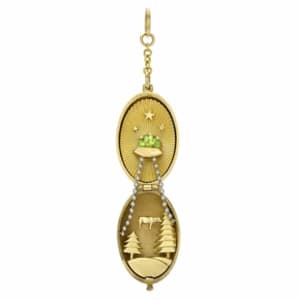
The strongest tactile designs are also the ones that work within familiar jewelry categories. Spinner rings make the concept easy to understand. Textured rings add interest without relying on sparkle alone. Movable charms and articulated chains bring the same sensory appeal to bracelets and necklaces, where motion can be subtle and elegant instead of novelty-led. JCK’s examples, which include Toonz by Ash, Ashaha, Carina Hardy, Jacquie Aiche, Lucy Jade, Yvonne Léon, Ebba Goring, and Heidi Vornan, show that the trend spans both fine and fashion jewelry, not just one price tier or one aesthetic lane.
Why the trend feels bigger than jewelry
This is not only about a clever ring. Jewelers Mutual’s 2026 forecast points to a broader appetite for emotionally expressive jewelry, softer geometry, fluid shapes, and designs that feel more sculptural than ornamental. In other words, consumers are gravitating toward pieces that do something emotionally as well as visually. That helps explain why tactile jewelry has found such an audience: it satisfies the desire for form, but it also gives the wearer a physical relationship with the object.
Business of Fashion underscored the same cultural shift in a May 1, 2026 luxury discussion, where the conversation moved away from jewelry as a purely visual symbol and toward deeper emotional connection. That matters because sensory appeal is often the difference between a beautiful accessory and a piece someone reaches for every single day. Jewelry that can be layered, touched, spun, or held tends to earn more real-world use than jewelry that only performs in a display case.
Stress relief, style, and the rise of wearable focus tools
There is a clear commercial precedent for this in CONQUERing, the Milford, Ohio brand founded in 2011 that makes interchangeable fidget jewelry. The company explicitly designs its rings to be spun, clicked, and swapped, framing them as tools for calm and focus as much as style. Inc. identifies CONQUERing as the No. 1 jewelry brand on its list, with 245 percent two-year growth and a No. 21 ranking on the 2026 Midwest Regionals list, while founder Tammy Nelson appears on the 2026 Female Founders 500 list.
That kind of growth says something important about demand. People are not only buying jewelry to look polished in public; they are also buying it to help regulate their day. For tactile pieces, that is the sweet spot: the object has to be beautiful enough to wear with a blazer or a T-shirt, but useful enough that the hand keeps finding it at a desk, on a train, or between meetings.
The sustainability question behind sensory jewelry
The ethical dimension is impossible to ignore. Forbes reported that the global jewelry market was valued at $353.26 billion in 2023 and projected to grow at a 4.7 percent CAGR from 2024 to 2030, but it also pointed to the environmental and human costs of conventional mining. Producing a single gold ring can generate up to 20 tons of mine waste, and an estimated 40 million artisanal miners work in hazardous conditions.
That context should sharpen how tactile jewelry is evaluated. A piece meant for daily wear should not only feel good in the hand; it should also hold up under scrutiny. The brands worth trusting are the ones that can speak clearly about metal sourcing, stone origin, and any third-party verification they use. If the language stays vague, if “ethical” is doing all the work, or if the material story stops at mood words, the claim is not yet strong enough for a piece that asks for an emotional attachment.
How to judge tactile jewelry before you buy it
The most convincing tactile jewelry tends to share a few qualities:
- It has a clear sensory purpose, such as spinning, touching, or moving, rather than decoration for decoration’s sake.
- It keeps the mechanic low-profile, so the piece still looks like jewelry first.
- It uses texture, relief, or articulation to create interest without snagging or bulk.
- It can be worn comfortably all day, layered with other pieces, and repeated often enough to justify the investment.
- It comes with a transparent materials story, especially if the brand invokes sustainability or responsible sourcing.
That is why this trend feels less like a novelty wave and more like an evolution in how people buy jewelry for themselves. The pieces that last will be the ones that balance sensory pleasure with craft, provenance, and restraint. In a market that is getting more expressive, more emotional, and more conscious of what lies behind the shine, tactile jewelry is persuasive because it offers something rare: beauty you can actually live with.
This article was produced by Prism’s automated news system from verified source data, official records, and press releases, then run through automated quality and moderation checks before publishing. The system is built and supervised by the people who set the standards it runs under. Read our full AI policy.
Did this article answer your question?