Why Shoppers Are Trading Fast-Fashion Jewelry for Handmade Everyday Pieces
Fast-fashion jewelry's rough edges, failing clasps, and nickel reactions are pushing a generation of shoppers toward handmade studio pieces built for real all-day wearability.
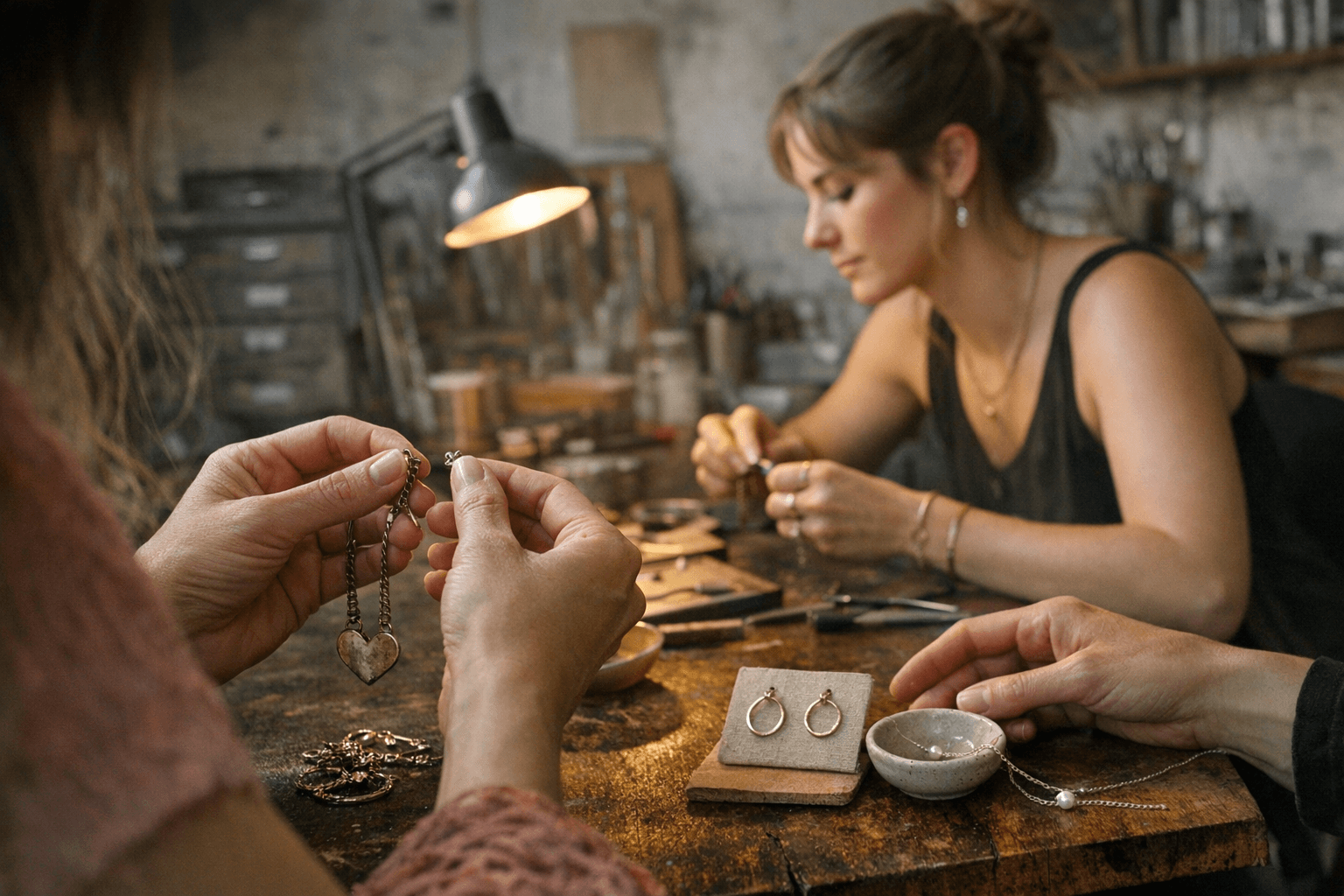
Pick up a piece of fast-fashion jewelry and run your thumb along the back of the setting. Odds are, you'll find a rough edge, a casting seam that was never filed down, or a plating so thin it has already begun to wear through at the high points. Now compare that to a piece made by a studio jeweler working in small batches: the metal is burnished smooth, the weight is deliberate, and the clasp closes with a quiet, firm click. That contrast, tactile and immediate, is precisely what is driving one of the more meaningful shifts in how people approach the accessories they wear every single day.
Why Fast-Fashion Jewelry Falls Short
The problems with mass-produced costume jewelry are not subtle. Factories optimizing for volume spend less time on each individual piece, and the compromises accumulate: rough finishing, undersized lobster clasps that pop open under the slightest tension, and, most critically, base metals that provoke skin reactions after a few hours of wear. Nickel is the central culprit here. It is the most common cause of jewelry-related allergic contact dermatitis and affects roughly 15% of the population, yet it remains a standard hardening agent in cheap gold alloys and a core component of the plated base metals found in most fashion-price earrings and chains.
The opacity around what a piece is actually made of compounds the problem. Most fast-fashion jewelry is sold by its surface finish: "gold," "silver," "rose gold." What sits underneath that micron-thin plating is rarely disclosed. Gold-plated brass, one of the most common constructions at accessible price points, is not reliably safe for sensitive skin, because as the plating wears away, the brass and any nickel it contains makes direct skin contact. There is no legal or medical definition of "hypoallergenic" or "nickel free" in the US jewelry market, which means brands can use those terms without meeting any standardized threshold. The European Union's Nickel Directive, which limits the amount of nickel that can be released onto skin from jewelry and other products, remains the most recognized benchmark globally, but American shoppers have no equivalent consumer protection.
The Case for Studio-Made Work
Handcrafted jewelry operates from a different set of priorities. Where a factory is optimizing for throughput, a studio jeweler is optimizing for the individual piece: its weight distribution, the angle at which a setting sits against skin, the smoothness of every edge that will press against a wrist or earlobe for ten hours. The result is typically a lighter piece, not because it uses less material, but because material has been placed with intention. A well-made hoop, for instance, is designed to hang in a specific way so the weight is dispersed comfortably through the ear rather than pulling at a single point.
Finishing is where the gap between handmade and machine-made becomes most visible under close examination. Machine production applies consistent processes across identical units, but handcrafted jewelry allows the maker to refine each element as the piece develops, adjusting proportions, correcting irregularities, and applying surface treatments that a finishing machine cannot replicate. Hand-filed edges, hand-burnished bezels, and patinas applied individually rather than through a bulk chemical bath are the markers of this attention. Critically, these qualities are not merely aesthetic; they are what makes a piece genuinely wearable across a full day without snagging fabric, irritating skin, or losing structural integrity.
Reading Materials Honestly
Material transparency is not just a marketing phrase in the handmade space; for serious makers, it is a practical commitment. A studio jeweler who discloses every metal used in a piece, down to the findings and ear wires, is giving buyers the information they need to make decisions based on their own sensitivities. The hypoallergenic metals with the strongest safety profiles are platinum, titanium, and palladium at the top of the range; 925 sterling silver and solid 14k or higher gold in the accessible-luxury tier. These metals are either inherently free of nickel by definition or structured so that nickel content is too low to release ions into the skin.
What to be skeptical of: the word "hypoallergenic" on its own, without any disclosure of specific metals. "Surgical steel" is frequently cited as safe, but its nickel content varies significantly depending on grade. Brass and bronze, which can read as natural and artisanal, are alloys that often contain nickel as part of their composition. When a maker lists every component, from the sheet metal used to form the body of a ring to the jump rings connecting a pendant to its chain, that transparency is itself a signal of quality.
A Practical Buying Framework
When assessing any piece for everyday rotation, four qualities deserve close attention:
- Finish: Turn the piece over. Run a fingernail along every edge, through every groove. There should be no sharp catches, no visible seam lines, no pitting in the surface. The back of a setting should be as considered as the front.
- Weight and proportion: A piece should feel balanced in the hand and, more importantly, on the body. Earrings too heavy for their backing style will stretch the lobe; a pendant hung on a chain too delicate for its weight will constantly migrate. Studio jewelers calibrate these relationships; fast-fashion production rarely does.
- Clasp and backing security: Lobster clasps should require deliberate pressure to open, not a casual brush of the thumb. Earring backs, whether butterfly, screw, or latch, should hold firmly without pinching. Post thickness matters: thin posts are more prone to bending and less comfortable for extended wear.
- Metal disclosure: Ask, or look for, specific metal names and purity marks. "Gold-tone," "silver-colored," or "metal alloy" are not answers. A maker confident in their materials will tell you exactly what you are buying.
The Broader Shift
The appetite for this kind of accountability reflects a genuine change in how people relate to the jewelry they put on every morning. Buyers in 2026 are increasingly investing in fewer, better pieces: designs intended to withstand not just trend cycles but the daily friction of actually being worn, washed around, and carried through a life. The sustainable jewelry market is projected to reach $61.75 billion by 2032, and the growth is being driven not only by environmental concern but by a fundamental dissatisfaction with the short lifespans and skin costs of disposable accessories.
Handmade makers have stepped into this gap not by positioning themselves against trends but by offering something trends cannot: a piece made for a specific person's skin, weight tolerance, and daily context. That proposition, part craft, part ethics, part genuine comfort, is proving harder to walk away from than any seasonal style. When the alternative is another reddened earlobe and a clasp that failed on the third outing, the reasoning for trading up becomes its own argument.
This article was produced by Prism’s automated news system from verified source data, official records, and press releases, then run through automated quality and moderation checks before publishing. The system is built and supervised by the people who set the standards it runs under. Read our full AI policy.
Did this article answer your question?