World Cup jewelry tie-ins turn soccer fandom into collectibles
World Cup jewelry is shifting from souvenir to wardrobe piece, with licensed pendants, diamond soccer balls, and fan bands built for gifting, collecting, and repeat wear.
The 2026 FIFA World Cup is already doing what the best sports moments do to jewelry: turning fandom into something you can wear, gift, and keep. With 48 teams, 104 matches, and 16 host cities across the United States, Canada, and Mexico, this tournament has created room for everything from collectible luxury to mass-market trinkets, and the real question for shoppers is not whether the pieces are themed, but whether they can live beyond the final whistle.
The new fan object
What stands out in this wave of product is the split between jewelry made for daily life and objects that exist mostly as spectacle. JCK’s reporting shows diamond-studded soccer balls, officially licensed pendants, and team-color bead necklaces entering the market at very different price points, which is exactly how a cultural event becomes a commercial ecosystem. The most interesting pieces are not the loudest; they are the ones that can signal allegiance without looking like costume jewelry once the tournament ends.
That distinction matters because the World Cup is no small backdrop. The expanded field of 48 teams and the 104 matches across North America make this the largest edition in tournament history, ending with the final on July 19, 2026, at MetLife Stadium in New Jersey. When an event reaches that scale, the merchandise does not merely commemorate it. It becomes part of the way fans participate in it, whether they are buying for themselves, for a child, or for a friend who treats national colors like a second skin.
What FIFA is selling, and why it matters
FIFA’s official store is already selling World Cup 2026 merchandise, and that early inventory tells you how seriously the organization is treating the retail opportunity. Fanatics has been selected as FIFA’s official on-site retail partner, handling in-venue sales across all 104 matches and at FIFA Fan Festival locations in host cities. In other words, this is not a one-table souvenir operation. It is a fully staged retail program with the infrastructure to move everything from entry-level keepsakes to higher-end collectibles.
That scale also helps explain why the category feels broader than simple team merch. Q-LIVE says it is an official licensee of FIFA World Cup 2026 in North America, the Caribbean, and the GCC, which signals a licensing network extending well beyond the stadium gates. The result is a marketplace where a fan can choose between something cheap and cheerful, something officially licensed and giftable, or something so precious it belongs more in a display case than a jewelry box.
The pendant that tries to be both souvenir and jewel
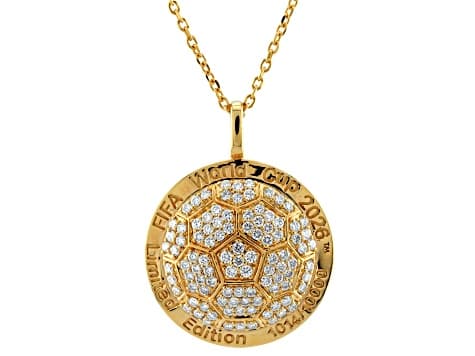
Renaissance Jewel’s licensed FIFA World Cup 2026 pendant is the clearest attempt to make that bridge. The company says it is the first diamond product officially licensed under the FIFA World Cup banner, and it is limiting production to 10,000 pieces worldwide. That scarcity gives it the language of collectibles, but the silver version, priced at $779, keeps it within the realm of a real jewelry purchase rather than an untouchable trophy object.
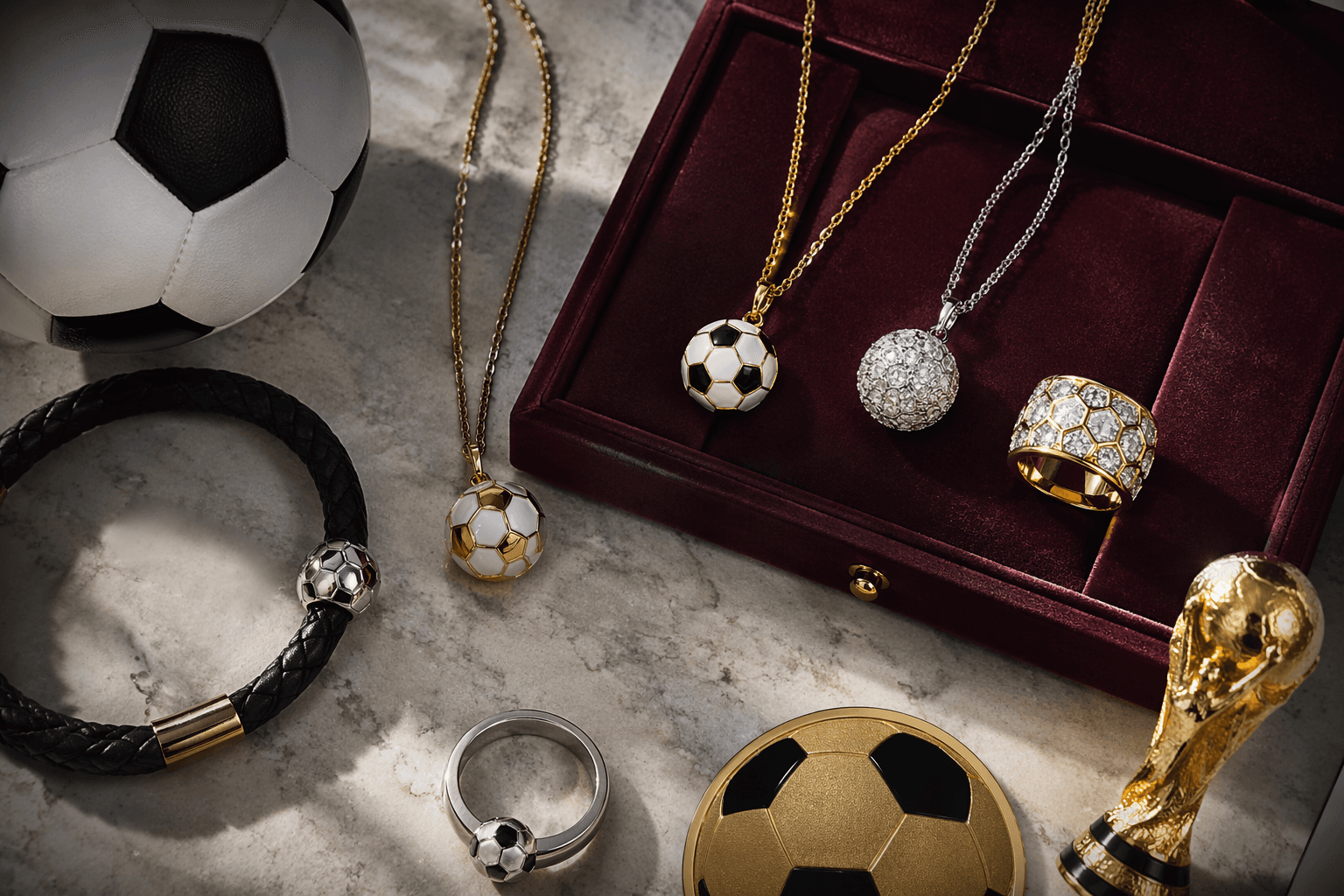
The appeal here depends on restraint. A pendant works year-round only if the symbolism is compact enough to disappear into an ordinary chain and specific enough to matter to the wearer. In that sense, a licensed soccer pendant has an easier path to repeat wear than a shirt or cap, especially if the design leans on clean outlines, modest scale, and recognizable iconography rather than oversized branding. The stronger the piece feels as jewelry first, the more likely it is to be gifted, layered, and worn after the tournament calendar is gone.
At the other end of the spectrum is Renaissance Jewel’s 5.5-inch 18k white-gold soccer ball, covered in 507 carats of black-and-white diamonds and priced at more than $1.08 million. This is not wearable jewelry in the practical sense, and it does not pretend to be. Its role is pure display, a high-jewelry proof of concept that turns a sports symbol into a luxury object so extravagant it reads like a commission for a private collection. It is useful precisely because it shows how far the World Cup motif can be stretched, even if almost no one will ever wear it.
Mass appeal still belongs to the simplest forms
If the pendant is the bridge between fandom and fine jewelry, Bank of America’s fan bands show how broad the appetite runs below that level. As the Official Bank of FIFA World Cup 2026, the company announced 2 million free collectible fan bands, built around 140 unique beads and 10 million beads in total, to be distributed starting June 11 across all 11 U.S. host cities. The appeal is obvious: the pieces are free, colorful, and easy to hand out, which makes them ideal for families, casual fans, and anyone who wants a souvenir that feels participatory rather than precious.
The fan bands also underscore the central wearability question. Jewelry inspired by soccer can succeed in very different ways. Some pieces are meant to be worn every day and fade into personal style. Others are meant to be worn for one season, one match, or one trip to a stadium. The smartest designs are the ones that understand this difference and choose their lane clearly. A bead bracelet can be playful and fleeting. A pendant can be subtle enough to slip into rotation. A diamond soccer ball can be dazzling, but it is really a mascot for the category, not a piece of it.
Why this market is already crowded
The category is not waiting for the tournament to begin. Etsy is already showing hundreds of World Cup 2026 jewelry listings, including bracelets, pendants, and necklaces inspired by national teams and host countries. That breadth matters because it reveals where consumer energy actually lives: in small, personal objects that can be customized, gifted, and worn with a light touch.
For jewelry shoppers, that means the most compelling buys are unlikely to be the most obvious ones. The year-round pieces will probably be the ones that handle color with subtlety, keep logos under control, and feel like real accessories rather than promotional merchandise. The one-event items will still have a place, especially for collectors and superfans, but the pieces with staying power are the ones that understand how jewelry lives on the body. In a tournament this large, the best fan pieces will not just commemorate the game. They will survive it.
This article was produced by Prism’s automated news system from verified source data, official records, and press releases, then run through automated quality and moderation checks before publishing. The system is built and supervised by the people who set the standards it runs under. Read our full AI policy.
Did this article answer your question?