Young lapidarists use social media to build gemstone businesses
A modest U.S. gem market is getting a social-media makeover, as young cutters turn finished stones into direct-to-consumer stories buyers can follow.
A small market with a much bigger story
The modern gemstone business is being reshaped by cutters who post, teach, and sell before they ever set foot behind a velvet tray. That shift matters because the U.S. gem market is still relatively small: the U.S. Geological Survey estimated combined U.S. natural and synthetic gemstone output at $73 million in 2024, down 8 percent from 2023.
That modest scale is exactly why the new generation stands out. Arizona, Oregon, Nevada, California, Montana, and Maine accounted for 71 percent of U.S. natural gemstone production in 2024, so much of the country’s gem story is still concentrated in a handful of places. Yet the stones that leave those cutters’ wheels do not stay local for long. The U.S. Geological Survey says major gemstone end uses include carvings, gem and mineral collections, and jewelry, which helps explain why younger lapidarists are building brands around finished stones and custom work instead of waiting for the traditional wholesale pipeline to carry them.
Why lapidary suddenly feels contemporary
Lapidary may be having a digital moment, but the craft itself is ancient. The International Gem Society traces its history back to early stone carving around 70,000 BC and describes gem cutting as a discipline that grew out of experimentation with stone hardness, flaking, polishing, and drilling. That long arc is part of what makes the current wave so compelling: the tools have changed, but the essential act remains the same, revealing beauty already hidden inside the rough.
What is new is the way young cutters present that process. Social media has turned faceting into both a performance and a storefront, where a cutter can show the transformation from rough crystal to brilliant finished gem, explain a pavilion decision, and build a following at the same time. For everyday jewelry buyers, that creates something mass-market stones rarely offer: a direct line to the person who cut the gem, and a clearer sense of why one stone looks and feels different from another.
The new apprenticeship model is both online and hands-on
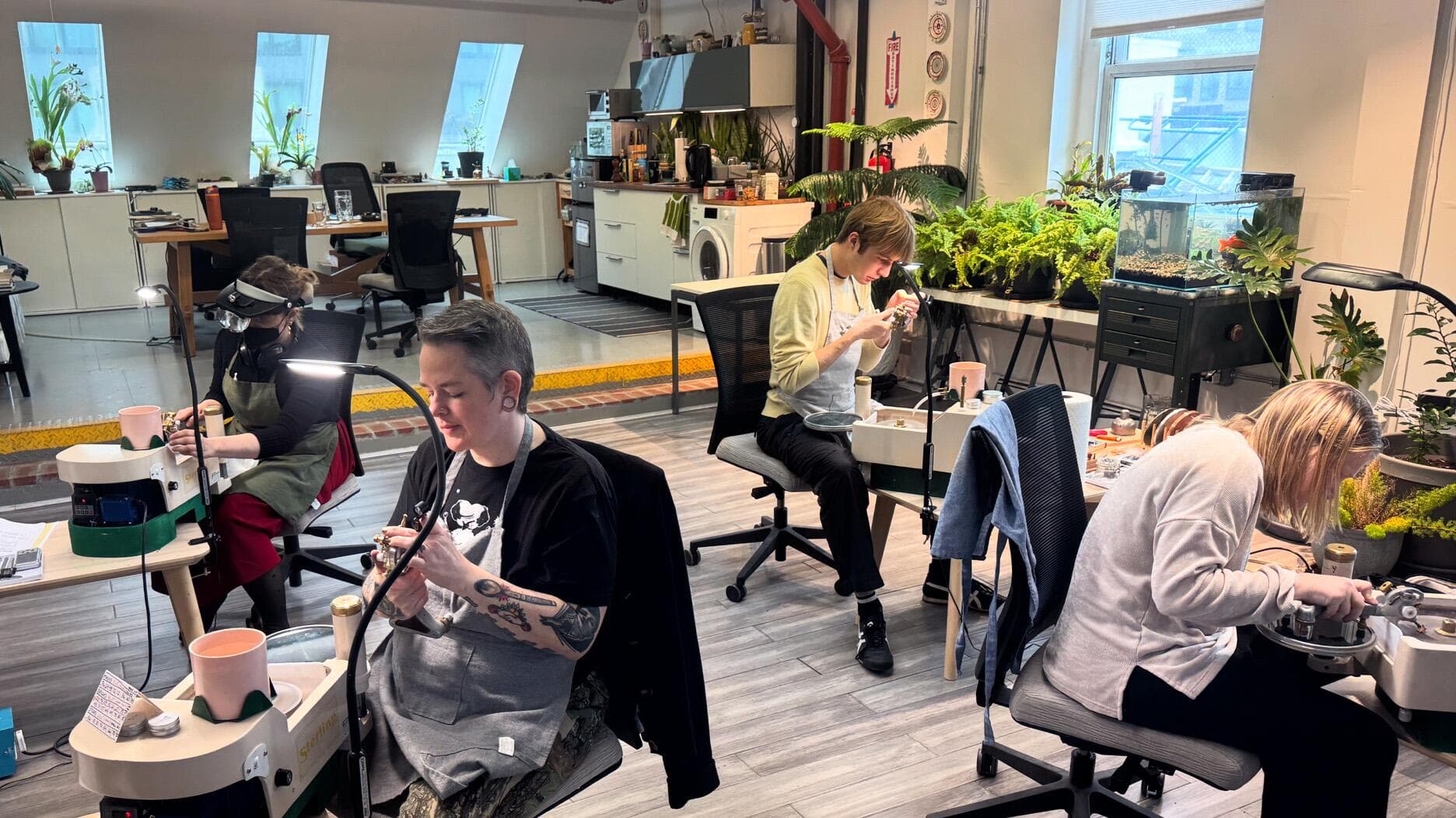
Faceting Apprentice, founded in 2019 by lapidarists Justin K. Prim and Victoria Raynaud, sits squarely inside this shift. The school says it offers both in-person and video-based gemstone cutting courses, moving students from first steps in gemcutting through advanced faceting projects. That hybrid model reflects the way the trade now works, with instruction no longer confined to a single studio or a single city.
Justin Prim said he began cutting gemstones in 2013 after joining the San Francisco Gem and Mineral Society, which places his path in the older club-and-apprenticeship tradition that still anchors the field. But the next chapter came during the pandemic, when Justin and Victoria Prim launched their business, online courses, a school, and YouTube content. They later moved their base to Lyon, France, a reminder that the internet has made geography less important than visibility, teaching ability, and a recognizable aesthetic.
For emerging cutters, that mix of old-school skill and online fluency is now a business model. A gem cutter can teach a faceting diagram in one video, show a finished stone in the next, and use direct sales to turn viewers into clients. In practice, that means craftsmanship is no longer hidden behind the counter. It is part of the brand.

Why buyers are responding now
The appeal of U.S.-cut stones is not only patriotic or artisanal. It is also practical and visual. A buyer who chooses a stone cut by a known lapidarist is often buying distinction, traceability, and a more personal story than a generic calibrated gem can provide. That is especially persuasive in everyday jewelry, where a ring, pendant, or pair of earrings often does its most important work as a daily signal of taste, values, and identity.
This is where the social-media generation has an edge. Young cutters know that jewelry is rarely purchased only for technical specification. It is bought to mark a milestone, to feel like a private luxury, or to stand apart from the predictable. A stone that comes with a cutting story and a face attached to it feels more like a design decision and less like a commodity.
The result is a more direct-to-consumer value chain, in which the cutter is not just a craftsman but also a narrator. For emerging designers, that opens a useful supply of stones with personality. For buyers, it creates a way to choose pieces that feel curated rather than standard issue.
The institutions still matter, even in a digital age
None of this has erased the role of the trade’s long-standing organizations. The American Gem Trade Association says it remains dedicated to promoting, educating, and maintaining fair business practices in the natural colored gemstones, natural pearls, and cultured pearls industries. It is also promoting AGTA GemFair Las Vegas, scheduled for May 28 to June 1, 2026, at The Venetian Expo, which shows how important in-person trade still is even as sales and learning move online.
The United States Faceters Guild adds another layer to this ecosystem. Its mission is to promote the art of gemstone faceting around the world, and its free FacetDiagrams.org platform gives cutters another digital tool in a field that has become increasingly self-educated and peer-driven. Together, these organizations suggest that the next generation is not abandoning the old structure of the trade. It is extending it, making it more accessible and more public.
That is the real significance of young American lapidarists now. They are not just cutting stones more skillfully or posting prettier videos. They are changing how gemstone value is created, explained, and sold, and in doing so they are making U.S.-cut stones feel less like niche collectibles and more like a distinctive language for modern jewelry.
Know something we missed? Have a correction or additional information?
Submit a Tip