Ancient Varna Necropolis Recognized as Earliest Large-Scale Gold Jewellery Collection
A 6,500-year-old Bulgarian burial site holds over 3,000 gold artifacts — including 1.5 kg found in a single grave — now recognized as the world's earliest large-scale gold assemblage.
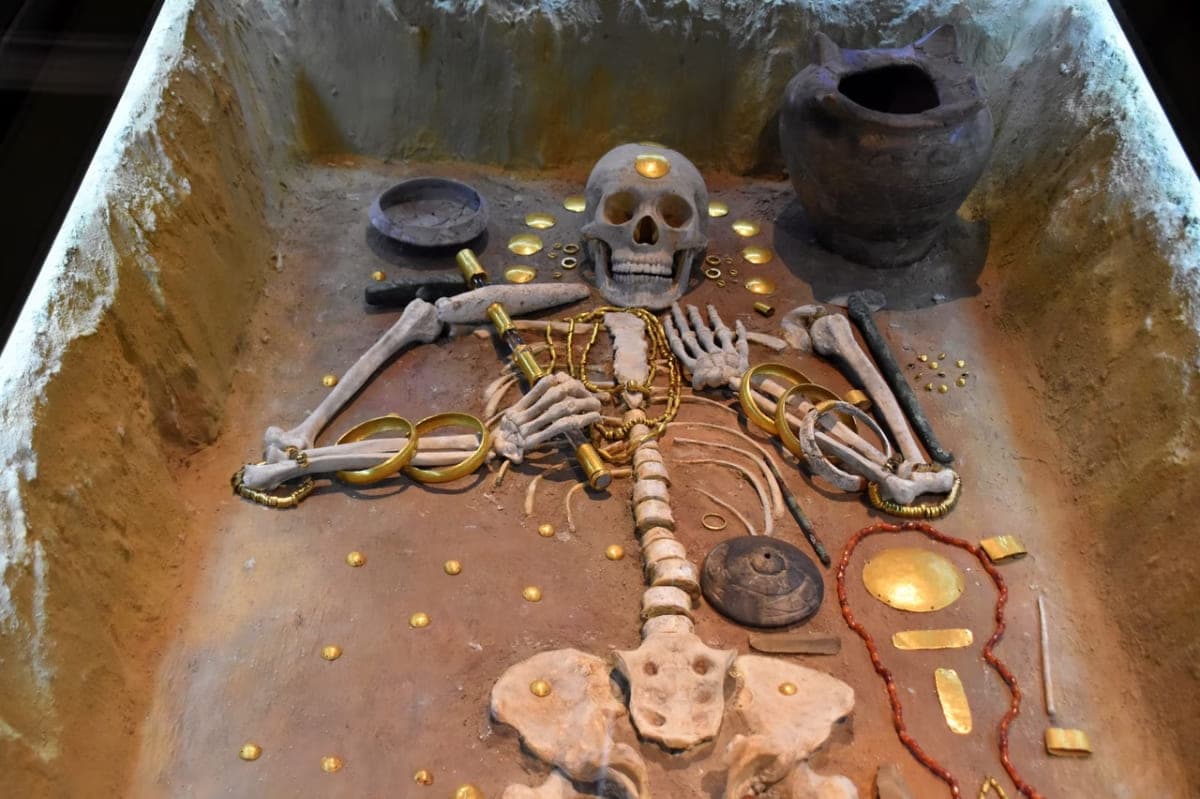
Buried in the western industrial zone of the Bulgarian city of Varna, roughly four kilometres from its centre and half a kilometre from the lake that shares its name, lies one of the most consequential archaeological sites in the history of human adornment. The Varna Necropolis, a Chalcolithic burial ground associated with the Copper Age Varna Culture, is now broadly recognized as home to the oldest and largest early gold jewellery assemblage ever documented — a designation that recent coverage has revisited with fresh attention to the evidence underpinning it.
The site dates to the fifth millennium BCE, though calibrated radiocarbon ranges reported across the scholarly literature vary slightly: approximately 4600 to 4300 BCE according to one recent overview, 4600 to 4200 BCE in the Wikipedia entry on the necropolis, and 4560 to 4450 BCE in other published accounts. Raiko Krauß, Clemens Schmid, David Kirschenheuter, Jonas Abele, Vladimir Slavchev, and Bernhard Weninger provided an updated chronological framework in their 2018 paper "Chronology and development of the Chalcolithic necropolis of Varna I," published in Documenta Praehistorica, which remains the primary academic reference for the site's phasing.
What makes Varna extraordinary is not simply age, but scale and sophistication. The Varna Gold Treasure comprises over 3,000 gold artifacts spanning 28 distinct typological categories, with a combined weight of 6.5 kilograms. The inventory includes beads, appliqués, rings, bracelets, pectorals, and diadems — the full vocabulary of personal adornment rendered in gold at a moment when the metal was, as far as the archaeological record shows, nowhere else being worked in comparable volume. Inside the hole of a single carnelian bead, archaeologists found a gold mini-cylinder measuring approximately 2 by 2 millimetres, a detail that communicates both the precision of the metalworking and the deliberate attention paid to every element of a finished ornament.
The weight distribution of these objects is itself analytically significant. Analysis of the gold artifacts revealed a weight system built around at least two minimal units: approximately 0.14 grams and 0.40 grams. The latter, equivalent to roughly two carats, was proposed by researcher Kostov as a basic "Chalcolithic unit," named the van after the first letters of Varna Necropolis. The existence of a standardized weight system implies not improvisation but intentional production within an understood framework of value.

Two graves in particular concentrate that value to a striking degree. Grave No. 43, unearthed in the central part of the necropolis in 1974, belonged to a male aged 40 to 45, standing approximately 1.70 to 1.75 metres tall — notable stature for his era. His grave contained over 1.5 kilograms of gold artifacts, including 10 large appliqués, rings strung on cord, two necklaces, beads, and a copper axe with gold decoration. Archaeologists have interpreted the density of gold as evidence that this individual held exceptional social standing, possibly that of a ruler or king-priest. Grave No. 36, a symbolic burial containing no body, held over 850 gold items: a tiara, earrings, a necklace, a belt, bracelets, a breastplate, a gold hammer-sceptre, a gold model of a sickle, two gold lamellas depicting animals, and 30 small models of horned animal heads. The symbolic grave is, in some respects, even more arresting than the occupied one — gold assembled not to accompany the dead, but to stand in for them.
The social interpretation of these finds has generated scholarly debate. According to archaeologist Marija Gimbutas, Varna may represent the oldest known burial evidence of elite males, a hypothesis she connected to broader theories about a transition toward male-dominant social structures at the close of the fifth millennium BCE. More recent scholarship has approached these interpretations with caution, treating the "ruler or king-priest" reading as a hypothesis rather than settled fact.
Varna's significance has long exceeded academic circles. The gold began touring internationally in 1973 as part of "The Gold of the Thracian Horseman" national exhibition, and in 1982 travelled to Japan for a seven-month showing under the title "The Oldest Gold in the World: The First European Civilization," generating two full-length television documentaries. Through the 1980s and 1990s, the collection was exhibited in Canada, Germany, France, Italy, and Israel, and was the subject of a National Geographic cover story. Today the artifacts are held primarily at the Varna Archaeological Museum and the National Historical Museum in Sofia, where the evidence of a 6,500-year-old goldworking tradition remains available for examination.
This article was produced by Prism’s automated news system from verified source data, official records, and press releases, then run through automated quality and moderation checks before publishing. The system is built and supervised by the people who set the standards it runs under. Read our full AI policy.
Did this article answer your question?