Budget-friendly gold engagement rings from Quince, Brilliant Earth and more
Budget-friendly engagement rings save money in 14K gold, lighter settings and lab-grown stones. The real question is how those choices affect wear, sparkle and resale.

The easiest way to make an engagement ring feel more attainable is not to shrink the sentiment, but to change the architecture. 14K gold, slimmer settings and lab-grown center stones can bring a ring down into a more comfortable range, especially when the purchase happens online rather than in a showroom. The best value is rarely the lowest sticker price alone: it is the balance between durability, visual presence and what the ring may be worth later.
Where the affordability comes from
Budget-friendly gold engagement rings tend to become affordable in four specific ways. Lower-karat gold reduces metal cost, lighter settings use less gold, lab-grown center stones cut the biggest line item, and online-only retail trims the overhead that can inflate a store case price. Those savings are real, but they do not all land the same way on the finger or on a future resale estimate.
14K gold is the sweet spot for many shoppers because it offers a sturdier daily-wear profile than higher-karat gold, even if the color is slightly less rich. A simpler prong setting will usually cost less than a more elaborate halo or cathedral design, while a lab-grown center stone can create a far larger-looking ring for the money than a natural diamond of comparable size.
Quince keeps the equation lean
Quince makes the clearest case for entry-level gold engagement-ring spending. Its engagement-ring prices start at $498, and one of the current examples is a 14K gold lab-grown diamond and morganite halo ring at that exact price. The brand’s broader ring assortment stretches across 410-plus designs from $48, but the engagement category is where the gold-and-lab-grown formula feels most disciplined.
The current selection also moves quickly into more substantial price points, with lab-grown diamond rings shown online in the $900 to $4,700 range. Quince also advertises lab-grown diamond engagement rings from $2,900 with free shipping, which suggests the line is built to look modest at entry and more traditional as the center stone grows. Styles such as solitaire, accent-stone, hidden halo, halo and cathedral settings show how the design language itself can change price without changing the basic idea of a gold ring.
Brilliant Earth makes the build process visible
Brilliant Earth takes a different route to affordability: it lets you build upward, component by component. The brand says shoppers can start with a setting, then choose a natural diamond, a lab diamond or a gemstone, which is useful if you want to control exactly where the money goes. Its pricing reflects that modular approach, with settings starting at $750 and diamonds starting at $180.
The petite Elodie solitaire ring currently listed at $790 is a good example of how restrained design can keep the opening cost in check. Brilliant Earth is also offering a free pair of 1/4-carat lab diamond studs on purchases over $1,000 with code STUDS, a sweetener that matters most if you are already spending in four figures. The appeal here is customization, but the tradeoff is obvious: once the setting gets more refined and the stone gets larger, the total climbs quickly.
With Clarity leans on aftercare as much as price
With Clarity’s value proposition is less about an eye-catching floor price and more about what comes with the ring. The brand is currently advertising a summer sale of up to 25% off, free insured shipping and returns, and a lifetime warranty, which gives the purchase a more protective frame than a bare-bones discount does. That matters when a ring is meant to be worn every day, not just admired in a box.
Its ready-to-ship lab-grown diamond engagement rings currently sit around $2,372 to $5,576 after discounts. That places the brand above Quince’s most accessible entry points, but still squarely in the territory where lab-grown stones and online pricing can keep a ring below the psychological shock of a traditional bridal counter. The value here is as much in the post-purchase coverage as in the markdown itself.
Friendly Diamonds plays the discount card hardest
Friendly Diamonds is the most aggressively promotional of the group, with up to 60% off in-stock engagement rings and lab-grown diamond rings, plus coupon code LOVJUNE. The ready-to-ship framing matters: it usually means less room for deep customization, but it also means the savings are easier to see and the purchase can move faster. For a buyer chasing a lower checkout total rather than a tailor-made project, that can be persuasive.
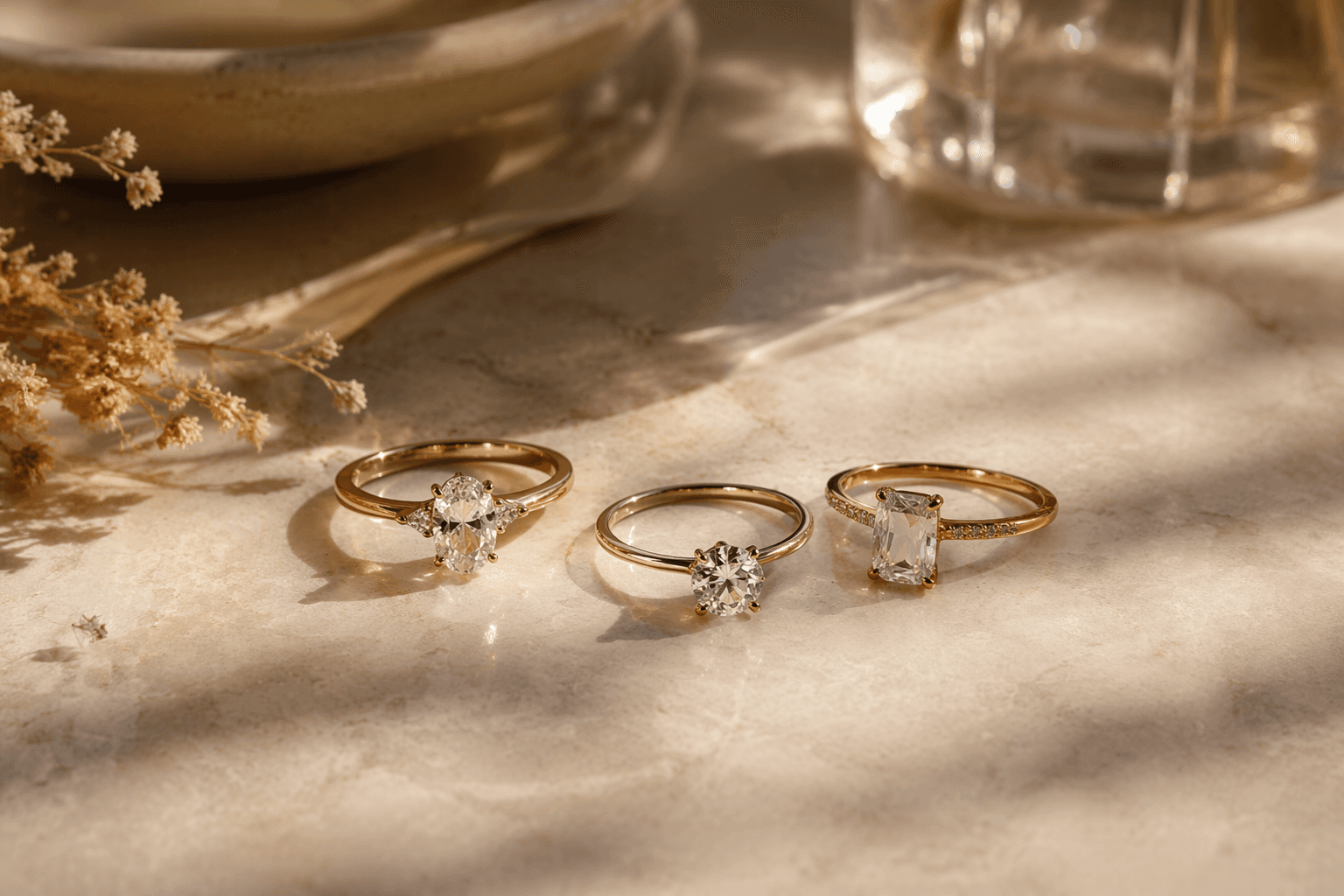
The brand’s emphasis on in-stock rings also hints at where the compromise sits. You are often trading some design freedom for speed and a steeper discount, but the core value proposition remains the same as elsewhere in this roundup: lab-grown stones keep the center stone affordable while the gold setting gives the piece permanence and everyday wearability.
Blue Nile, Rare Carat, Ritani, Etsy, Nordstrom and Zales widen the field
The broader field of affordable engagement-ring shopping stretches well beyond the four names headlining this roundup. Blue Nile, Rare Carat, Ritani, Etsy, Nordstrom and Zales all sit inside the value conversation, which tells you how much the category has changed: savings now come from online efficiency, marketplace variety and familiar retail names rather than only from clearance cases or seasonal promotions.
That breadth also matters because it gives shoppers different ways to define value. Some want comparison shopping, some want a familiar brand, and some want the widest possible spread of styles. The common thread is that affordability no longer means compromise alone; it often means choosing a business model that keeps overhead, and therefore prices, lower.
Why the average ring now sits at $5,200
The Knot’s 2024 Jewelry & Engagement Study puts the average engagement-ring cost at $5,200, down from $6,000 in 2021, $5,800 in 2022 and $5,500 in 2023. That steady drop explains why a $498 ring can feel plausible rather than implausible, and why a $2,372 ready-to-ship ring can still read as budget-conscious rather than bare minimum. The market is simply more willing to separate romance from maximum spend.
That shift has pushed more shoppers to ask not just what a ring costs, but what each dollar is buying. A ring that starts near $500 is not merely cheaper than the average; it usually reflects a very different mix of gold weight, stone type and setting complexity.
What lower-karat gold and lighter settings really change
When a ring is budget-friendly, the metal itself deserves scrutiny. 14K gold contains more alloy than higher-karat gold, which generally makes it more durable for daily wear, though less saturated in color than 18K. A lighter setting can also keep costs down, but it may feel less substantial in the hand, especially if the shank is slim or the shoulders are pared back.
The setting style changes the story too. A prong setting uses less metal and lets more light reach the stone, while a bezel wraps the center more fully in gold and can feel more protective. Quince’s mix of solitaire, hidden halo, halo and cathedral styles shows how these design choices affect both price and personality: the more gold and labor involved, the more the cost tends to rise.
How to judge value, durability and resale
The best budget ring is the one whose compromises you understand before you buy it. If your priority is durability, 14K gold is a sensible foundation and a classic solitaire or prong setting often gives the best balance of cost and longevity. If your priority is size and sparkle per dollar, lab-grown centers deliver the most visual impact, though their secondary-market value is usually softer than that of comparable natural diamonds.
Online pricing can be a gift to the budget-conscious, but it also shifts the burden of judgment onto you. Quince, Brilliant Earth, With Clarity and Friendly Diamonds each show a different version of the same equation, and the smartest purchase is the one that makes its tradeoffs visible in the metal, the setting and the stone rather than hiding them in a low headline price.
This article was produced by Prism’s automated news system from verified source data, official records, and press releases, then run through automated quality and moderation checks before publishing. The system is built and supervised by the people who set the standards it runs under. Read our full AI policy.
Know something we missed? Have a correction or additional information?
Submit a Tip