Choosing 14K Versus 18K Gold for Everyday Necklaces and Rings
Match karat to your life: 14K for daily durability, 18K for richer color and heirloom value, choose by wear, allergies, and the level of care you want to give the piece.
1. Lede: the practical trade-off
When deciding between 14K and 18K, think of this as a match between gold and habits rather than a matter of one being objectively superior. Goodstoneinc puts it plainly: “When deciding, match the gold to your habits. If you want a ring or chain you almost never take off, pick 14K for its durability and day-to-day reliability. If you are buying for a milestone or an heirloom piece to keep in the family, and you prefer richer color or custom features, 18K is the classic choice.” That framing will steer the rest of the technical and stylistic choices you make.
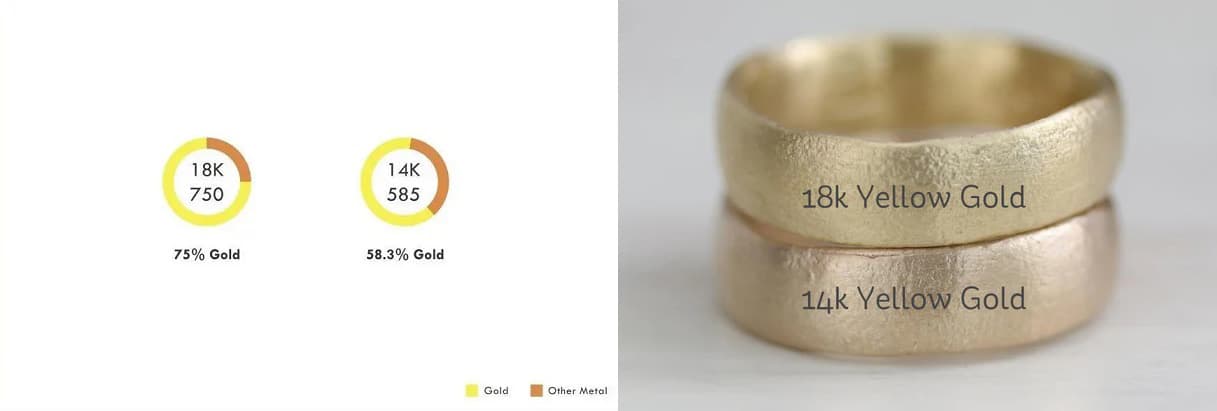
- 14K gold = 14 parts gold out of 24, or 58.3% pure gold; the remaining 41.7% is alloy metals such as silver, copper, or zinc.
- 18K gold = 18 parts gold out of 24, or 75% pure gold; the remaining 25% is alloys.
- 24K = 100% pure gold and is generally too soft for most jewelry.
2. Quick facts: what the karat numbers mean
Billigjewelers summarizes these definitions clearly: “18k gold means the gold is 18 parts pure, or 75% gold and 25% alloys. 14k gold is 14 parts gold, or 58.3% gold and 41.7% alloys. 24K gold is pure gold (100%) but is too soft for most jewelry.”
3. Color and tone: visibly different on the wrist or finger
The higher gold percentage in 18K produces a warmer, richer yellow that reads as more “luxurious” on the finger or chain. Billigjewelers notes: “18k gold has a richer yellow color due to the higher percentage of gold. 14k gold offers a lighter, more subtle tone, especially in white gold.” With rose gold, the difference is also clear: Brilliantearth points out that “14K rose gold exhibits a more pronounced pink color due to its higher copper content in the alloy mixture, while 18K rose gold features a softer, more subtle blush tone.”
4. Durability and everyday wear: why 14K is often chosen for daily pieces
The trade-off for richer color is softness: 18K contains more pure gold and is more prone to scratching and dents, while 14K is harder and more scratch-resistant. The Original Report states that “14k (58.3% gold) is harder and more scratch‑resistant than 18k (75% gold), so it’s often recommended for everyday‑wear rings and”, the truncated sentence carries the point: durability favors 14K. Brilliantearth echoes this: “14K gold demonstrates superior durability compared to 18K gold, making it the more practical choice for everyday wear pieces.” That makes 14K the pragmatic choice for rings and chains you truly live in.
5. Allergies and alloy composition: ask the exact question
Higher gold content generally reduces exposure to reactive alloy metals, so 18K “typically offers better hypoallergenic properties than 14K gold due to its higher pure gold content and lower percentage of potentially reactive metals,” writes Brilliantearth. Blue Nile’s fragments underline the same point with phrases such as “Hypoallergenic and ideal for sensitive skin.” Still, sources stress variability: Valeriemadison and Brilliantearth both advise verifying the exact alloy recipe and asking specifically about nickel or other reactive metals if you have sensitive skin. Do not accept a vague “hypoallergenic” label, ask for the metals used.
6. Technical details makers care about: melting point, casting and weight
Metalsmiths and repairers read these numbers closely: Goodstoneinc gives melting points of about 879°C for 14K and 926°C for 18K, and notes that 18K’s higher melting point and malleability allow “tighter casting and finer surface detail.” That’s why some intricate settings and sculptural rings are executed in 18K. Conversely, Goodstoneinc says 14K “is easier to process for 3D-printed or engineered jewelry and results in stronger pieces.” In feel, 18K is denser, “the same ring feels noticeably weightier in the hand,” which contributes to perceived value.
7. Value, appraisals and the heirloom question
Expectation and reality can diverge: 18K commands higher appraisal values because of greater gold content, and is culturally and sentimentally preferred in some regions; Goodstoneinc summarizes: “Maintenance and upkeep affect long-term value. Data show that 14K pieces need fewer repairs but are less likely to be passed down as family heirlooms compared to 18K, which holds cultural or sentimental appeal in some regions. Appraisal values are consistently higher on 18K gold, but insurance claims are also more common, signifying more accidental damage.” In short: 18K can be a better choice if your priority is legacy and resale value, but it requires greater care and often more insurance attention.
8. Price and buyer trade-offs: what you give and what you get
Price tracks gold content: Billigjewelers and Valeriemadison both note that 18K is more expensive than 14K due to its higher percentage of pure gold. Valeriemadison sums the aesthetic-cost trade-off: “If you’re drawn to a richer color and want something more luxurious, 18K gold may be the better choice. It’s perfect for special pieces or occasions, though it requires a bit more care to maintain its pristine look.” Conversely, 14K offers affordability without sacrificing the essential strength needed for everyday wear.
- For everyday-wear rings, wedding bands, and chains: the consensus from Original Report, Brilliantearth, Billigjewelers and Valeriemadison is that 14K generally wins on longevity and resistance to daily knocks.
- For milestone pieces, statement jewelry, and settings that demand fine casting or a richer tone: Goodstoneinc, Billigjewelers and Valeriemadison point toward 18K as the classic, heirloom-minded choice.
- Engagement-ring nuance: Brilliantearth explicitly recommends 14K for engagement rings that will be worn constantly, but Goodstoneinc and Billigjewelers also observe that 18K is commonly chosen when finer surface detail or heirloom aesthetics are the priority. Preserve both perspectives: pick 14K if you prioritize daily durability; pick 18K if you prioritize color and provenance.
9. How to choose by piece: necklaces, rings and daily accessories
10. Labeling, regulation and buyer protections to watch for
Retail transparency matters: Goodstoneinc warns that “New regulations may soon affect both types. Under government proposals, 14K and 18K purity may need to be labeled clearly on all retail listings, with possible penalties for mismarked pieces. This aims to help buyers know what they own and avoid overpriced low-karat items.” Until clear, enforceable labeling is universal, insist that karat stamps, paperwork, and a written description of alloys accompany any purchase you consider significant.
- Check the stamp and ask for written confirmation of karat and alloy composition; don't accept "hypoallergenic" without specifics.
- Match the karat to your routine: choose 14K for rings, chains and bracelets you never remove; choose 18K for milestone pieces or finely detailed settings.
- Ask about nickel and other potential allergens; request nickel-free alloys if you have sensitive skin.
- Consider weight and feel, 18K will feel heavier and more substantial in hand, 14K will feel lighter and tougher.
- Factor maintenance, appraisal and insurance into the purchase: 18K may hold higher appraisal value but can attract more repair and insurance claims; 14K typically needs fewer repairs.
11. Practical buyer checklist and closing counsel
Goodstoneinc’s summation remains a useful closing reminder: “There is no ‘better’, only what works for your life, your budget, and your sense of style. Check the label, ask about alloys if you have allergies, and treat your jewelry with care, no matter the karat. Let function and comfort guide you, not only the shine in the display case.” Choose deliberately, your everyday pieces should reflect how you live, not only how they look on a polished stand.
This article was produced by Prism’s automated news system from verified source data, official records, and press releases, then run through automated quality and moderation checks before publishing. The system is built and supervised by the people who set the standards it runs under. Read our full AI policy.
Did this article answer your question?