Diamond and Gold Birthstone Picks for April, From 14K to 18K
April's birthstone needs no color filter; the gold you pair with a diamond does more work than most buyers ever realize.
April is the only birth month whose stone is colorless by design. A diamond has no hue to guide your metal choice, no saturation to flatter or fight. That apparent neutrality is actually the most demanding brief in fine jewelry: every decision you make about karat, gold tone, and setting style becomes visible in a way it simply isn't with, say, a ruby or an emerald. Get it right, and even a modest piece reads like an heirloom. Get it wrong, and a genuinely expensive stone can look smaller, flatter, and cheaper than it is.
The Karat Question: 14K vs. 18K
The difference between 14-karat and 18-karat gold is not just marketing hierarchy. Fourteen-karat gold is 58.3% pure gold, the remainder being alloyed metals (typically copper, zinc, or silver) that increase hardness and resistance to daily wear. Eighteen-karat gold is 75% pure, producing a richer, deeper color in yellow and rose tones, but at a softer hardness that shows fine scratches more readily over time.
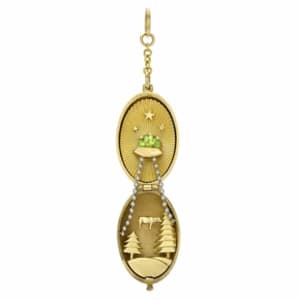
For diamond jewelry worn every day, 14K is a genuinely intelligent choice. The Brevani 14-karat yellow gold musical-note necklace is a perfect illustration of where this karat earns its place: it is a piece designed for real life, delicate enough to layer, sturdy enough to survive the desk-to-dinner routine without developing the soft surface patina that 18K can accumulate on high-contact pieces. The warmth of 14K yellow gold also pairs forgivingly with diamonds that sit in the H-to-I color range, where the gold's amber undertone renders any faint yellow in the stone essentially invisible to the naked eye, a quiet budget-stretching trick that jewelers rarely volunteer.
When you move to 18K, you are paying for depth of color and a certain weightiness to the metal itself. Katkim's hoops in 18-karat yellow gold set with diamonds demonstrate exactly what that richer alloy delivers: the gold reads as genuinely saturated rather than pale, which creates a more dramatic frame for the stones. Katherine Kim's label, handcrafted in Los Angeles using recycled gold and conflict-free diamonds adhering to the Kimberley Process, is a reminder that 18K gold can carry an ethical provenance story as well as an aesthetic one.
Gold Tone and the Diamond Relationship
Yellow gold, white gold, and rose gold are not interchangeable backdrops for diamonds; each actively alters the visual story.
Yellow gold creates contrast. The warmth of the metal throws a diamond's colorless brilliance into sharper relief, the same way a dark mat makes a pale artwork pop. It also brings an unmistakable reference to antique and Victorian jewelry, a quality that makes modern, minimal pieces in yellow gold read as more considered and less generic. The Katkim hoops and the Anita Ko baguette fan earrings both lean into the tension between the cold precision of diamond and the honeyed richness of 18-karat yellow, which is precisely why baguette cuts perform so well in yellow gold: their step-cut facets produce long flashes of light rather than the disco-ball sparkle of round brilliants, and those flashes look electric against a warm gold frame.
White gold changes the conversation entirely. A diamond set in white gold essentially disappears into its setting, making the stone appear larger and more dominant, ideal for solitaire designs where the stone is the entire point. The tradeoff is that white gold requires rhodium plating to maintain its bright silver-white finish, which wears off over one to two years and needs re-plating, adding a modest but real maintenance cost.
Rose gold sits in softer territory: romantic, photogenic, and currently near the peak of its popularity cycle. For diamond jewelry, rose gold is most flattering when the stones are brilliant-cut (round, oval, cushion), whose fiery sparkle contrasts cleanly with the blush of the metal. Its copper content is also the highest of the three tones, giving rose gold pieces particularly satisfying heft and, in 14K versions, impressive durability.
Settings: Where the Light Actually Lives
The choice between setting styles is where most buyers leave money on the table, or more precisely, where they make the piece look worth less than it cost.
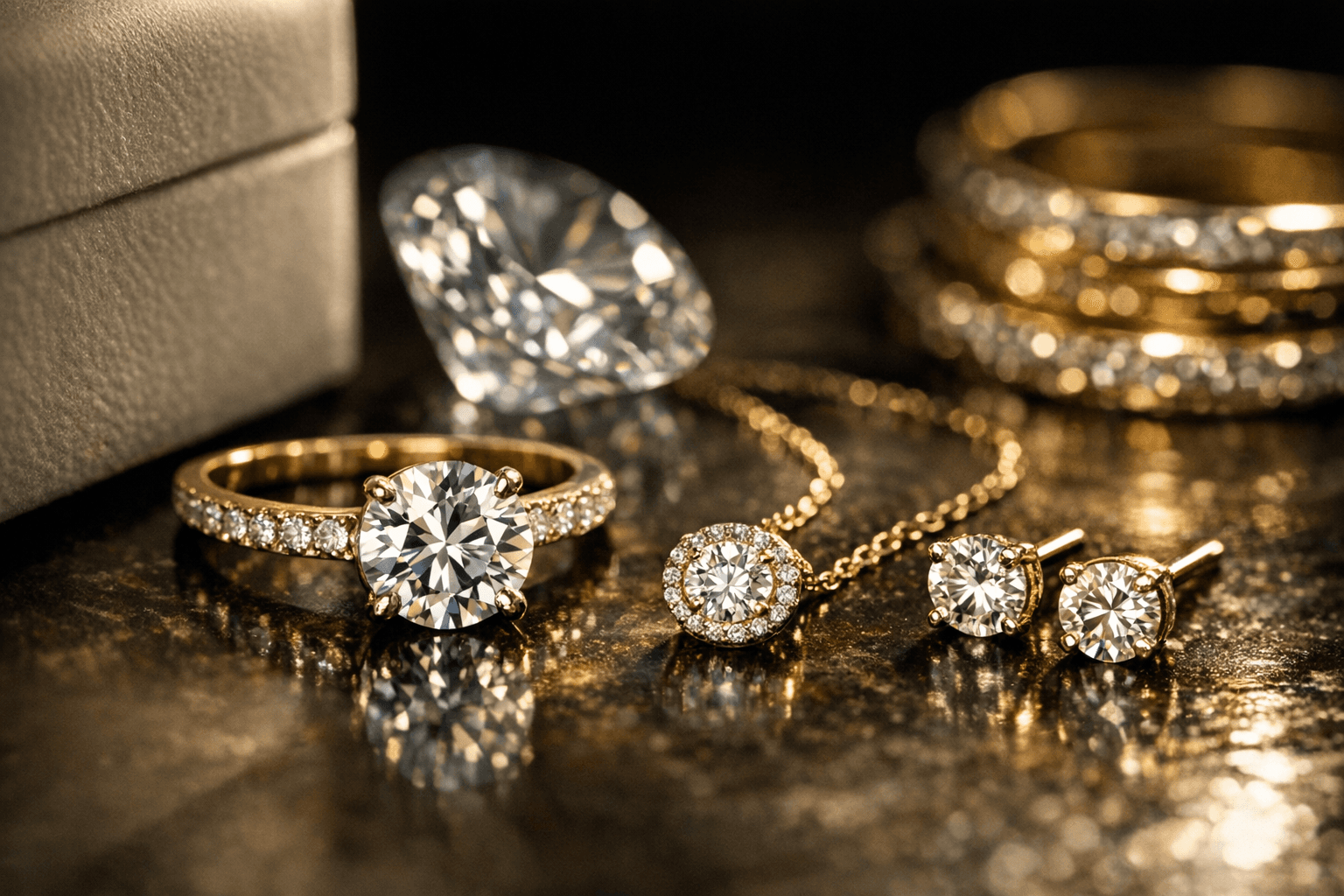
Prong settings are the architecture of maximum light. Thin metal claws hold the stone aloft, exposing as much of its surface as possible to incoming light. The result is the full optical performance of the diamond: brilliance (white light return), fire (spectral dispersion), and scintillation (the on-off flash as the piece moves). For a solitaire where a single stone carries all the weight, a four- or six-prong setting in yellow gold is the highest-drama, lowest-metal option. It also photographs beautifully, which matters in an era when jewelry is assessed as often through a screen as in person.
Bezel settings encircle the stone in a continuous rim of metal. The stone is more protected, useful for active wearers or pieces on the hands, but some light entry is sacrificed at the girdle. In yellow gold, however, the bezel's metal presence becomes part of the design's visual logic rather than a subtraction from it; the gold rim acts as a frame, and the diamond within it reads as deliberately contained rather than merely held. Bezel-set diamond studs or pendants in 18K yellow gold are among the cleanest, most modular pieces in a well-built jewelry wardrobe.
Pavé settings, in which a field of small diamonds is set flush with the metal surface with minimal metal showing, are the most effective tool for making a piece look expensive relative to its actual stone weight. The total carat weight of a pavé piece may be modest, distributed across twenty or thirty small stones, but the resulting surface of continuous sparkle registers visually as abundant. On the Katkim hoops, diamonds set into an 18K yellow gold frame create a ring of light that owes its impact to surface coverage rather than individual stone size, a useful lesson for any buyer working with a finite budget.
Anita Ko's baguette fan earrings in 18-karat yellow gold represent a third visual logic: channel-set baguettes, with their long rectangular facets, produce a geometric shimmer that is architectural rather than brilliant. The step-cut facet pattern emphasizes clarity over fire, which means the stones in a piece like this need to be clean-looking (VS or SI clarity at minimum), but the visual result, structured, graphic, and glinting, lands in a register that round-brilliant pavé simply cannot reach.
Buying Smart: Decision Points Before You Commit
Before choosing between accessible and high-end pieces in this category, a few questions sharpen the decision considerably.
- Daily wear or occasion? Fourteen-karat gold for every day; 18K for pieces worn selectively. The Brevani 14K necklace is built for the former; the Anita Ko earrings are built to be noticed.
- Setting maintenance tolerance: Prong settings should be inspected annually to check for bent or worn prongs. Bezel settings require virtually no maintenance. Pavé settings sit between the two; individual micro-pavé stones can loosen with impact. If the recipient is hard on jewelry, favor bezel or channel settings over delicate prong work.
- Lab vs. natural diamonds: A lab-grown diamond is chemically and optically identical to a mined stone; gemological instruments cannot distinguish them without specialized testing. The price difference, however, remains substantial: lab diamonds typically cost a fraction of what a natural equivalent costs per carat at the same grade. For a pavé or melee-heavy design where the individual stones are small and the total carat weight drives the price, lab-grown diamonds are a straightforward way to buy a more heavily diamonded piece within a set budget. For a solitaire, where the stone's individual character and long-term value narrative matters more, natural makes a different emotional argument.
- Total carat weight vs. individual stone size: A 1.00 ctw pavé band often looks more impressive than a 0.50 ct solitaire at comparable or lower cost. If visual impact is the goal and single-stone prestige is not the brief, total carat weight distributed across a well-designed setting beats a single smaller stone every time.
April's birthstone may be the most demanding to buy well precisely because it offers the fewest guardrails. There is no color to work around, no rarity narrative to lean on, no exotic origin story to tell. What remains is the metal, the setting, and the quality of the light the piece produces. Get those three elements right, and the diamond does exactly what it was always designed to do.
This article was produced by Prism’s automated news system from verified source data, official records, and press releases, then run through automated quality and moderation checks before publishing. The system is built and supervised by the people who set the standards it runs under. Read our full AI policy.
Did this article answer your question?