Five Simple Home Tests to Verify Your Gold Jewelry Is Real
Fake gold is more common than most buyers realize — these five non-destructive tests can tell you what you actually own before you spend another dollar.
Before you inherited that chain, bought that vintage ring at an estate sale, or accepted a too-good-to-be-true deal on a bracelet, someone probably told you it was real gold. Here's how to find out if they were telling the truth, using nothing more than a magnet, a ceramic tile, and a glass of water.
Read the Hallmarks First
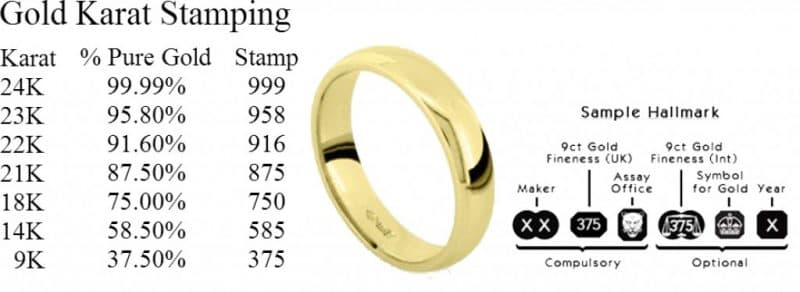
The first thing to examine on any piece of gold jewelry is its stamp, and this step costs nothing but a magnifying glass and a few minutes. Legitimate gold jewelry is stamped with a karat marking that tells you exactly what percentage of the alloy is pure gold. A "24K" stamp indicates 99.9% pure gold; "18K" means 75% gold; "14K" means 58.3%; and "10K," the legal minimum to be sold as gold in the United States, means 41.7%. European pieces may use a millesimal fineness system instead, where "750" corresponds to 18K, "585" to 14K, and "417" to 10K. Look for these stamps inside a ring band, on the clasp of a necklace or bracelet, or on the post of an earring. The absence of any stamp doesn't automatically mean a piece is fake, since older antique jewelry predates mandatory hallmarking, but on any piece made in the last several decades, a missing mark warrants serious scrutiny. Gold-plated items may carry stamps like "GP," "GF" (gold-filled), or "RGP" (rolled gold plate), which confirm that only a surface layer of gold is present over a base metal core.
The Magnet Test
Gold is not magnetic. That single fact makes a strong magnet one of the most useful tools in a quick authentication kit. Hold a rare-earth magnet, the kind sold in hardware stores as neodymium magnets, close to your piece and watch for any attraction. If the jewelry pulls noticeably toward the magnet, the piece almost certainly contains ferrous metals like iron or steel beneath a gold-toned surface. A weak attraction can indicate other base metals like nickel or brass in the alloy, since pure gold and standard gold alloys are non-magnetic. One important caveat: a piece passing the magnet test doesn't confirm it's gold. Metals like copper, aluminum, and stainless steel are also non-magnetic, so a fake piece could still pass. Think of the magnet test as a useful eliminator rather than a final verdict.
Weight and Density as a Clue
Real gold is extraordinarily dense, with a density of approximately 19.3 grams per cubic centimeter for pure 24K gold, which is nearly twice as heavy as most metals commonly used in counterfeit pieces. When you hold a piece of solid gold jewelry, it should feel noticeably heavier than its size suggests. Hollow gold pieces and gold-filled jewelry will feel lighter, so this test works best when comparing pieces of similar size and construction. A small, solid ring that feels almost weightless in your palm is a red flag. If you have a kitchen scale and want to go further, you can compare the measured weight against known specifications for the piece's supposed karat and dimensions, though this requires reference data and works better as a confirming step than a standalone test. The density test is most reliable when you've handled enough genuine gold to have a physical memory of what it should feel like, which is one reason why visiting a reputable jeweler to handle verified pieces before testing your own is genuinely useful preparation.
The Ceramic Tile Test
Unglazed ceramic tile, the kind used for flooring or available at any hardware store for minimal cost, provides a simple surface for testing gold's streak. Drag the piece gently across the tile's unglazed surface using light pressure. Real gold will leave a golden yellow streak behind it. A black streak, by contrast, is a strong indicator that the piece contains pyrite (commonly called fool's gold) or another non-gold metal. This test is effective precisely because gold is a soft metal that transfers color readily onto abrasive surfaces without changing its own color in the process. The important limitation here is that the test works best on areas of a piece where you can make direct contact with the material itself; if a piece is heavily plated, you may be testing the plating rather than what lies beneath. Apply only light pressure to avoid scratching a piece that turns out to be authentic.
The Float Test
The float test is the simplest of the five and requires only a glass of water deep enough to fully submerge your piece. Drop the jewelry in. Real gold, given its exceptional density, sinks immediately and without hesitation. If a piece floats or hovers at any depth rather than sinking straight to the bottom, it is not solid gold. A piece that sinks slowly may contain air pockets (indicating hollow construction) or be made of lighter base metals with a gold-toned coating. The float test won't distinguish between solid gold and a very heavy non-gold alloy, so like the magnet test, it functions best as part of a sequence rather than in isolation. Run it alongside the hallmark check and the ceramic test for a more complete picture.
Putting the Tests Together
No single home test is definitive on its own, and that's the point of running all five. A piece that carries a legitimate karat stamp, fails the magnet test, sinks in water, leaves a gold streak on ceramic, and feels appropriately heavy for its size has cleared every reasonable hurdle a home test can present. A piece that passes four out of five while failing one deserves professional evaluation. For anything valuable, an appraisal by a certified gemologist or a refiner's acid test remains the gold standard for authentication, and organizations like the Gemological Institute of America maintain directories of credentialed professionals. Home tests are best understood as triage: they can save you from making a costly mistake or give you confidence before spending on professional verification. The piece you've been wearing for years might be exactly what you were told it was. These five tests are how you stop wondering and start knowing.
This article was produced by Prism’s automated news system from verified source data, official records, and press releases, then run through automated quality and moderation checks before publishing. The system is built and supervised by the people who set the standards it runs under. Read our full AI policy.
Did this article answer your question?