How to Authenticate Gold Jewelry Before Buying or Selling It
Fake gold costs buyers thousands and sellers even more. Here's exactly how to verify what you have before any money changes hands.
Gold has a density of 19.3 grams per cubic centimeter, which makes it one of the heaviest naturally occurring metals on earth. Counterfeit gold cannot replicate that physics. Every legitimate authentication method, from a kitchen magnet to a professional X-ray fluorescence machine, ultimately exploits that physical reality. Knowing how each test works, and when to trust it, is the difference between a confident transaction and an expensive mistake.
Read the Hallmarks First
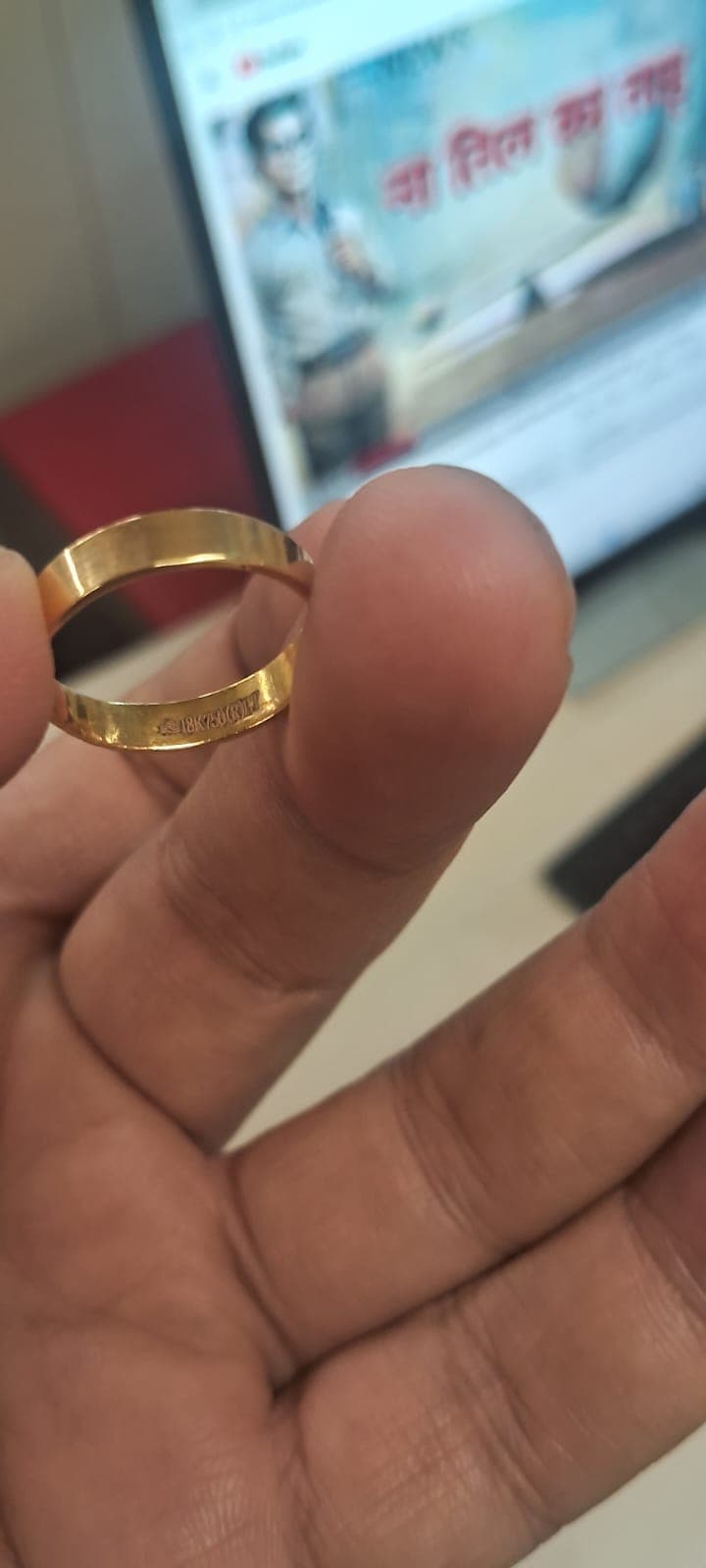
The first place to look on any gold piece is the interior surface: the inside of a ring band, the clasp of a necklace, the back of a pendant. That is where karat stamps and hallmarks live. In the United States, standard karat stamps are 10K, 14K, 18K, and 22K. Their European numeric equivalents express the same purity as parts per thousand: 417 for 10K (41.7% pure gold), 585 for 14K (58.3%), 750 for 18K (75%), and 916 for 22K (91.6%). A 999 stamp indicates 24K gold, the purest commercial grade.
It is worth understanding the distinction between a hallmark and a manufacturer's stamp. A hallmark is applied by an officially recognized assay office under a government-regulated system. A stamp can be applied by the maker and carries no independent certification. British, French, Italian, and Indian pieces, for instance, frequently carry official assay office hallmarks alongside the maker's mark. A piece with only a manufacturer's stamp deserves additional scrutiny.
Examine placement and clarity under a loupe. Legitimate stamps are precise, cleanly struck, and consistent in depth. A blurry or uneven impression, or a stamp placed on an unusual part of the piece, is worth questioning.
Visual Checks That Matter
Color consistency is one of the easiest free tests available. Examine the piece across its edges, inside its settings, along solder joints, and anywhere the surface has worn. Solid gold maintains the same color throughout. A mismatch between the outer surface and worn edges, where a brighter yellow shows through a slightly different tone, is a textbook indicator of gold plating over a base metal.
Gold-filled and vermeil pieces can pass a casual color check because their gold layers are thicker than simple plating. Gold-filled jewelry must contain at least 5% gold by weight and is often stamped with a fraction like "1/20 14K," indicating that 1/20th of the total weight is 14K gold. Vermeil uses fine or sterling silver as its base, which is why some vermeil pieces carry a ".925" or "STER" mark alongside the gold karat. Both categories are legitimate products with real value, but neither should be sold as solid gold.
The Magnet Test
Gold is not magnetic. This is one of the simplest and fastest preliminary checks. Hold a strong rare-earth magnet, not a standard refrigerator magnet, close to the piece and observe carefully. Any attraction, even a faint pull, suggests the presence of ferrous base metals or a heavily plated core. Some non-gold metals used in counterfeits are also non-magnetic, so a clean magnet result is necessary but not sufficient on its own. Think of it as the first filter, not the final verdict.
Acid Testing and Electronic Verification
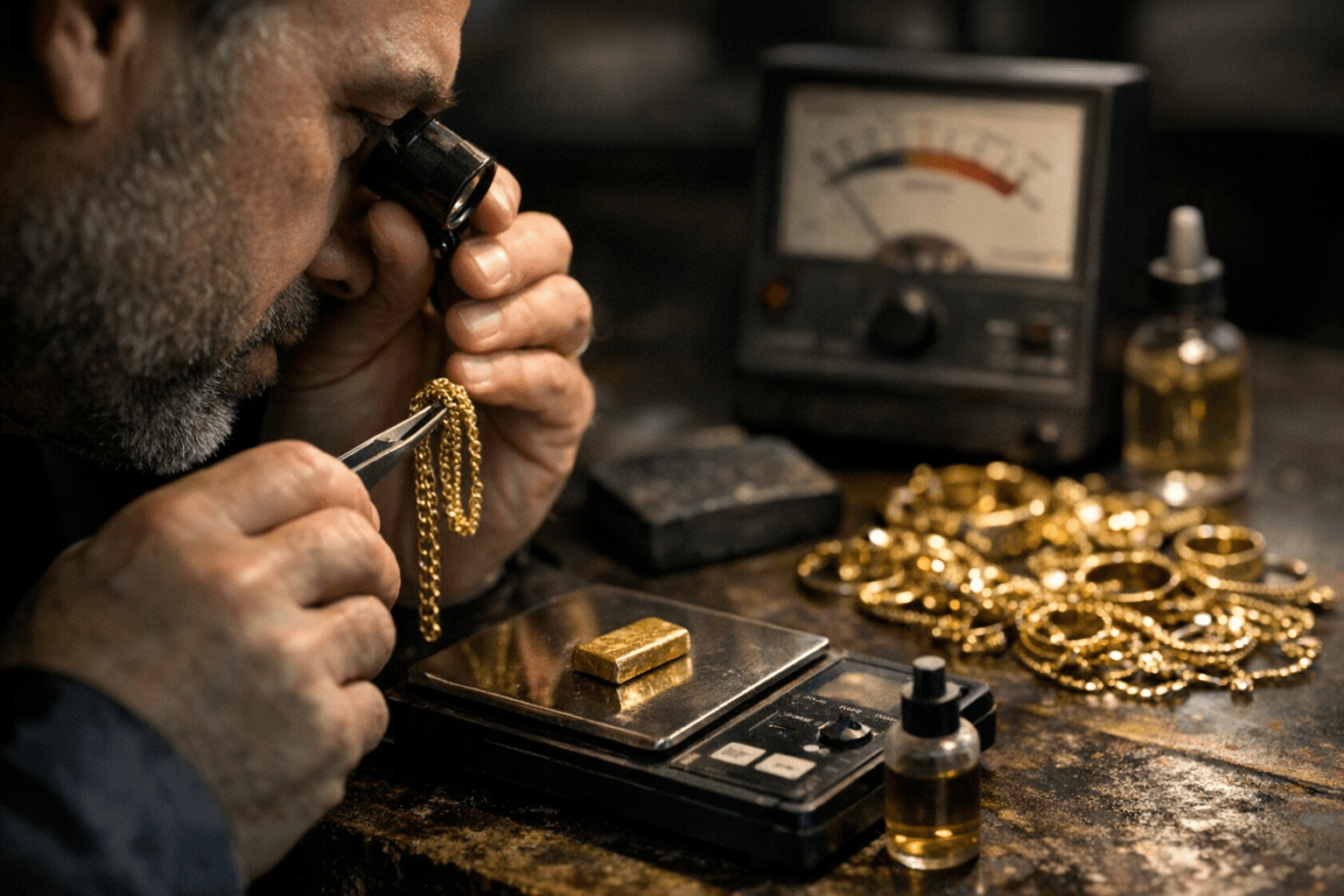
For pieces with meaningful value, professional testing is worth the cost. The acid test, also called the nitric acid or scratch test, is one of the most reliable traditional methods. A jeweler scratches the piece against a testing stone and applies nitric acid to the mark. Genuine gold does not react to nitric acid; base metals and plated items dissolve or change color at the scratch point. Different acid concentrations test different karat levels, which is why a skilled professional rather than a general home kit gets a more precise result.
Electronic testers measure electrical conductivity to determine gold purity. Handheld units range from roughly $100 to $500 and give a digital karat reading. They are faster than acid tests but can produce errors on heavily plated pieces, since the probe reads only the outer surface.
The gold standard for non-destructive analysis is X-ray fluorescence (XRF). A reputable jeweler or certified pawn shop can run an XRF scan that reports karat composition without touching or scratching the metal. It reads accurately across yellow, white, and rose gold regardless of surface color. For high-value purchases, estate acquisitions, or any situation where the hallmarks are unclear, requesting an XRF result is entirely reasonable.
Weight and Dimensions as a Reality Check
Because gold is so dense, weight is a practical proxy for authenticity. A solid 18K gold chain of a given length and gauge has a predictable mass that can be cross-referenced with standard specifications. Gold-filled and vermeil pieces are measurably lighter, since their cores are brass or silver. If a piece is being sold as solid gold but feels notably light for its size, that disparity is a concrete data point, not just a feeling.
Documentation and Provenance
Every legitimate gold transaction should come with paperwork. For new jewelry, that means a receipt specifying the metal type, karat, and weight. For branded pieces, the serial number on the piece can be verified directly with the manufacturer. For estate or vintage jewelry, ask for any prior appraisals, insurance documents, or hallmark certificates. In the absence of original paperwork, an independent appraisal from a Graduate Gemologist (GG) or a certified member of the American Society of Jewelry Appraisers establishes a verifiable baseline for both value and material composition.
Selling Safely: What to Insist On
When you are on the selling side, the authentication process runs in reverse but the stakes are equally high. Get at minimum two or three independent offers from licensed dealers, established pawn shops, or auction houses with documented jewelry expertise. Insist on an itemized written appraisal that breaks out the metal value by weight and karat before you agree to anything. That document protects you whether you accept an offer or walk away.
Verify that any buyer holds a current business license and check their standing with local authorities or the Better Business Bureau. Reputable buyers welcome that scrutiny. Anyone who resists it is telling you something important.
Red Flags to Walk Away From
Certain patterns repeat in gold jewelry fraud regardless of the setting. Walk away immediately if you encounter:
- An unsolicited buyer who approaches you with an offer, particularly in a parking lot or at your door
- Pressure to decide immediately or risk losing the deal
- An offer of cash significantly above current market spot price with no documentation
- A buyer who proposes melting an heirloom or estate piece before any appraisal
- Anyone who refuses to provide credentials, a business address, or a written offer
The combination of urgency and unusually high offers is particularly deceptive because it seems like good news. It rarely is. Legitimate gold buyers operate transparently, give you time to compare, and provide paperwork without being asked.
Gold rewards patience. A piece that has held value for decades is not made less valuable by taking a week to verify it properly.
This article was produced by Prism’s automated news system from verified source data, official records, and press releases, then run through automated quality and moderation checks before publishing. The system is built and supervised by the people who set the standards it runs under. Read our full AI policy.
Did this article answer your question?