How to Choose Gold Jewelry: Karats, Hallmarks, and Quality Explained
Not all gold is created equal: knowing the difference between 10K and 24K could save you from a purchase you'll regret.
Gold has been traded, worn, and coveted for millennia, but the modern jewelry market has made buying it more complicated than it needs to be. Walk into any jewelry store today and you'll encounter a cascade of numbers, stamps, and terminology that can feel deliberately opaque. It isn't. Once you understand the logic behind karats, hallmarks, and the difference between solid gold and its many alternatives, you'll shop with the confidence of someone who has spent years behind the counter.
What Karats Actually Mean
The karat system is the foundation of every gold purchase. Pure gold is 24 karats, meaning 24 out of 24 parts are gold. From there, the scale descends: 22K gold is 91.7% pure, 18K is 75%, 14K is 58.3%, and 10K is 41.7%. In the United States, 10K is the legal minimum that can be sold as "gold jewelry" at all.
Understanding this isn't just academic. The karat you choose determines three things simultaneously: purity, durability, and price. Pure gold, 24K, is extraordinarily soft. A 24K ring worn daily will scratch, dent, and lose its shape in ways that a 14K or 18K piece simply won't, because those lower karat alloys incorporate harder metals like copper, silver, or palladium to strengthen the structure. This is why most engagement rings and everyday fine jewelry are made in 14K or 18K gold. They offer a workable balance between genuine gold content and the structural integrity required to hold a stone securely over decades of wear.
22K gold occupies an interesting middle ground, popular in South Asian bridal jewelry and investment-grade pieces where purity signals status and cultural meaning. Its softness makes it less practical for intricate Western-style settings, but for high-relief work and ceremonial pieces, it's unsurpassed in warmth and depth of color. 18K, by contrast, is the gold of choice for most European fine jewelry houses. Its 75% purity gives it a richness and slightly deeper yellow tone compared to 14K, while still being hard enough for daily wear.
Price, naturally, tracks purity. An 18K piece will cost more than a 14K piece of identical weight and design, because it contains more actual gold. The tradeoff is yours to make, but it's worth knowing that the jump from 14K to 18K is not merely cosmetic. The metal composition changes meaningfully, which affects both how the piece feels and how it wears over time.
How to Read Hallmarks and Assay Marks
A hallmark is a stamp or mark applied to a piece of jewelry that guarantees its metal content. In the United States, hallmarks are regulated and should appear somewhere on every piece sold as gold: inside a ring band, on the clasp of a bracelet, or on the back of a pendant. The American Gem Society recommends buyers learn to identify these marks before purchasing.
The most common stamps you'll encounter in the U.S. market are the karat designations themselves: 10K, 14K, 18K, 22K, and 24K, sometimes written as 417, 585, 750, 916, or 999, respectively. These three-digit numbers represent the gold content in parts per thousand, a system more commonly used in European and international markets. A piece stamped 750, for instance, is 75% pure gold: identical to 18K.
Beyond the purity stamp, look for a maker's mark, which is a separate symbol or set of initials identifying the manufacturer or assayer responsible for that piece. In countries with mandatory hallmarking systems, such as the United Kingdom, a full hallmark includes the purity mark, the assay office mark, the date letter, and the maker's mark. The UK's system is among the most rigorous in the world, dating back centuries, and a piece bearing a British hallmark comes with a level of institutional accountability that is genuinely meaningful.
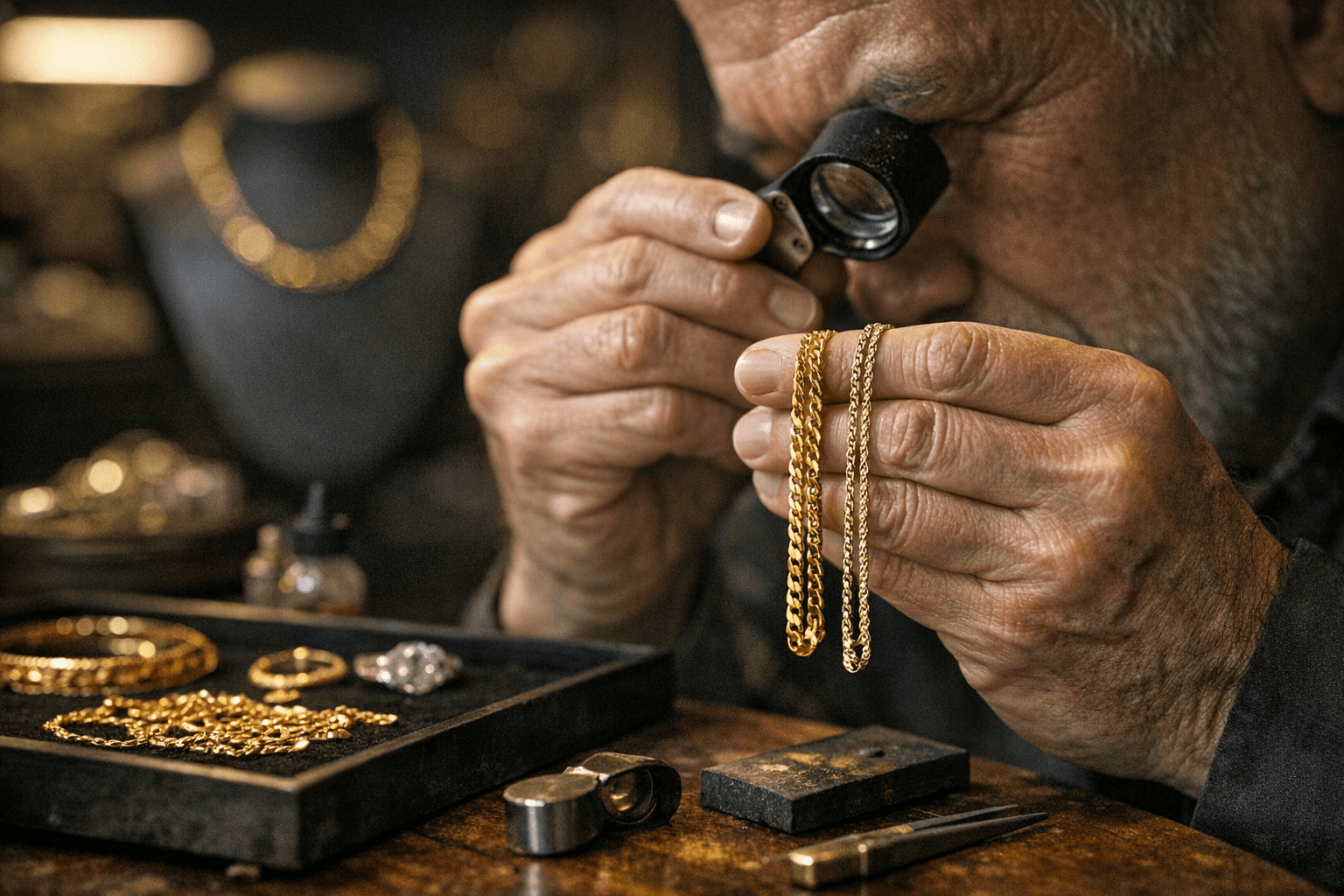
If a piece carries no hallmark at all, that's a significant red flag. Reputable jewelers and manufacturers mark their work. An unmarked piece could be plated, filled, or misrepresented entirely.
Solid Gold vs. Gold-Filled vs. Gold-Plated
This is where many buyers get confused, and the confusion is expensive. The terms are not interchangeable, and the differences between them are not trivial.
Solid gold means the entire piece, throughout its mass, is made of the indicated karat gold. It doesn't mean 24K pure gold; it means the alloy is consistent from surface to core. A solid 14K gold ring is 14K gold all the way through.
Gold-filled pieces are constructed differently. A gold-filled item has a layer of karat gold mechanically bonded to a base metal core, typically brass. By U.S. law, gold-filled jewelry must have a gold layer that constitutes at least 5% of the item's total weight. This produces a piece that looks and wears surprisingly well, and with proper care it can last decades without the plating wearing through. The hallmark for gold-filled typically reads "14K GF" or "1/20 14K GF," meaning one-twentieth of the piece's weight is 14K gold.
Gold-plated jewelry sits at the other end of the spectrum. An electroplated piece may have a gold layer as thin as 0.5 microns, applied chemically rather than mechanically. It looks identical to solid gold when new but will wear through, fade, and expose the base metal beneath, sometimes within months of regular wear. Vermeil, a specific category of gold-plated jewelry, requires a sterling silver base and a gold layer of at least 2.5 microns. It's a step above standard plating, but still a surface treatment rather than a through-and-through metal. That said, vermeil done well can be a genuinely appealing entry point — brands like Oak & Luna build entire collections around it, including personalized name necklaces and stackable initial rings in 14k gold vermeil, while Mejuri and Gorjana similarly occupy this accessible space, though with less emphasis on customization.
The practical upshot: if you're buying jewelry intended to last, solid gold is the only category that will. Gold-filled pieces occupy a legitimate middle ground for those who want the look at a lower price point, provided they understand what they're buying. Gold vermeil offers a meaningful step up from standard plating — the thicker gold layer provides better durability and longevity — though for pieces intended to last decades through daily wear, solid gold remains the more reliable choice.
What Color Has to Do With Alloy
Gold's color is determined by what it's alloyed with, and this choice carries real aesthetic and wearability implications.
Yellow gold in any karat is alloyed primarily with silver and copper, which preserves the warm tones most associated with the metal. The higher the karat, the more saturated and intense the yellow.
White gold is created by alloying gold with palladium, nickel, or silver, and then typically coated with rhodium to achieve its bright, cool finish. That rhodium coating wears off over time, requiring replating every few years if you want to maintain the pristine white look. It's a maintenance consideration worth knowing before you buy.
Rose gold gets its warm, pinkish hue from a higher copper content in the alloy. 14K rose gold typically contains more copper than its 18K counterpart, which makes it slightly more durable and also more distinctly pink. Its color is entirely stable; rose gold doesn't require the maintenance that white gold does.
Making an Informed Purchase
The American Gem Society advises buyers to treat hallmarks as a baseline, not a guarantee, and to purchase from reputable jewelers who can provide documentation and provenance for their pieces. A karat stamp tells you what the metal should be; the jeweler's reputation and return policy tell you what recourse you have if it isn't.
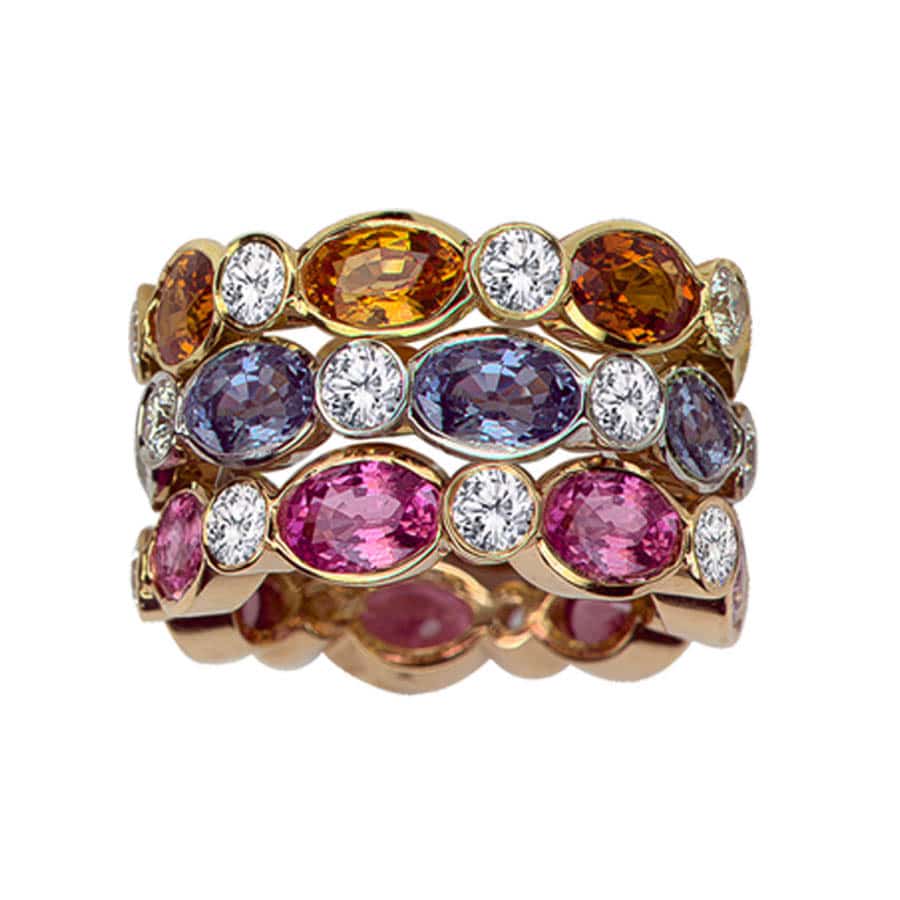
Before buying, handle the piece. Weight is a useful if imperfect indicator: solid gold feels substantial in a way that plated or hollow pieces don't. Ask about the setting construction if stones are involved. A bezel setting, which encircles the stone in a continuous rim of metal, protects the gem more aggressively than a prong setting, though it also shows less of the stone. These decisions matter as much as the karat number stamped inside the band.
Gold jewelry bought with knowledge is gold jewelry that holds its value, its beauty, and its meaning across generations. The karat system, for all its initial opacity, is a remarkably honest framework once you learn to read it.
This article was produced by Prism’s automated news system from verified source data, official records, and press releases, then run through automated quality and moderation checks before publishing. The system is built and supervised by the people who set the standards it runs under. Read our full AI policy.
Did this article answer your question?