Livescience Explains a Rare 19th‑Century Asante Gold 'Spider' Sword Ornament — and Its Return Story
A gold-copper-silver spider ornament belonging to Asante king Kwaku Dua II traveled from Kumasi to a Texas family before a U.S. museum's provenance work finally brought it home.
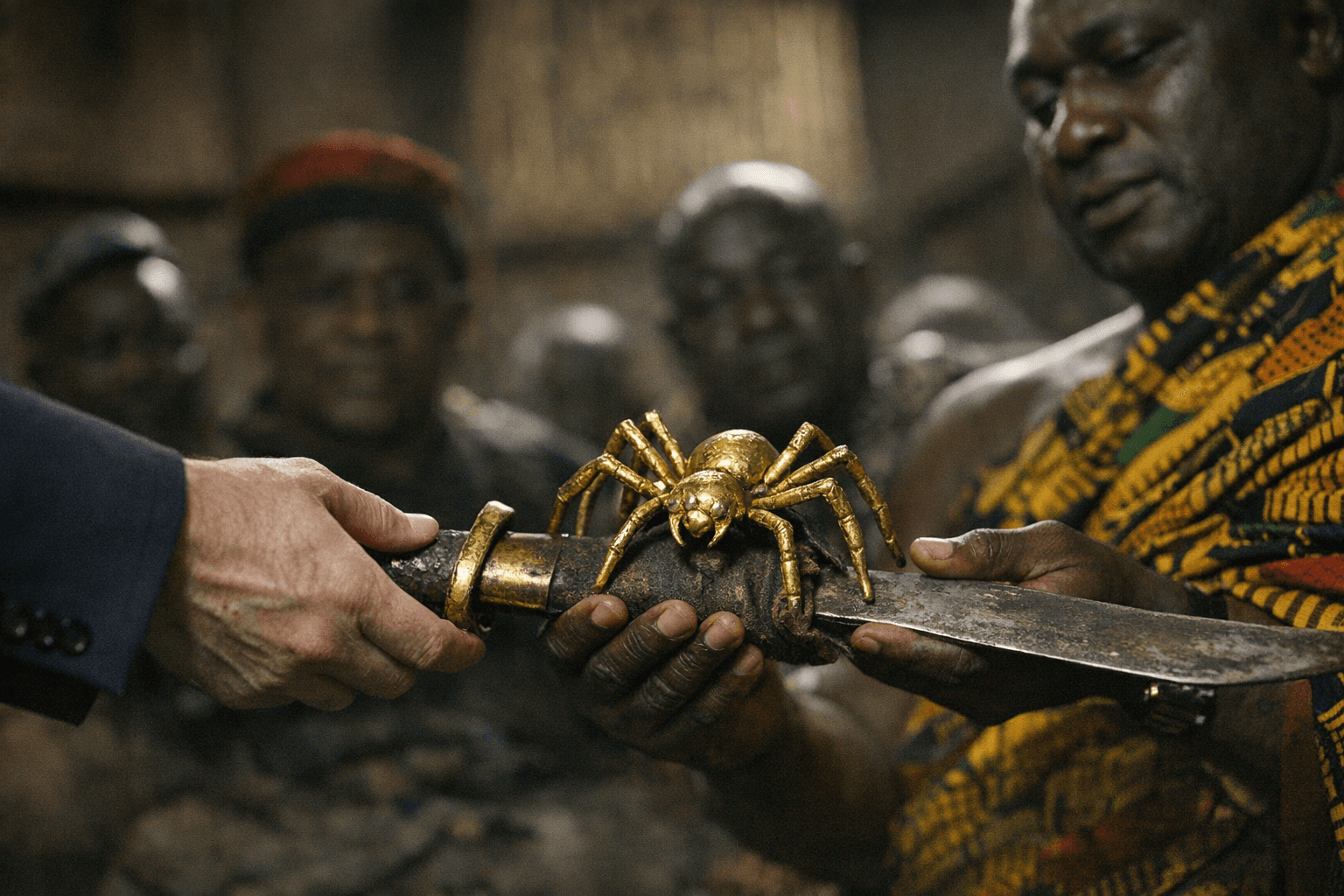
At just 4 inches by 2.9 inches, the Asante spider barely fills a palm. Yet this cast-metal ornament, fashioned from a gold-copper-silver alloy in late 19th-century Kumasi, carries the compressed weight of an empire's final decades, a colonial transfer of power, and a provenance journey spanning continents and more than a century. Recent research led a U.S. museum to repatriate the piece, and the story of how it left Ghana, passed through Texas, and found its way back is as intricate as the object itself.
An Empire's Most Powerful Symbol
The Asante Empire, also known as the Ashanti Empire, ruled the Gold Coast of West Africa, in what is now Ghana, for two centuries, from 1701 to 1901. At the apex of Asante ceremonial culture stood the sword: not merely a weapon but a statement of dynastic authority, typically decorated with a cast gold ornament shaped like an animal. The spider was among the most charged of those emblems. According to Roslyn Walker, a curator at the Dallas Museum of Art who researched the object's history, the chief spokesman of the Asante royal court, Bosommuru, explained the significance directly: "the spider was a symbol of wisdom and only the king was allowed to wear the spider emblem on his sword." That restriction was not incidental etiquette. In Akan cultural tradition, the spider, most familiar through the Ananse storytelling canon, represents accumulated knowledge and strategic intelligence. Reserving the emblem exclusively for the king encoded political hierarchy into the metalwork itself.
This particular ornament, described as one-of-a-kind, belonged to one of the last Asante kings, Kwaku Dua II. That it was made from a gold-copper-silver alloy rather than pure gold is itself worth noting: Asante goldsmiths working in Kumasi were sophisticated metallurgists who adjusted alloy compositions to achieve specific surface qualities and casting properties. The Dallas Museum of Art, which later analyzed and acquired the piece, attributes the alloy identification to its own examination of the object.
A Diplomatic Gift in 1884
The first documented transfer of the spider out of the Asante royal court is a matter of recorded diplomatic history. In 1884, Bosommuru, the chief spokesman of the Asante royal court in Kumasi, the imperial capital, visited Sir Samuel Rowe, the British governor of the Gold Coast. During that state visit, Bosommuru presented Rowe with the gold spider as a mark of friendship from Kwaku Dua II. The gesture was laden with meaning on both sides: a symbol reserved exclusively for the king, offered to a colonial administrator, signals either a profound act of goodwill or the kind of strategic diplomacy an empire under increasing British pressure might deploy.
The ornament may have once been affixed to an Asante ceremonial sword, though it arrived in Rowe's possession as a standalone object. What happened between 1884 and the 20th century remains, on current evidence, an open question. The documented chain of custody jumps from Rowe's receipt of the piece to its presence in a Texas family's hands, with the intervening transfers not yet fully reconstructed in the public record.
Removal in the Context of the Anglo-Ashanti Wars
The spider's departure from Ghana must be read against a broader, grimmer history of colonial extraction. It was likely taken out of Ghana in the late 19th century, along with hundreds of other royal gold objects, during one of the Anglo-Ashanti wars as Britain expanded its control over the Gold Coast. Those conflicts, spanning several decades in the latter half of the 19th century, resulted in the systematic displacement of Asante royal regalia, much of it never returned. The spider's documented 1884 diplomatic transfer is distinct from outright seizure, but it unfolded within precisely the political climate that made refusal difficult for the Asante court. The same period saw the empire stripped of its autonomy and, ultimately, its independence.
From Kumasi to Texas
At some point after leaving British colonial custody, the ornament passed into private American hands. The Dallas Museum of Art purchased the item from a Texas family in 2014. The family's name and the full history of how the piece crossed the Atlantic and ended up in Texas have not been publicly established in detail. The Yahoo syndication of the original reporting on the object includes a striking assertion in its headline framing: that the ornament "helped a man in Texas barter for his life." The circumstances behind that claim, whether a hostage negotiation, a debt settlement, or something else entirely, are not detailed in any available published account. It stands as one of the more dramatic unsolved threads in the spider's modern biography, the kind of detail that, if verified, would illuminate just how far an object of Asante royal authority traveled from its original context.
The Dallas Museum of Art and Provenance Research
The DMA's 2014 purchase brought the spider into institutional custody and, crucially, into the sphere of professional provenance research. Walker's work tracing the object's history represents the kind of curatorial detective work that has accelerated across American museums over the past decade as pressure to examine acquisition histories has grown. The museum confirmed the alloy composition and the 4-by-2.9-inch dimensions, and Walker reconstructed the 1884 Bosommuru-to-Rowe transfer from historical records. That research ultimately contributed to the conclusion that the piece warranted repatriation. A U.S. museum undertook that return, though the precise institution, the repatriation date, and the receiving Ghanaian authority have not been named in published accounts available to date.
What the Spider Tells Us About Asante Goldsmithing
Beyond its provenance drama, the object is a document of extraordinary craft. Cast metalwork of this complexity, produced in Kumasi at the end of the 19th century, required both technical mastery of alloy behavior and a sophisticated iconographic tradition that dictated not just what animals could appear on royal swords but what they meant and who could claim them. The spider's compactness, measuring less than three inches across its widest dimension, makes its symbolic freight all the more concentrated. A king's emblem, a diplomat's gift, a family heirloom, a museum acquisition: each new context reshaped how the object could be understood, but none erased what it originally was.
The repatriation, when its full details are confirmed, will close one chapter of that journey. It will not undo the circumstances that began the spider's displacement during the Anglo-Ashanti wars, nor fully account for the gaps between Rowe's drawing room and a Texas household. What it does mark is a growing institutional recognition that provenance research is not merely an administrative function but an act of historical reckoning, one that occasionally ends with an object returning to the culture that made it what it is.
Know something we missed? Have a correction or additional information?
Submit a Tip