Luxury Giants Deploy AI to Personalize, Forecast, and Scale Gold Jewelry Sales
LVMH and Dior are building internal "AI factories" that compress design timelines, personalize gold jewelry offers, and target high-margin pieces with surgical precision.
The machinery reshaping luxury jewelry sales runs on something far less tangible than 18-karat gold. Across the world's most powerful fashion conglomerates, artificial intelligence is now embedded in nearly every step of how gold and gem pieces are conceived, priced, distributed, and sold, and the transformation is accelerating faster than most consumers realize.
LVMH, home to labels including Dior, Celine, and Tiffany, is turning to artificial intelligence to combat a slowdown in luxury spending, particularly in the U.S. and China, by deepening its AI investments to strengthen its competitive edge. The ambition is not cosmetic. In collaboration with Google Cloud, LVMH built a centralized data platform that now includes AI tools for key business areas, forming what the group describes as an internal "AI factory" — a dedicated infrastructure designed to push intelligence into every corner of its 75-plus maisons.
The Architecture Behind the Intelligence
LVMH developed a company-wide generative AI agent called MaIA that fields over two million requests a month from 40,000 employees, driving internal efficiency. Through its high-profile presence at VivaTech, LVMH also fosters a vibrant ecosystem of startup partnerships. The results are measurable: the MaIA platform has reduced internal processing times by 40% across departments, enabling faster decision-making and cost savings.
For a house like Dior, that speed advantage translates directly into jewelry and ready-to-wear development cycles. Dior uses AI from startup Kahoona to personalize web experiences, even for anonymous visitors, with conversion rates for audiences that previously ignored the brand's digital campaigns rising significantly. The Kahoona collaboration itself grew out of La Maison des Startups LVMH, the group's accelerator at Station F in Paris, illustrating how the conglomerate systematically scouts and scales technology that solves a specific commercial need before rolling it across the broader portfolio.
Forecasting the Right Piece for the Right Boutique
Perhaps nowhere is AI's impact more consequential for gold jewelry than in demand forecasting and inventory placement. High jewelry operates at the extreme end of scarcity: a single sapphire-set collar or a hand-engraved gold cuff may exist in only a handful of examples worldwide. LVMH is trying to use data and recommendations in ways unique to itself, such as determining the best stores for certain pieces of very high-end jewelry, of which there may only be one or a few in the whole world. The logic extends to clienteling: if a client is traveling to Zurich, AI can prompt an advisor to let them know a relevant piece is waiting in that boutique.
In the fashion division, AI-driven demand forecasting has cut excess inventory by 15%, a critical advantage in an industry where raw materials are costly and product cycles are short. For gold jewelry specifically, where commodity exposure and artisan labor costs compress margins, that reduction is not a minor operational footnote — it is a direct profit lever.
Richemont, home to Cartier, applied AI forecasting to predict demand for high-ticket jewelry and watches; during the pandemic, Cartier used AI to avoid over $280 million in excess stock, protecting margins and brand equity. That case has become something of a benchmark for what rigorous forecasting infrastructure can do when applied to gem and gold categories that carry the highest per-unit exposure.
Personalized Clienteling at Scale
The tension luxury has always faced is how to deliver the intimacy of a private appointment to a client base that now spans continents and time zones. AI is reframing that problem. AI agents assist advisors at Tiffany, Louis Vuitton, and Sephora by surfacing customer preferences and suggesting products. Tiffany sales associates now use AI tools to tailor client communication based on historical interactions.
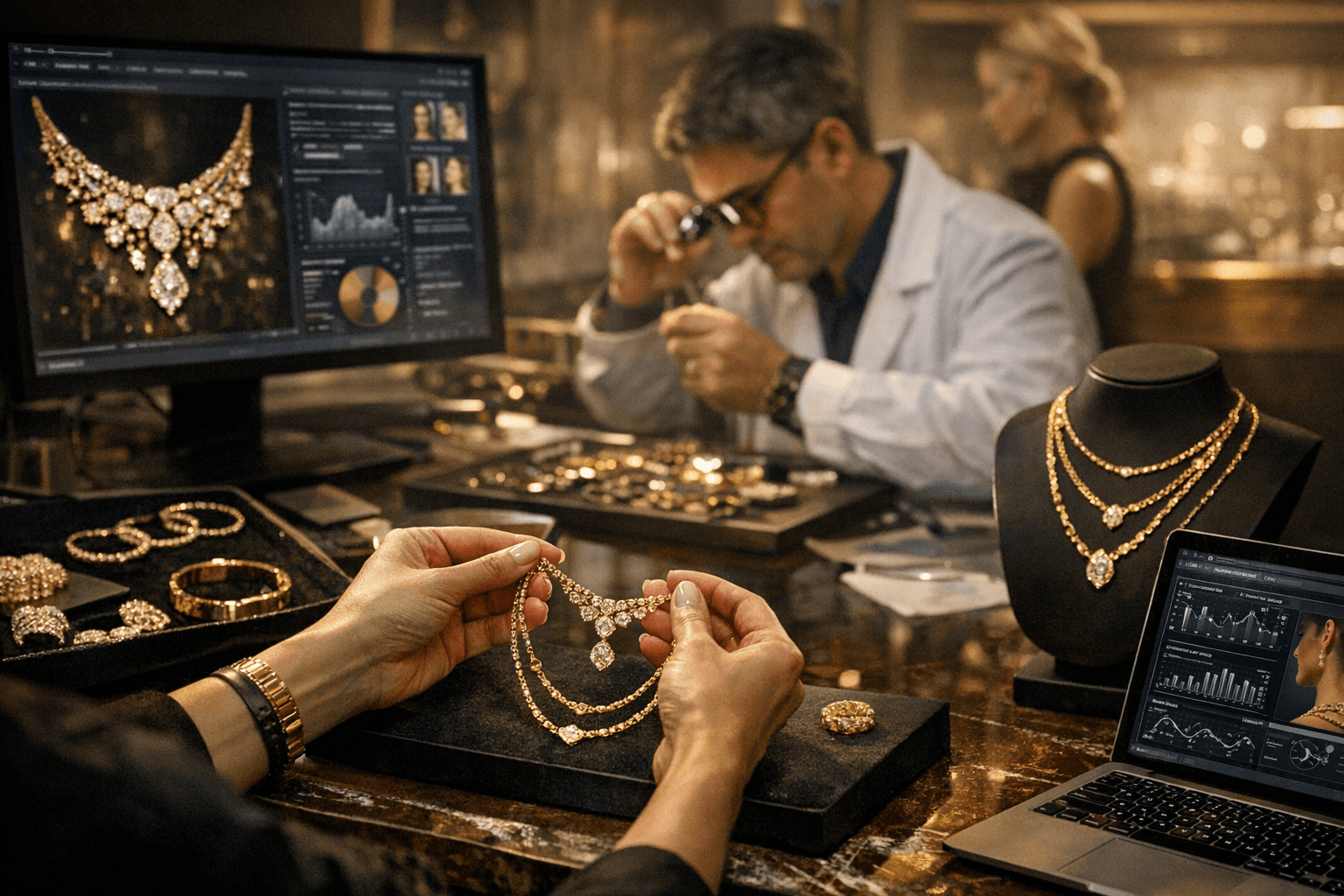
The commercial payoff is tangible. AI agents at brands like Tiffany and Sephora generate tailored follow-up messages for clients, improving retention rates by 20% in pilot programs. That kind of retention figure, applied to a customer who purchases a gold bracelet every two years, compounds dramatically across a clientele of tens of thousands.
Tiffany uses AI-driven customer profiles to refine its marketing strategy across regions, moving away from flooding a global ad campaign toward knowing precisely which ring catches the eye of a Tokyo tech founder versus a Parisian fashion editor. Dynamic pricing follows the same logic: algorithms adjust to demand, rarity, and currency fluctuations while maintaining exclusivity, with Tiffany leveraging AI to manage regional pricing and protect margins.
Configurators, AR Try-Ons, and the New Design Conversation
The front end of the jewelry purchase is being redesigned just as radically as the back-end supply chain. Jewelry configurators, powered by generative AI, allow clients to explore stone combinations, metal weights, and setting styles interactively, compressing what was once a months-long bespoke commission into an hours-long digital dialogue. Generative design algorithms can automatically create a multitude of design options based on a set of constraints and preferences, exploring a vast design space and generating innovative solutions that a human designer might not have considered.
Augmented reality try-on layers the physical intuition back in. Virtual jewelry try-on tools use augmented reality technology to simulate how rings, necklaces, earrings, or bracelets would look when worn, reshaping how customers experience luxury and style online and providing both convenience and confidence. For a client weighing an 18-karat gold choker at several thousand dollars, the ability to see scale and proportion on their own neck before stepping into a boutique changes the psychological calculus of the purchase entirely.
More than 35% of luxury brands have implemented augmented reality solutions to enhance customer experience. That adoption figure is now rising as the technology matures and headset-free web AR becomes standard across mobile browsers, removing friction that once made the tools feel like novelties.
Generative AI and the Design-to-Market Window
On the creative side, design teams use AI for mood boards, and marketing teams use it for copywriting and product descriptions. For gold jewelry, where a collection's narrative — the mythological source, the archival reference, the gemstone geography — is as carefully constructed as the piece itself, generative tools are accelerating the research and concepting phases without displacing the artisans who execute in the atelier.
Deloitte notes that 41.2% of luxury companies surveyed are already implementing GenAI in selected areas, while 11.9% have already embedded it in core operations. The gap between those two groups will likely define competitive positioning in jewelry over the next three years, as the houses that have fully integrated AI into core workflows will be able to move from trend signal to finished collection with a speed that hand-process competitors simply cannot match.
The broader jewelry market context matters here. Jewelry emerged as a pocket of resilience while other luxury categories struggled, with global sales growth between 4 and 6% in 2025 compared to a flat to declining market for personal luxury goods overall, according to Bain & Company senior partner Federica Levato. Into that growth window, the houses deploying the most sophisticated AI infrastructure are arriving with sharper inventory, more targeted clienteling, and shorter design cycles. The gold piece on a client's wrist may still be shaped by a craftsman's hands — but the intelligence that put it there has been trained on millions of data points the craftsman never saw.
Know something we missed? Have a correction or additional information?
Submit a Tip