Oscar Heyman’s America250 flag brooch honors a century of Americana
Oscar Heyman’s platinum flag brooch turns America250 into a precise patriotic statement, set with rubies, diamonds and sapphires in a design dating to 1917.
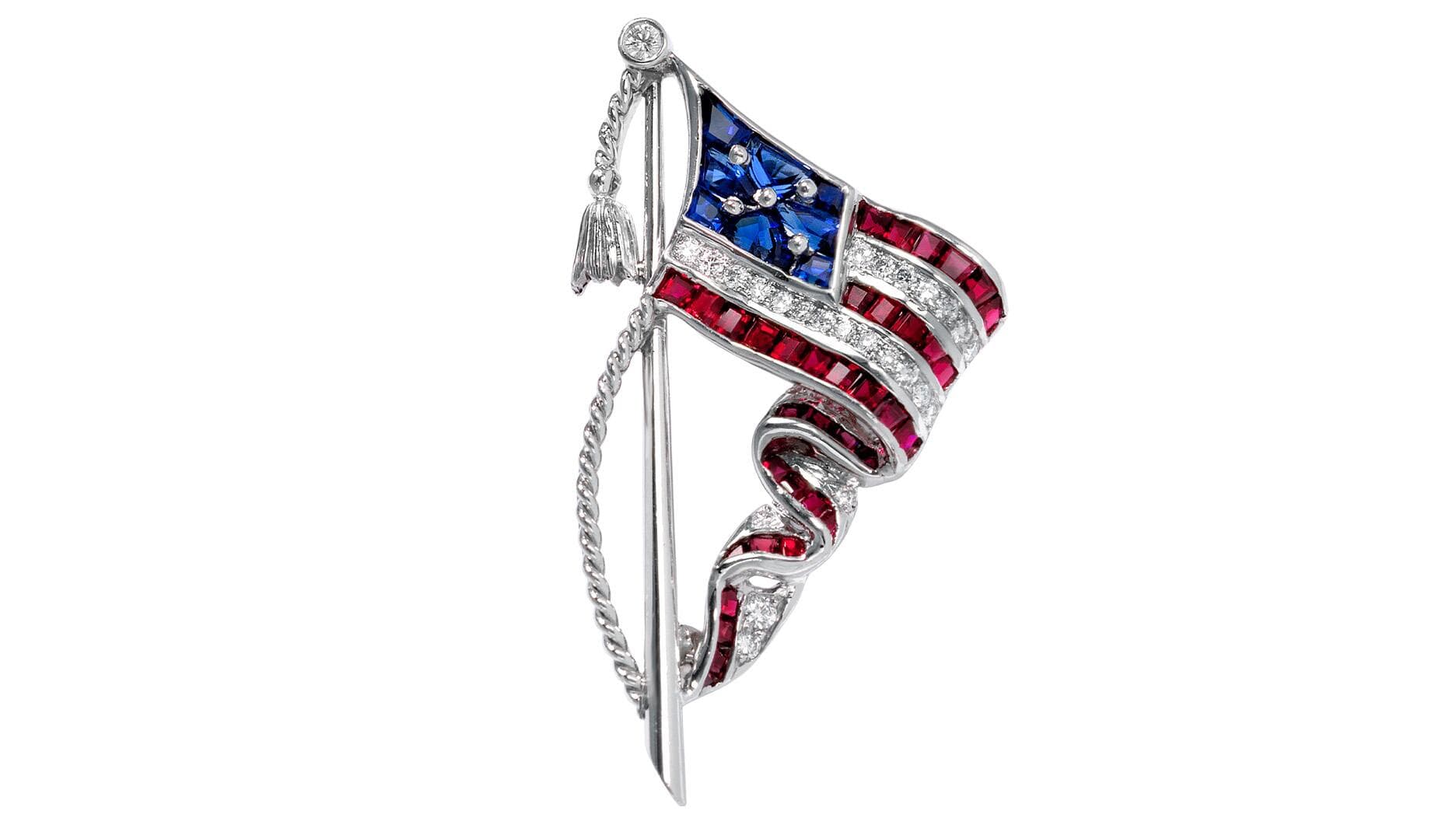
Oscar Heyman’s flag brooch makes America250 look less like souvenir season and more like a serious jewelry brief. In platinum, it turns the American flag into a compact composition of 36 square-cut rubies, 27 round-cut diamonds and eight square-cut sapphires, with the flag cascading on a pole instead of flattening into cliché.
Patriotic jewelry, with receipts
The timing matters as much as the stones. America250 marks 250 years since the signing of the Declaration of Independence in 1776, and the bicentennial-plus-fifty is already shaping a yearlong retail moment around red, white and blue references. National Jeweler’s July 2026 Piece of the Week placed Oscar Heyman’s brooch squarely inside that conversation, but the stronger point is that the design does not read like a rushed nod to the calendar. It belongs to a motif the house has been refining for more than a century.
That distinction separates collectible patriotic jewelry from the flood of generic national symbolism that tends to appear around anniversaries. A flag pin can tip into costume quickly; a brooch like this survives because it is built with the discipline of high jewelry. The symbolism is immediate, but the finish is precise enough to make the piece feel like a lapel jewel first and a commemorative object second.
Inside the brooch
The structure is doing a lot of quiet work here. Square-cut rubies create the red stripes with hard edges that echo the geometry of the flag, while the round-cut diamonds keep the white stripes bright without making the brooch feel visually heavy. The eight square-cut sapphires form the blue field for the stars, and that choice keeps the color blocks orderly rather than painterly.
Platinum gives the whole design a cool, rigid framework, which is exactly what a flag motif needs if it is going to read as jewelry and not a novelty. The material also sets off the color contrast sharply, so the stones do not blur together from a distance. In a category where patriotic jewels can lean theatrical, this one works because every element is controlled: cut, count, placement and proportion.
National Jeweler also noted that the brooch appears alongside other Americana-minded pieces, including a set of American flag brooches and invisibly set ruby, sapphire and diamond bracelets. That matters because it shows the flag motif is not being isolated as a one-off talking point. It is part of a larger gemstone vocabulary that treats national color as a design system.
Why Oscar Heyman owns this motif
Oscar Heyman has the kind of provenance that makes this sort of jewelry convincing. The New York house was founded in 1912 by Latvian immigrants, and the company says it has been making American flag brooches since 1917, when the motif emerged in the World War I era. Rapaport adds that the original patriotic flag brooch was made in recognition of World War I and has sold steadily over the years, which suggests the design has real collector traction rather than archival novelty.
The brand’s own history page calls it “The Jewelers’ Jeweler®,” a reputation earned in the trade by making important pieces for people who know how to judge setting quality, stone matching and finish. Oscar Heyman says its in-house team includes designers, lapidaries, setters, engravers, jewelers and polishers, and that internal chain of craft is exactly what a brooch like this demands. Patriotic symbolism is easy to sketch; making the lines crisp in platinum and the stone work seamless is the harder part.
That behind-the-scenes role also explains why Oscar Heyman can return to the flag without making it feel repetitive. The house has kept the motif alive across decades because it knows how to vary the execution while keeping the idea intact. In that sense, the brooch is not just a patriotic ornament but a piece of design continuity.
Beyond the anniversary moment
The real test for overtly national jewelry is whether it can move beyond the commemorative buyer. Oscar Heyman’s flag brooch has a strong case because it balances clarity with restraint. It is visually legible at a glance, but the platinum setting, the stone counts and the exacting mix of square and round cuts give it the seriousness expected of a high-jewelry object.
That is why the America250 context feels useful rather than limiting. The brooch speaks to the present celebration of the nation’s 250-year milestone, yet it also reaches back to the World War I moment when American flag jewelry first became part of the house’s language. In a market crowded with patriotic references, the pieces that last are the ones that can carry national symbolism without surrendering to kitsch, and Oscar Heyman’s flag brooch does that by keeping the craftsmanship fully visible.
This article was produced by Prism’s automated news system from verified source data, official records, and press releases, then run through automated quality and moderation checks before publishing. The system is built and supervised by the people who set the standards it runs under. Read our full AI policy.
Did this article answer your question?