Paris Couture Week spotlights standout high-jewelry designs at Place Vendôme
Place Vendôme’s strongest pieces leaned on scale, symbolism and exacting craft, from Anna Hu’s emerald parures to Hermès, Graff and Mellerio.

Place Vendôme turned Couture Week into a second runway, where high jewelry spoke in the sharper language of silhouette, setting and symbol. The strongest presentations did not chase mere brilliance; they used gold, diamonds and colored stones to tell stories about memory, nature and identity, with Anna Hu, Hermès, Graff and Mellerio each staking out a distinct mood.
Place Vendôme as couture’s parallel stage
Haute Couture Fall/Winter 2026-2027 ran in Paris from Monday, July 6 to Thursday, July 9, 2026, and the Fédération de la Haute Couture et de la Mode listed 29 houses on the official calendar. That timing matters because the jewelry did not sit outside the couture conversation. It was staged alongside the runway shows, turning Place Vendôme into the week’s historic center of gravity for collectors, editors and celebrities seeking the most ambitious objects in the room.
That framing also explains why the most memorable pieces read less like seasonal accessories and more like statements of intent. Natural diamonds and jewelry coverage from the week cast the presentations as a major high-jewelry moment, but the real shift was aesthetic: maisons were using gold and gemstones to foreground narrative, craftsmanship and symbolism instead of spectacle alone. The result was a season of jewelry that felt considered, not merely lavish.
Anna Hu’s gemstone architecture
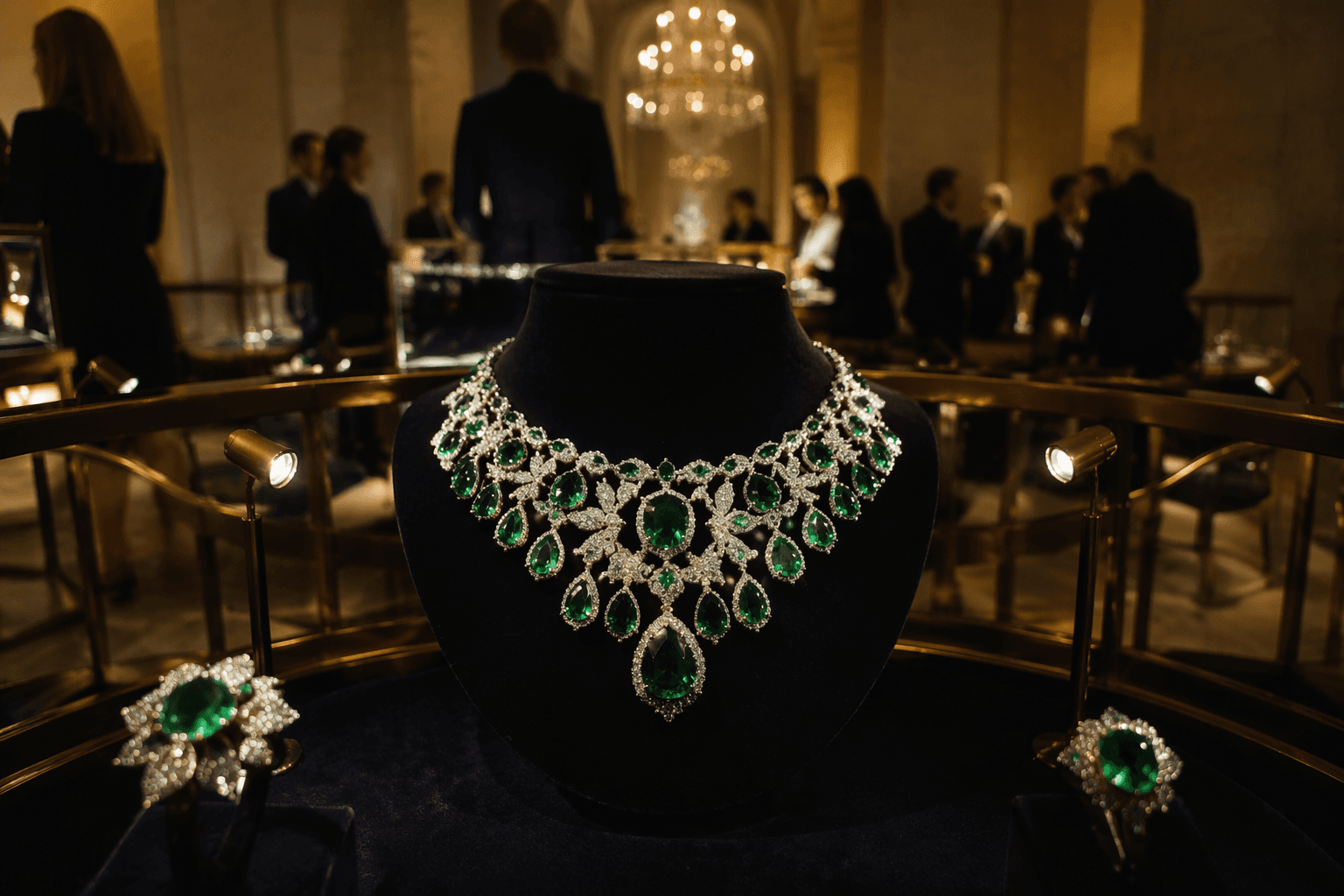
Anna Hu supplied some of the week’s most explicit examples of that approach. Her Jardin Émeraude de Monte-Carlo necklace centered five Zambian cabochon emeralds totaling more than 105 carats, a scale that gives the piece a commanding, almost ceremonial presence. Diamond openwork framed the stones, and the geometry drew inspiration from the windows of Beijing’s Palace Museum, giving the necklace a rigor that kept the color and volume from tipping into excess.
Her Route des Fleurs Impériales necklace pointed in a different direction while staying within the same high-drama register. Set with pink tourmalines, sapphires, diamonds and white gold, it pushed floral imagery into a more chromatic, layered register. Together, the two necklaces show why Hu’s work resonated in Paris: the stones are substantial, but the architecture is what makes them memorable, with each gem acting as part of a larger composition rather than a standalone flourish.
The season’s most persuasive silhouettes
The week’s other standout ideas were less about the single gemstone hero and more about form. Hermès’s Clou de Forge necklace distilled the house’s love of industrial precision into a gold-jewelry statement that feels ready to migrate beyond high jewelry into everyday luxury accessories. Its appeal lies in the hard-edged clarity of the silhouette, the kind of shape that can translate into cuffs, collars and chain-linked pieces without losing its authority.
Graff took the opposite route, letting movement and softness lead through butterfly brooches. The motif is familiar, but Graff’s version matters because brooches have become one of the clearest ways high jewelry reasserts itself as wearable art rather than purely a neck or wrist category. A butterfly rendered in precious metal and stone carries built-in symbolism, yet it also functions as a styling device, a piece that can animate a lapel, a dress or even a ribbon-tied neckline.
Mellerio’s gem-set nail art pushed the idea of adornment even further from traditional classification. It treated the hand as a canvas and gold as a finishing line between jewelry and beauty object, a direction with obvious crossover potential for mainstream accessories. The piece distilled the season’s fascination with small-scale precision: when a house can turn the shape of a nail into a jeweled surface, it signals that luxury is no longer limited to necklaces and rings.
What these pieces say about gold now
Across the week, the recurring motifs were clear: mixed symbolism, strong geometry, botanical references and surfaces that felt deeply worked rather than merely polished. Nature appeared in Graff’s butterflies and Anna Hu’s floral necklace, while memory and identity surfaced in the Palace Museum-inspired latticework of the Jardin Émeraude de Monte-Carlo. Even the more industrial language of Hermès’s Clou de Forge necklace fit the same larger pattern, because it relied on disciplined form rather than decorative overload.
The gold work itself also matters. These are not flat, purely ornamental gold objects. They depend on openwork, framing, joins and construction, the technical details that let heavy stones breathe and give brooches, necklaces and nail-inspired pieces a sense of line. That kind of craftsmanship is exactly what gives high-jewelry ideas their afterlife, because a sharp clasp, a sculpted link or a distinctive collar shape can move from one-off masterpiece into the vocabulary of bracelets, earrings and gold accessories that read as current rather than trend-driven.
The details most likely to travel beyond Place Vendôme
A few elements stood out as especially transferable. Chunky, architectural chains and collars like Hermès’s Clou de Forge could easily inform more commercial gold jewelry. Butterfly and floral motifs, when stripped down to cleaner silhouettes, remain perennial, but Graff’s and Anna Hu’s versions show how they gain freshness through asymmetry, scale and precise metalwork. Mellerio’s gem-set nail idea suggests another avenue entirely: adornment that blurs jewelry and styling tool, a direction likely to influence everything from rings to manicure-inspired accessories.
That is why the best pieces from Paris did more than announce a season. They clarified where gold jewelry is heading: toward objects with stronger shape, more narrative, and enough constructional discipline to carry meaning without looking overworked. Place Vendôme has always rewarded excess, but this week its most compelling gold pieces proved that restraint in form can be as persuasive as abundance in stone.
This article was produced by Prism’s automated news system from verified source data, official records, and press releases, then run through automated quality and moderation checks before publishing. The system is built and supervised by the people who set the standards it runs under. Read our full AI policy.
Did this article answer your question?