Paris Fashion Week Fall 2026 Jewelry Trends Feature Bold Colors and Playful Gold
Gems the size of hard candy and 18-karat gold at sky-high prices defined Fall 2026 Paris Fashion Week's jewelry moment.

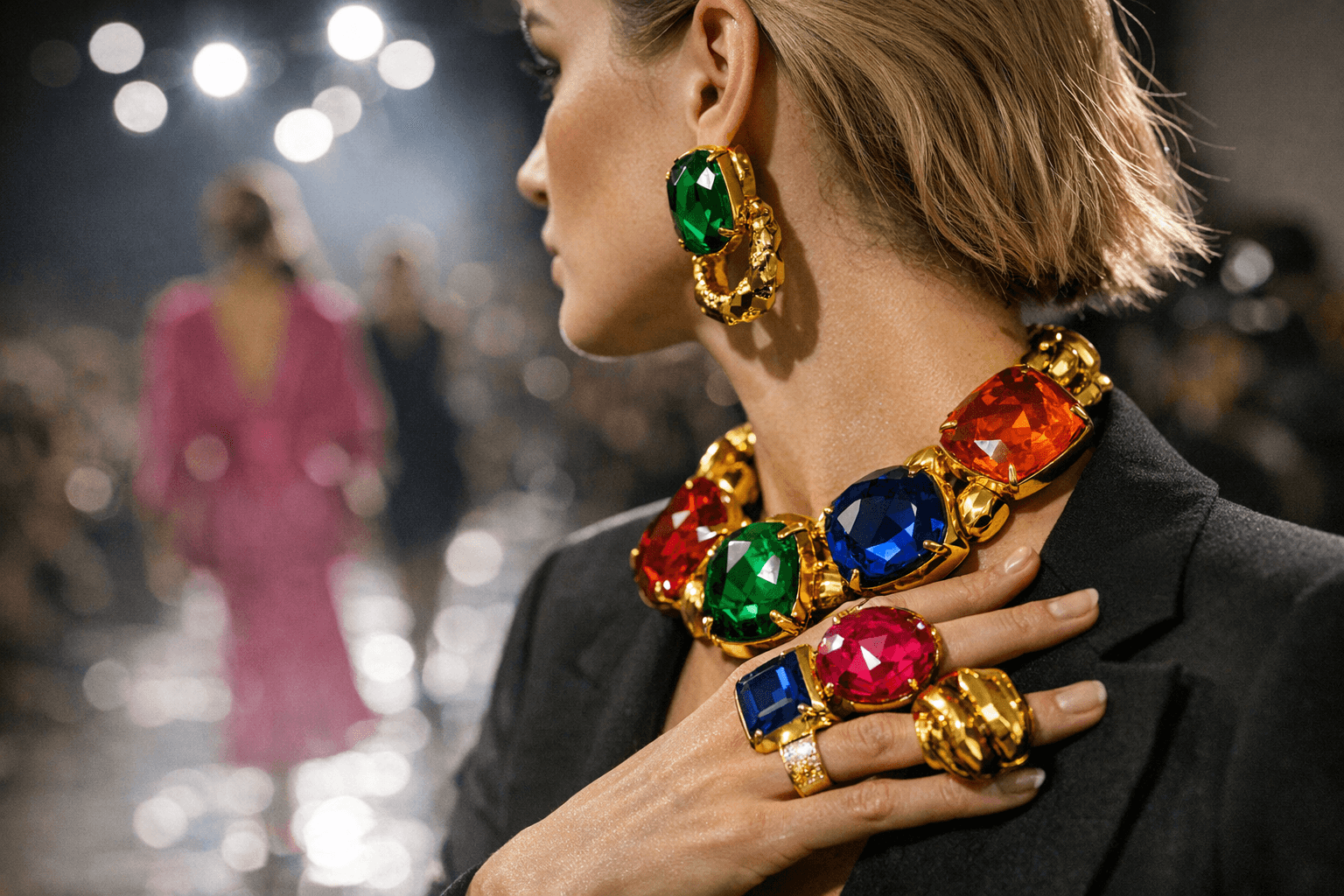
Gems the size of hard candy filled the showrooms of Paris this season, and not a single jeweler seemed troubled by the record cost of gold. The fall 2026 collections arrived with something close to defiance: jewelry brands went bold in their designs, unapologetic on their colors and playful in their approach, as if the entire industry had collectively decided that restraint was no longer an option.
Two currents ran through the week simultaneously. The first was chromatic and joyful, rooted in 18-karat gold and stones that practically vibrated with color. The second was sculptural and architectural, pushing pieces so far into the territory of wearable art that the line between adornment and object dissolved entirely. Both impulses shared one conviction: more is more.
House Janolo: Nature's patterns, candy-sized stones
Among the most arresting debuts of the season came from House Janolo, the fine jewelry label founded by sisters Dujahah and Oloof Jarrar. Working in 18-karat gold with gemstones in what can only be described as juicy hues, their philosophy is straightforward: a pop of boldness, every day. Their first collection, Wild Beginnings, translated that philosophy into striking patterns drawn from nature, executed in enamel and set with stones the size of boiled sweets. The effect is somewhere between a naturalist's field journal and a confectioner's display case, and it is entirely intentional. As WWD noted, since a leopard doesn't change its spots, you'll just have to collect multiple jewels from House Janolo.
The enamel work here deserves particular attention. Enamel in fine jewelry requires precision firing and layering to achieve saturated, stable color, and the Jarrar sisters use it not as accent but as the primary visual language of the piece. Paired with oversized stones set in open-claw or bezel-adjacent arrangements, the result is jewelry that reads as bold from across a room but rewards close examination.
Colette Jewelry: Three decades of stones, one deeply personal collection
Colette Steckel founded Colette Jewelry in 1995 and has spent more than thirty years accumulating stones the way some people accumulate memories. Her fall 2026 collection, Anis, is the most personal distillation of that archive yet. "Anis is not a collection like the others. It's probably the most personal one I have ever created. Its name comes from my mother's favorite candy," Steckel said. The candy metaphor, it turns out, was not incidental to the season's larger mood.
The collection brings together emeralds, sapphires, peridots, topazes, amethysts, tourmalines and quartz in different sizes and cuts, all set in 18-karat gold. Rings, heart-shaped earrings and standout necklaces carry this chromatic abundance, but the technical decision that elevates the whole is the finish: the gold was deliberately given a subtly darker patina, allowing the gems' vibrant hues to advance rather than compete with the metal beneath them. It is the kind of detail that separates a jeweler who understands color theory from one who simply assembles beautiful materials.
Boucheron and Chaumet: Heritage reframed
The legacy houses arrived with their own arguments. Boucheron, synonymous with Parisian elegance and architectural precision, presented fall 2026 offerings built on bold, geometric forms and the contrast between polished gold and frosted rock crystal. The combination creates a visual tension that is simultaneously severe and luminous. Most significantly, Boucheron reinterpreted its iconic Question Mark necklace with a more minimalist, sculptural approach, proving that a truly great design doesn't need reinvention so much as reexamination.
Chaumet drew from deeper in its archives, presenting tiaras and parures that referenced the grandeur of empresses while feeling utterly contemporary. Diamonds were arranged in intricate lacework patterns reminiscent of delicate embroidery, a technique that requires extraordinary stone-setting skill to achieve the illusion of fabric rendered in faceted white light.
The sculptural turn: From ear cuff to breastplate
Across the week, the season confirmed a significant rise in sculptural statement jewelry, pieces that push beyond mere adornment into wearable art. Designers experimented with oversized silhouettes and abstract forms, creating work that commanded attention and challenged traditional notions of what jewelry is permitted to do.
The ear cuff emerged as a defining silhouette: colossal forms that snaked up the entire earlobe, crafted from blackened gold and adorned with raw, uncut gemstones. The choice of uncut stones is meaningful. Where a faceted gem invites comparison and grading, a raw stone carries geological particularity, a sense that no two pieces can ever be identical. Blackened gold, achieved through oxidation or rhodium treatments, provides a dramatic foil that makes both the metal's texture and the stone's natural character legible.
Necklaces scaled up to what can only be called breastplates: forged from innovative alloys, featuring fluid, organic shapes that mimicked molten metal caught mid-pour. The emphasis throughout was on volume and texture, with highly polished surfaces set against matte finishes in deliberate contrast.
Bracelets: The stacking imperative
The wrist became its own composition this season. Bracelets for fall 2026 were about accumulation and impact, with multiple delicate bangles and chain bracelets worn together, creating what one observer aptly called a luxurious jingle. At the same time, bold sculptural cuff bracelets made a strong showing, often crafted from weighty gold or platinum with intricate engravings, embedded gemstones, or abstract forms that wrapped around the wrist like wearable sculptures. The two impulses, delicate stacking and single-statement cuffing, are not contradictory. They represent different moods within the same maximalist argument.
The consumer translation: Clear, cord, and the pinky ring
Not every fall 2026 jewelry story required 18-karat gold or a runway. Three subtrends translated the season's energy into more accessible terms.
Clear and lucite jewelry offered shine and dimension without visual weight. Translucent hoops, sculptural bangles, and glossy "jelly" cocktail rings carried the season's playful spirit in a different register. On the Bottega Veneta runway, a clear-bead necklace made the case for going oversized. At Maison Margiela and Courrèges, see-through cuffs provided architectural edge. The principle is simple: choose one statement piece and let the material do the work.
Leather cord pendants brought a different texture to the conversation entirely. Seen on the runways at Michael Kors and Ralph Lauren, they carry what Marissa Galante Frank, Bloomingdale's beauty and accessories fashion director, described precisely: "Leather cord pendants feel like the modern answer to statement jewelry. They're relaxed, effortlessly chic, and incredibly flattering because they lengthen your entire look." Finished with a charm, stone, or medallion, they offer a slightly '90s grunge-cool counterpoint to the season's more opulent directions.
The pinky ring completed the trio, arriving as what Frank called "a modern expression of luxury, rooted in vintage references but styled with a fresh sense of attitude. Whether worn solo or stacked, it's a subtle flex that adds personality and signals confidence without trying too hard." Signet styles, many available for monogramming, bring personalization to a maximalist stack, while tiny gemstone versions soften the more masculine-leaning edge of the trend.
The gold question
Despite sky-high gold prices, there was no shortage of glittering metal visible in showrooms across Paris. That fact is worth sitting with. When the cost of raw materials rises this sharply, jewelry design often retreats toward minimalism, thinning the gauge, reducing the surface area, letting stone carry more visual weight than metal. Fall 2026 refused that logic. The presence of 18-karat gold throughout the week, from the Jarrar sisters' enamel-and-stone constructions to Steckel's patinated settings to Boucheron's polished geometric forms, read less like a commercial decision and more like a collective statement of intent. Gold, at whatever price the market demands, remains the medium through which fine jewelry makes its most fundamental argument about permanence.
This article was produced by Prism’s automated news system from verified source data, official records, and press releases, then run through automated quality and moderation checks before publishing. The system is built and supervised by the people who set the standards it runs under. Read our full AI policy.
Did this article answer your question?